



.png)
.png)
.svg)

.png)
.png)


.png)


.png)


.svg)


.svg)

Everyday life in human resources is increasingly characterized by constant pressure. The majority of HR employees experience high levels of emotional strain and stress in their jobs – and this trend is on the rise. The reason for this overload is obvious: HR is administratively overburdened. While the demands on strategic issues such as transformation, corporate culture, and leadership development are increasing, manual processes and operational tasks are eating into the available working time. Thanks to modern HR strategy and intelligent, digital coaching from Sharpist, HR teams are being relieved of their workload in the long term.
The Topic in a Nutshell
No Time for HR Strategy: The Most Common Problems
Monday, 9 a.m.: The HR department starts the week – and already there are fires to put out everywhere. A manager urgently needs support with a conflict meeting, three sick notes need to be recorded, the onboarding of a new colleague is stalling because access details are missing, and management is asking about the status of the recruiting pipeline. Strategic HR work? Cultural development? Talent promotion? All of that is left undone.
HR teams know this scenario all too well. The demands placed on human resources departments have exploded recently. However, what has not changed in many companies are the framework conditions and resources. HR often does "a little bit of everything": from payroll accounting to organizing the summer party. The result? An administrative all-rounder role with strategic aspirations but without the capacity to fulfill them.
1. Job Seekers Have Higher Expectations
According to the XING Job Market Report 2024, job seekers today have significantly higher expectations when it comes to job conditions, corporate culture, and benefits, such as flexible working models and remote work. At the same time, 46% of job seekers expect feedback within one to two weeks – a requirement that is difficult for many overburdened HR teams to meet.
The result: talented individuals drop out because the application process takes too long or is too opaque. The shortage of skilled workers further exacerbates the situation. While HR tries to meet rising expectations, there is simply not enough time for quick feedback and a professional candidate experience.
2. Digital Transformation Is Advancing
From HR software to interfaces to data protection: digital transformation requires technical understanding and expertise. However, many HR teams lack the time to engage intensively with new tools. Although, according to XING's 2024 Labor Market Report 62% say that AI tools would make the recruiting process easier, only 37% use AI agents to help with administrative tasks, for example.
3. Mental Health and Diversity Are Becoming Increasingly Relevant
Issues such as mental health, feedback culture, and diversity are increasingly becoming the focus of attention – and rightly so. However, implementing appropriate programs requires time, expertise, and ongoing support. For HR teams that are already working at full capacity, this important strategic work often falls by the wayside.
A study by the KCS Competence Center for Statistics and Empirical Research at FOM University shows that companies with a strong health culture have significantly lower turnover rates. The challenge lies not only in addressing these issues, but also in systematically integrating them into the organization – for which HR departments urgently need more freedom.

4. Employer Branding and Onboarding Are Neglected
For many HR professionals, there is little time left for organizing and conducting job interviews. Structured onboarding that inspires and retains new employees from day one often remains a pipe dream.
The first few weeks determine whether employees stay or quickly leave. A chaotic start leaves a bad impression and significantly delays productivity. But when HR teams are bogged down in operational chaos, they lack the capacity for thoughtful employer branding and professional onboarding.
5. New Legal Regulations Pose Challenges
Time tracking, the EU Pay Transparency Directive, and the Documentation Act: the list of compliance requirements is getting longer. In the XING Labor Market Report, 63% of HR managers stated that the shortage of skilled workers and new regulations have led to higher administrative costs for documentation and reporting.
Mistakes can be costly – in fines, back payments, or legal disputes. But there is often not enough time for careful compliance work. Instead, HR employees have to juggle operational tasks and legal requirements, which increases their workload.
6. Skilled Labor Shortage Complicates the Recruiting Process
91% of the recruiting managers surveyed in the XING Job Market Report state that the shortage of skilled workers makes it more difficult to fill vacancies in a timely manner. Filling open positions currently takes an average of 165 days – longer than ever before. At the same time, pressure from company management is increasing: 90% report that expectations have become even greater this year.
This development is hitting the human resources sector particularly hard. While management demands quick results, HR teams are struggling with a dried-up labor market and applications that do not meet requirements. The reality: Recruiting is becoming a constant source of stress rather than a strategic talent acquisition process.

7. Low Employee Retention and High Turnover
When good people leave, expertise is lost. Training new employees costs time and money – estimates suggest six to nine months' salary per position. Exit interviews repeatedly show that a lack of development opportunities and a lack of appreciation are the main reasons for this.
However, HR simply lacks the capacity for structured employee development and regular feedback meetings. The result is a vicious circle: overburdened HR departments have no time for employee retention measures, which leads to higher turnover, which in turn requires more recruiting and onboarding – and puts even more strain on HR.
8. High Administrative Costs and Inefficient Processes
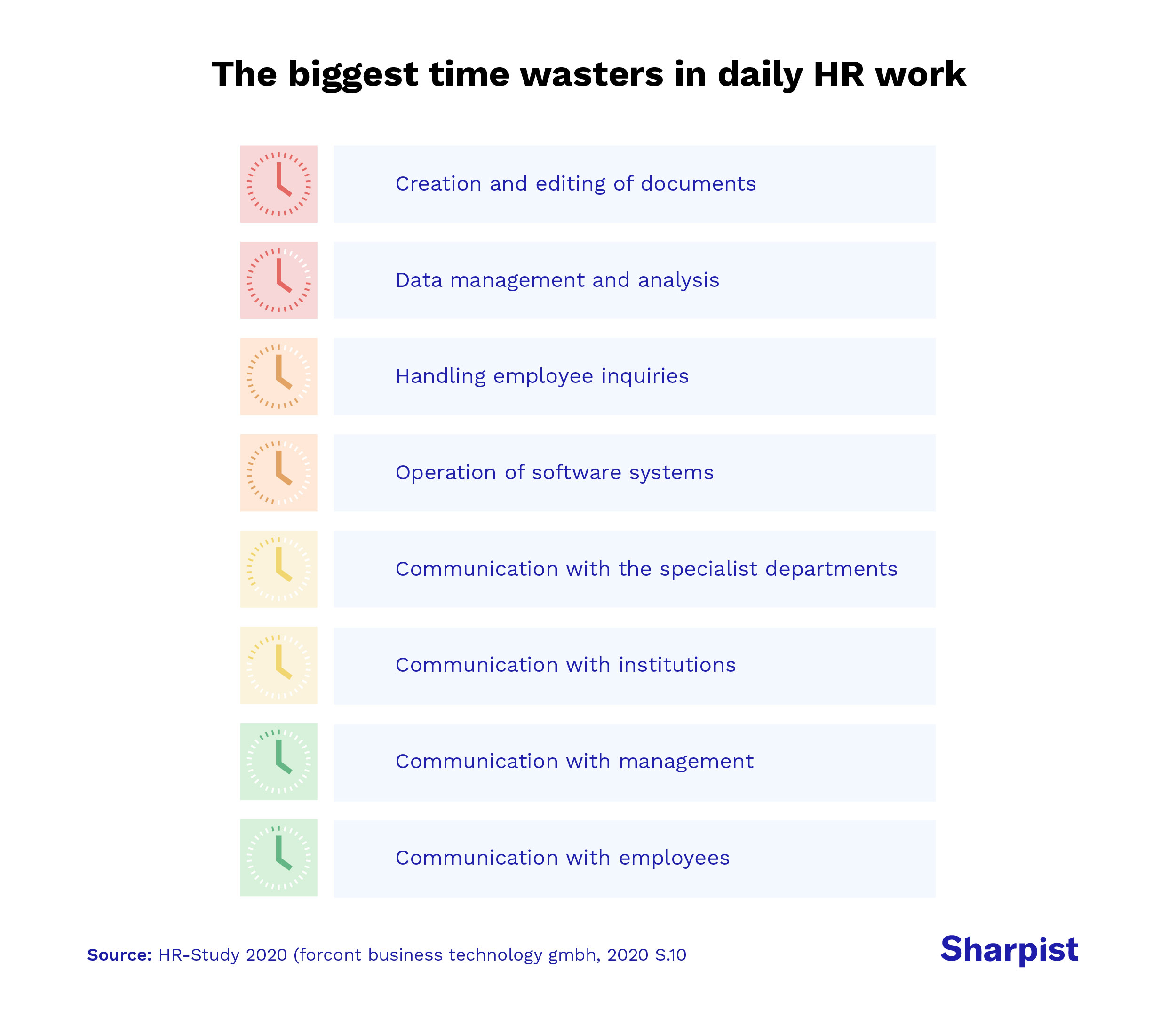
Vacation requests by email, sick notes on paper, personnel files in folders: manual processes are time-consuming and prone to errors. The HR manager of a retail company with 200 employees estimates that 60% of working time is spent on administrative tasks – precisely the time that is lacking for strategic personnel development.
51% of HR professionals complain that they spend most of their working hours dealing with tasks that could easily be automated. These inefficient processes are not only time-consuming but also demotivating. HR professionals want to work strategically, shape culture, and develop people – but instead, they are bogged down in administration.
Permanent Work Overload in HR: These Are the Risks
The consequences of chronic overload in HR are serious – both for employees themselves and for the company as a whole. According to a Sage study, the burnout rate among HR professionals is 79%. This figure is alarming and shows that HR is under pressure that is not sustainable. The consequences are manifold:
The majority of HR professionals feel that their work is not valued in their company. This lack of recognition further increases their stress levels. Yet good human resource management has long been a strategic success factor. Those who fail to invest in this area will lose their skilled workers to employers who are more modern in their approach and see HR as a business partner.

Why Executive Coaching Is the Solution – But Only if It Doesn't Take Up Too Much Time
The answer to many HR challenges lies in the systematic development of managers. Strong leadership reduces conflicts, increases employee engagement and retention, and provides lasting relief for HR. But traditional management coaching is time-consuming in itself: finding a coach, matching, coordinating appointments, tracking progress – all tasks that place an additional burden on HR.
The Sharpist platform was developed to take as much work off HR teams' shoulders as possible while ensuring the highest quality coaching – through intelligent automation that creates real freedom for strategic HR work.
The Vicious Circle of Weak Leadership
Weak managers generate a constant stream of HR tasks:
The paradox: HR knows that leadership development would solve these problems, but doesn't have time for it – because it's busy dealing with the symptoms.
Why Executive Coaching Is the Lever
Investing in executive coaching directly addresses the root cause of many HR time wasters:
Traditional Coaching Eats Up Time Itself
Many HR teams shy away from executive coaching because it is traditionally extremely time-consuming: finding a coach, matching process, coordinating appointments, tracking progress, managing budgets. A single coaching program can tie up HR managers in administrative tasks for weeks.
Sharpist helps HR teams regain an average of 60 to 70% of their time through automatic coach matching and reporting, flexible budget management, and rapid implementation, as administrative tasks are greatly reduced.
Conclusion: The Future of HR – Save Time With Automation From Sharpist
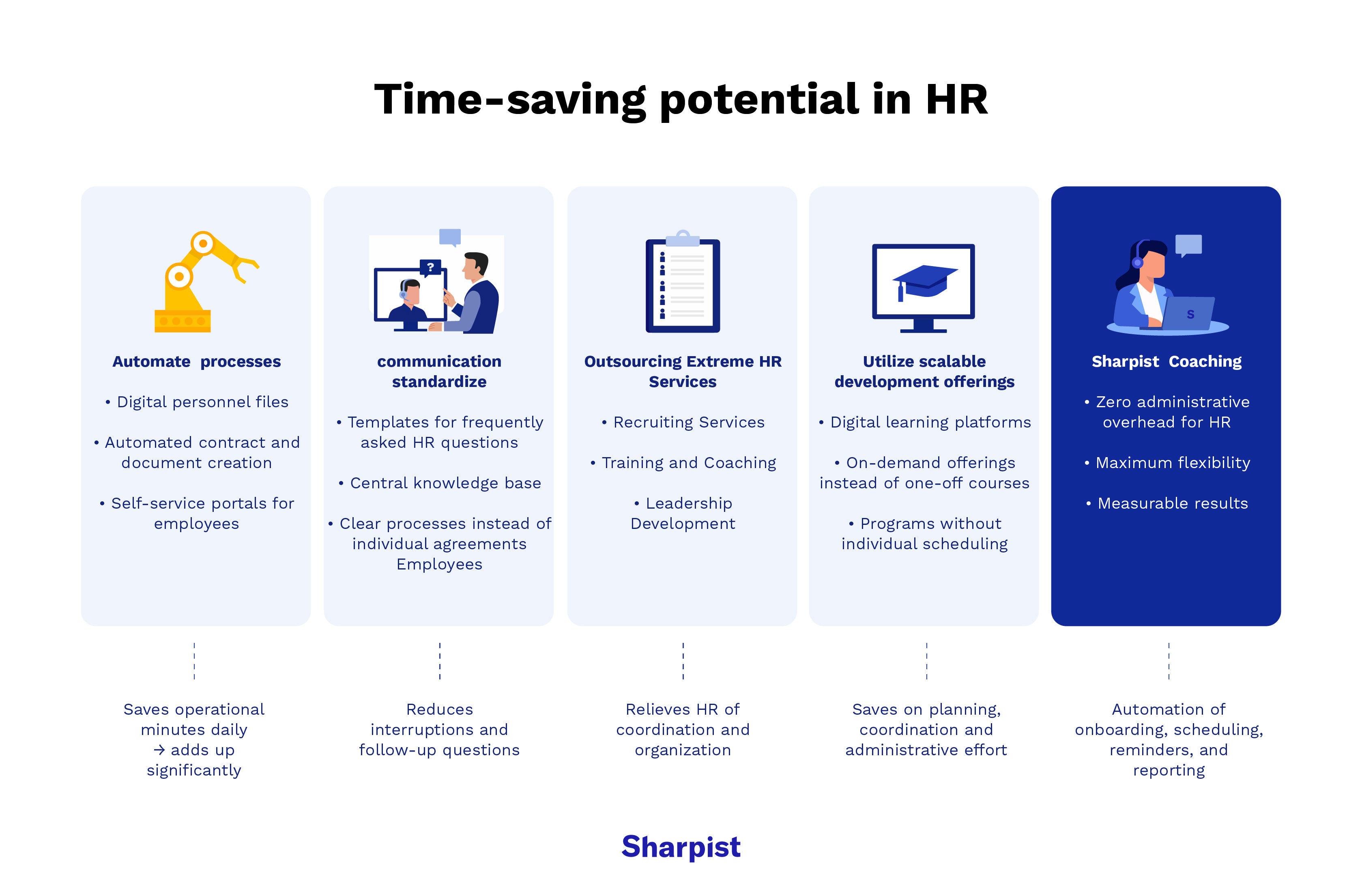
As a digital coaching platform, Sharpist enables HR teams to implement scalable leadership development without increasing administrative overhead. On the contrary, intelligent automation significantly reduces the workload for HR managers.
The advantages at a glance:
Sharpist's vision is to support everyone in their personal and professional development, from their first internship to retirement. For HR, this means you can finally drive strategic leadership development without getting bogged down in operational chaos.
FAQ
Why Do So Many HR Teams Not Have Time for Strategic Work?
HR teams spend a large part of their time on administrative tasks such as vacation management, sick leave notifications, and documentation. At the same time, demands have increased significantly due to skills shortages, new compliance regulations, and heightened expectations from management. Without automation, there is little time left for strategic HR work.
What Are the Consequences of Overburdening HR Departments?
79% of HR professionals have already suffered from burnout and are considering leaving the field. For companies, this means declining quality in HR work, missed talent opportunities due to slow processes, higher turnover, and compliance risks due to errors made under time pressure.
How Can Executive Coaching Relieve the Burden on HR Teams?
Systematic leadership development reduces conflicts, increases employee retention, and takes the pressure off HR in the long term. However, it is important that the coaching itself does not become a time-consuming task. Digital platforms such as Sharpist fully automate coach matching, scheduling, and reporting, enabling HR to implement scalable development programs without additional effort.
.avif)







.svg)


%20(1).avif)