



.png)
.png)
.svg)

.png)
.png)


.png)


.png)


.svg)


.svg)

The question of the right pricing model is crucial when choosing a suitable coaching solution. Flat rate models promise unlimited sessions at a fixed price, while credit systems allow for a flexible distribution of sessions. This decision affects not only the budget, but ultimately the success of the entire initiative. Discover the pros and cons of both models and how Sharpist's coaching programs deliver a particularly strong ROI.
The Topic in a Nutshell
Coaching Pricing Models at a Glance: Flat Rate vs. Credit Model
When choosing a coaching program, organizations face a fundamental question: flat rate with a fixed price, or a flexible credit system? Both pricing models promise professional leadership development, yet differ considerably in cost structure, usage efficiency, and measurable success.
What Is a Coaching Flat Rate?
A coaching flat rate works on the fixed-price principle: organizations pay a set monthly or annual fee, and employees can theoretically access unlimited coaching sessions. Many will recognize this concept from other areas such as streaming services or telecommunications. For HR teams, the flat rate appears attractive because it promises cost predictability. Coachees are meant to access coaching services without usage inhibitions, since they are already paid for.
What Is a Credit Model?
The credit model is based on a flexible, usage-based system: organizations purchase credits that are redeemed for coaching sessions. The key difference from a flat rate lies in its needs-based approach. This approach creates maximum transparency: HR teams can see exactly what needs exist and how credits are being deployed to achieve individual goals through personalized coaching.
Why Choosing the Right Pricing Model Is Critical
The choice of pricing model has strategic significance for talent development: it influences budget, usage behavior, training quality, ROI measurability, and scalability in equal measure. The wrong model can lead to considerable resource waste – for example, when flat rate sessions go unused or take place without clear objectives.
At the same time, dissatisfied leaders and low activation rates can jeopardize the success of the entire initiative. Modern talent development must deliver measurable business outcomes and contribute to leadership development.
Coaching Flat Rate: Benefits and Challenges for Organizations
Flat rate models in coaching initially appear to offer an attractive solution for talent development. But as with all fixed-price offerings, there are both advantages and considerable challenges that HR teams should carefully weigh up.
Benefits: Predictable Costs and Unlimited Usage
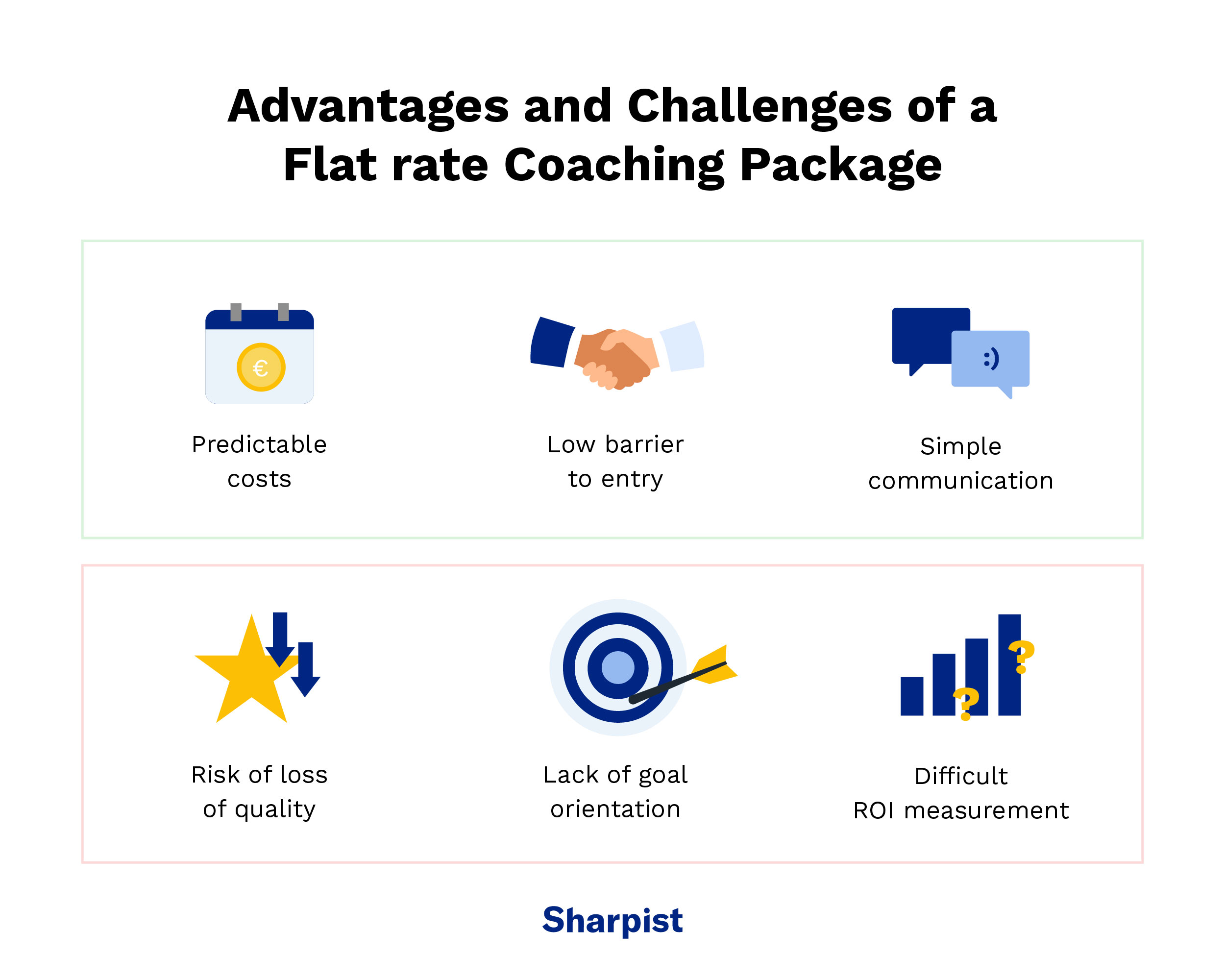
For HR teams, flat rate coaching seems appealing at first glance: a fixed price creates budget predictability and simplifies communication to leaders ("unlimited training is available"). The psychological barrier to use is lowered, since coaching sessions are already paid for and no additional request needs to be made. These advantages work well in other areas such as streaming or telecommunications.
Yet coaching operates under different dynamics than mass-produced products – the quality of development does not depend on the quantity of sessions.

Challenges: Loss of Quality and Lack of Goal Orientation
The greatest challenge with flat rate coaching lies in the risk of quality loss: when coachees can book as many sessions as they like without clear objectives, structured leadership development quickly turns into non-committal talk therapy. Unlimited availability does not automatically lead to better outcomes – quite the opposite.
Measurable development requires defined goals, structured processes, and binding focus areas. At Sharpist, we therefore rely on 32 structured focus areas and personalized micro tasks between sessions to ensure goal-oriented development.
The Risk of an “All-You-Can-Eat” Mentality in Coaching
With flat rate coaching, an “all-you-can-eat” mentality often emerges: coachees book sessions not because genuine needs exist, but simply because it is “included in the package.” This inefficient use of resources diminishes the ROI for the organization.
Quantity displaces quality, and genuine development falls by the wayside. HR teams and leaders need needs-based support, not unlimited availability without focus. The credit model offers a well-considered alternative that prioritizes success over mere usage.
Credit Model: Flexibility Meets Needs-Based Coaching
In contrast to the flat rate, the credit model is built on genuine needs-orientation: organizations invest only in coaching services actually used and retain full control over resources and development goals. This approach combines cost efficiency with individual adaptation to the needs of each organization.
Benefits: Cost Efficiency and Individual Customization
The credit model offers decisive advantages for talent development: organizations pay exclusively for sessions used and avoid waste from unused flat rate capacity. Credits can be flexibly distributed across different leaders and topics – according to current need.
Transparent Usage and Better ROI Measurement
Credit models create complete transparency for HR teams: they can see in real time which leaders are using how many credits, which focus areas and topics are in demand, and what measurable results are being achieved. This measurability enables evidence-based decisions rather than gut feeling.

Scalability for Growing Organizations
Credit models grow with the organization: as needs increase, credits can simply be topped up without complete contract renegotiations. The flexible cohort system enables targeted groupings by area, location, or development level. Flat rates quickly become too expensive or too limiting as organizations grow – credits, by contrast, adapt organically.
Sharpist scales from the shop floor to the boardroom: at Palfinger, 100 shop floor employees used the credit-based offering with 80% activation, while leaders simultaneously received intensive support. This scalability without any loss of quality makes the credit model the sustainable solution for talent development in growing organizations with 1,000+ employees.
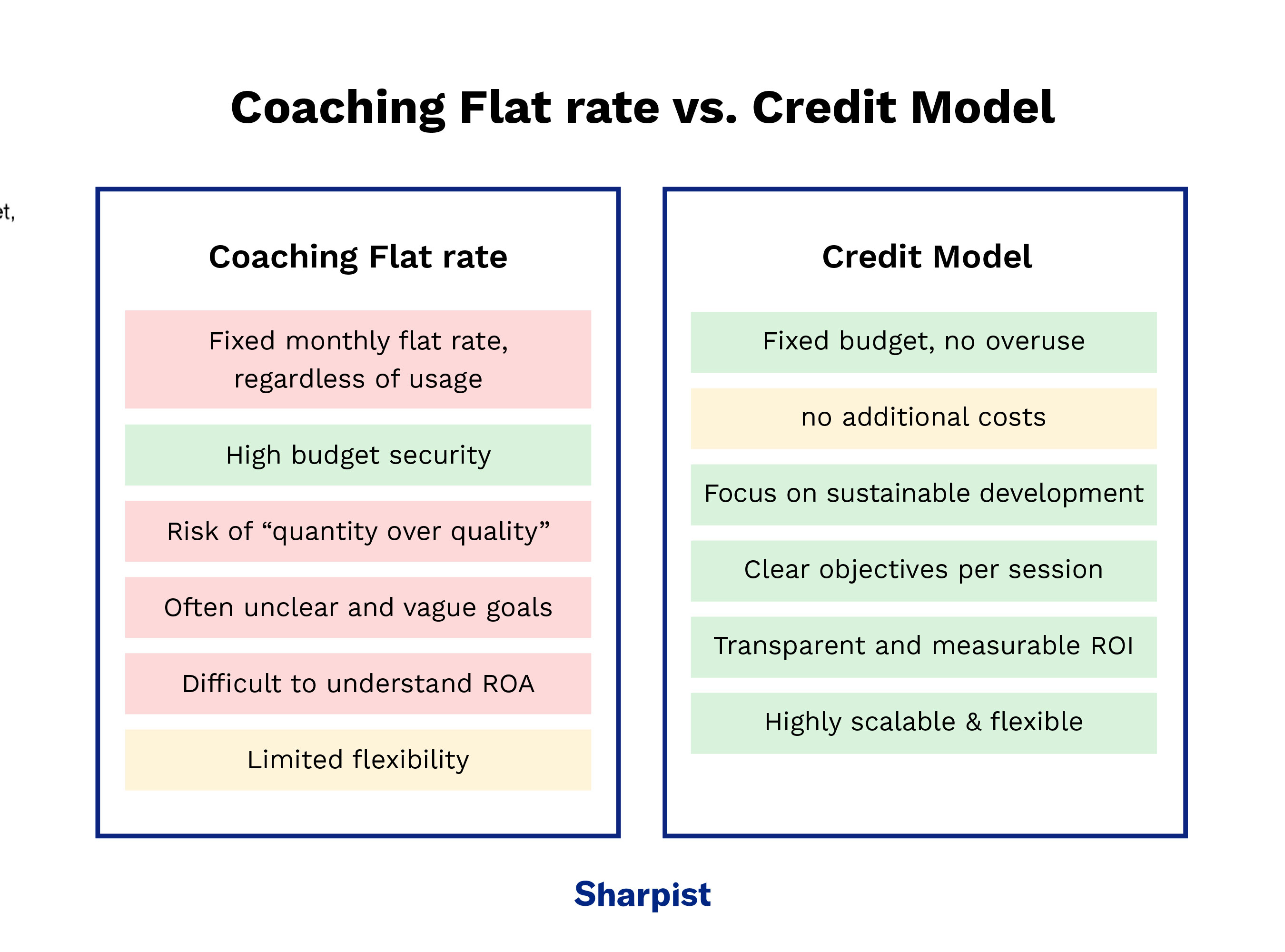
The Direct Comparison: Flat Rate vs. Credit Model – What Really Pays Off?
Both pricing models promise access to professional coaching, but the differences in cost efficiency, flexibility, and measurable success are significant. The following comparison shows which model truly delivers for sustainable talent development.
The credit model is clearly superior to flat rate coaching: it prevents waste through the redistribution of unused credits, delivers higher activation rates, and enables measurable results in leadership development.
Sharpist deliberately relies on this flexible system because it combines cost efficiency with the highest quality, and enables HR teams to demonstrate the ROI of their talent development transparently. While unused sessions are lost in flat rate coaching, the credit model maximizes every invested contribution for lasting organizational success.

Sustainable Talent Development with Sharpist's Flexible Credit Model
Flat rate models promise cost predictability through fixed pricing, but carry considerable risks: quality loss from a lack of goal orientation, inefficient usage without clear focus areas, and difficult ROI measurement. Credit models, by contrast, combine flexibility with transparency and deliver measurable results for sustainable leadership development.
Sharpist's credit system is the optimal solution because it actively prevents waste – unused credits are redistributed rather than expiring. With 99% satisfaction in training sessions and demonstrable business impact (such as +18% in leadership competencies at LVMH), this approach creates genuine success for organizations. Discover how Sharpist can advance talent development in your organization:
Find out how the credit model sustainably develops your leaders.
FAQ
What Is the Difference Between a Coaching Flat Rate and a Credit Model?
With a coaching flat rate, organizations pay a fixed price for theoretically unlimited sessions – regardless of whether they are actually used. The credit model, by contrast, is based on usage-based payment: organizations purchase credits that are flexibly redeemed for services and can be redistributed among employees as needed. The key difference lies between predictability (flat rate) and genuine needs-orientation (credits), with credits preventing waste from unused sessions.
What Are the Benefits of a Credit Model for Coaching?
The credit model offers compelling advantages for talent development: organizations only pay for coaching services actually used (cost efficiency), can flexibly redistribute credits among leaders rather than letting them expire, and gain transparent usage data for better ROI measurement. It also enables individual adaptations to specific needs across different areas of the organization.
What Are the Most Common Drawbacks of Flat Rate Coaching?
Flat rate coaching carries several risks: quality loss from too many unstructured sessions without clear goals, an "all-you-can-eat" mentality in which coachees book sessions because they are available rather than out of genuine need, a lack of goal orientation and accountability, and difficult ROI measurement. In addition, unused coaching services cannot be redistributed and simply expire, leading to considerable resource waste. Success can barely be tied to measurable focus areas.
How Can the ROI of Coaching Be Measured More Effectively?
Better ROI measurement is achieved through transparent real-time usage data, structured focus areas with clear development goals, and real-time analytics dashboards. Before-and-after competency assessments and the linkage to business KPIs such as employee retention or revenue growth create demonstrable results. Tracking features enable HR teams to document the concrete contribution of each training initiative to organizational success and to make evidence-based decisions.
.avif)






.svg)


%20(1).avif)