



.png)
.png)
.svg)

.png)
.png)


.png)


.png)


.svg)


.svg)

How do some HR teams achieve nearly universal adoption of their coaching programs immediately, while others struggle with activation rates of 10–20%? The difference lies not in budget or company size, but in the strategic preparation of the first week. Our client Breitling achieved 100% activation, for example, by consistently implementing five critical success factors. Discover how to systematically achieve high activation rates when implementing your digital coaching program – from leadership buy-in to perfect coach matching.
Why Activation Rate Is Your Most Important KPI
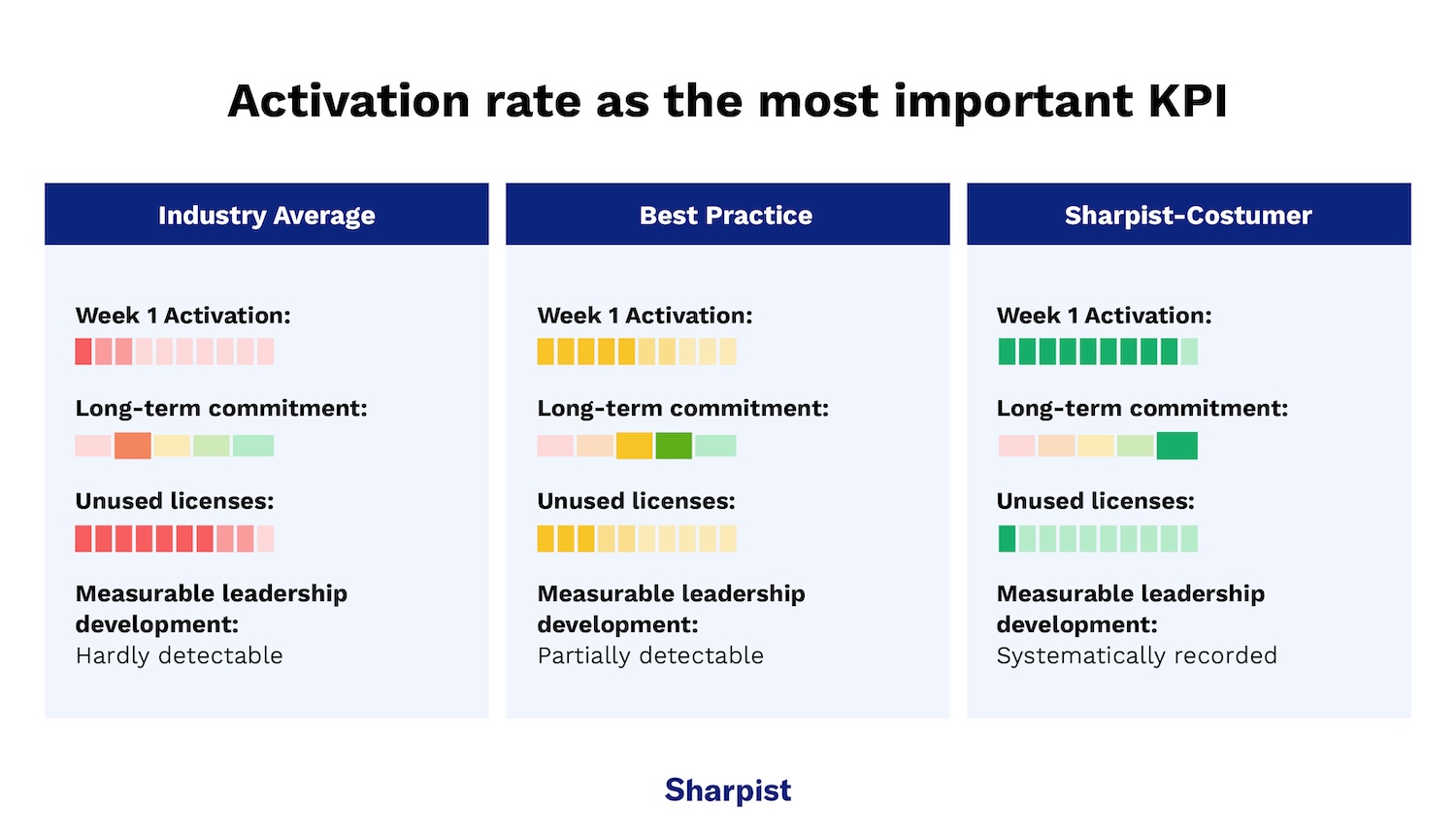
The activation rate in the first week is the most reliable indicator of your coaching program's success. Every unused license not only wastes budget but also represents missed development opportunities for leaders. With average costs of €1,500–3,000 per coaching license, unused programs quickly add up to six-figure losses.
The connection between early activation and long-term engagement is scientifically proven: Employees who start in Week 1 and have a positive program experience are 4× more likely to become active long-term users and achieve measurable improvements in their leadership competencies. Organizations with high activation rates document better metrics and tangible impact on team productivity and satisfaction.
The 5 Success Factors for 96% Activation in Week 1
Successful activation is not a coincidence but the result of systematic preparation. The following five success factors distinguish organizations with 90%+ activation rates from those with 10–20% – each factor is independently effective, but only the combination leads to success in talent development within your organization.
1. Leadership Buy-In as Foundation
Executive sponsorship is the most important success factor for high activation rates – a Prosci study with over 8,000 change management practitioners shows that projects with effective sponsorship are 3.5 times more successful. Without visible leadership support, even the best coaching platform remains ineffective. The ABCs of effective sponsorship are crucial:
Successful organizations implement leadership buy-in concretely by having leaders not only endorse the program but also actively model it. This creates an organizational culture where coaching is perceived as a strategic development tool and engagement across all employees increases.
2. The “What's in It for Me?” Factor
74% of employees feel, according to Middlesex University, insufficiently developed and want more workplace training. This gap between needs and offerings is the main reason for low activation rates. Successful coaching programs communicate the individual value for different target groups from the start.
Instead of generic messages like “Develop your leadership competencies,” they show concretely how coaching connects personal career goals with organizational objectives. The connection between individual talent development and strategic business goals makes the difference between “Do I have to do this too?” and “This really helps me.”

Customized development paths are crucial here. Sharpist offers 32 focus areas, for example – from self-leadership to team leadership to strategic leadership – that are tailored to specific challenges of different target groups. When young leaders recognize they'll receive concrete support in building their first team, or senior executives see they can work on their strategic vision, activation rates increase dramatically. The following table shows how to address different target groups with appropriate value propositions:
3. Seamless Onboarding Process
The first 48 hours after program launch determine the success or failure of your coaching program. Studies show that 22% of employees leave within the first 6 weeks when structured onboarding is missing – coaching programs experience similarly dramatic dropout rates with poor onboarding.
A seamless rollout minimizes technical and psychological barriers: Clear step-by-step instructions reduce uncertainty, immediate technical support prevents frustration, and low-threshold initial activities create quick wins.
Sharpist automates this critical onboarding process and guides users to their first valuable interaction within minutes – from login through goal setting to coach selection.

4. Fast, Precise Coach Matching
Ultra-fast coach matching is crucial to leverage employees' initial interest – every delay increases the risk that motivation decreases and activation fails. When leaders decide on coaching, their readiness for change is at its highest. Wait times of several days or weeks result in missing the moment and other priorities capturing attention.
The psychology behind direct assignment instead of a “dating app effect” is scientifically founded: Too many choices lead to decision paralysis and declining engagement. Sharpist deliberately avoids having users choose from dozens of coach profiles. Instead, intelligent matching based on objective criteria directly assigns the perfect coach. This approach saves time, builds trust in the platform's expertise, and enables a quick start to the productive coaching relationship.
Sharpist achieves a 97% success rate on first match – meaning nearly all coaches and coachees can work together productively immediately, without time-consuming rematching processes.

5. Multichannel Communication for Launch
An integrated communication strategy across multiple channels is crucial to reach all employees and successfully launch the coaching program. While some teams rely exclusively on email, successful organizations combine various touchpoints: personal invitations from leaders, intranet articles, announcements in team meetings, and targeted reminder emails.
Frequency and consistency in the first week are critical. The classic Marketing Rule of 7 states that people must see or hear a message at least 7 times before taking action – in today's information-overloaded world, it's probably even more touchpoints.
Different stakeholders also need different content: While leaders need strategic arguments and ROI data, employees are interested in concrete application examples and personal benefits. This target-group-specific communication significantly increases engagement and ensures the right messages reach the appropriate teams.
How Breitling Achieved 100% Activation
When Breitling launched its global leadership coaching program with Sharpist, the HR team relied on systematic preparation instead of spontaneous hope from the start. In close coordination with the executive board, they developed a multichannel communication strategy that consistently implemented all five success factors.
The CEO personally opened the program with a launch video positioning coaching as a strategic priority and announcing his own participation. In parallel, all leaders held personal conversations with their teams in Week 1 to clarify individual value – from young leaders wanting to master their first team leadership to senior executives working on strategic vision.
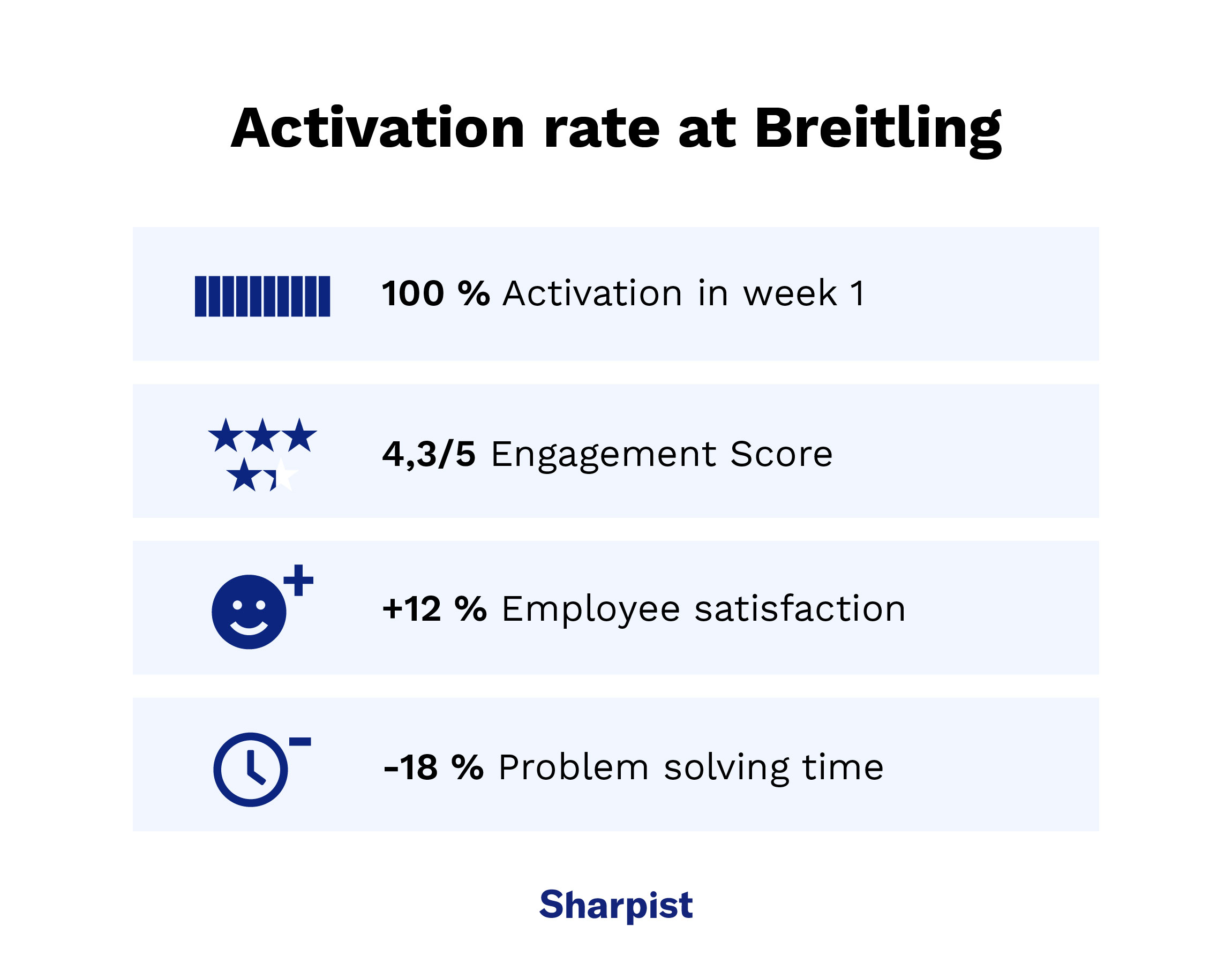
The result exceeded all expectations: 100% of invited leaders activated their coaching within the first 7 days. The engagement score was 4.3 out of 5 points after 30 days, and measurable business impacts emerged after Quarter 1: Employee satisfaction with their managers increased by 12%, the average time to problem resolution in teams decreased by 18%, and the retention rate for key positions improved significantly. Particularly impressive was the impact on organizational culture – coaching was not perceived as an external program but as an integral part of leadership development at Breitling.
After Week 1: Transforming Activation into Sustainable Usage
Successful activation in Week 1 is just the beginning – what matters is how you transform initial momentum into lasting usage. The next 90 days determine whether activated leaders become engaged long-term users who achieve measurable development progress. While many coaching programs lose momentum after launch, successful HR teams rely on systematic monitoring and targeted interventions to continuously increase adoption.
Month 1 – The Critical Consolidation Phase
The first 30 days after launch determine whether initial activation becomes genuine, sustainable engagement. While many coaching programs lose momentum after a successful first week, best-practice organizations systematically transform initial usage into regular habits.
The difference lies in focused monitoring and proactive measures: HR departments that check their dashboards daily and respond specifically to usage patterns achieve 3× higher adoption after 90 days. Critical is the integration of continuous learning between coaching sessions – Sharpist's Micro Tasks with over 2,000 short exercises (maximum 5 minutes) ensure that leaders advance their development in daily work and not just during sessions with their coach. The following tips help you successfully master the consolidation phase:

Quarter 1 – Measurable Impact Demonstration
In the first three months, you must make the business impact of your coaching program visible – not only for executive leadership but also for skeptical stakeholders and future budget decisions. Successful HR teams proceed systematically: They document not only activity metrics like booked sessions but also capture measurable skill development and link it to business KPIs.
The crucial difference lies in the transition from “How many use the program?” to “What impact does the program achieve?” Sharpist's analytics dashboard enables this transition through systematic capture of development data across 32 focus areas and delivers valuable insights and comparative analyses showing where your organization stands in industry comparison.
Start Online Coaching with High Activation Rates with Sharpist Now
The numbers speak for themselves: While typical coaching platforms see 10–30% activation, Sharpist clients average 91% – and that's no coincidence. Our coaching platform combines all five success factors you've learned about in this article: From systematic preparation through ultra-fast coach matching to continuous engagement promotion.
Our coaching platform combines various learning formats – from 1:1 video coaching through micro tasks to continuous progress tracking – and integrates all five success factors you've learned about in this article. Schedule a personal consultation now and discover how Sharpist transforms your leadership development with high activation rates and measurable ROI.
FAQ
What Is a Good Activation Rate for Coaching Programs?
Industry-typical activation rates are 10–30%, while 50%+ is considered optimal and 80%+ as excellent. Sharpist clients achieve an average of 91% activation. Crucially: The activation rate in Week 1 is the best predictor of long-term program success – those who start early show 5× higher completion rates and achieve measurable improvements in leadership competencies.
How Quickly Should Coach Matching Occur?
Fast coach matching within 24–48 hours is critical to leverage employees' initial interest – every delay significantly increases dropout risk. Sharpist sets the benchmark here with an average matching time of under 2 hours and achieves a 97% success rate on first match. This speed transforms interest immediately into productive coaching relationships before momentum is lost.
What Role Does Executive Sponsorship Play?
Executive sponsorship is the most important success factor – a Prosci study shows that projects with effective sponsorship are 3.5 times more successful. The ABCs of effective sponsorship (Active participation, Build coalition, Communicate support) make the difference: When leaders actively model and communicate coaching, it becomes a strategic priority. Without leadership buy-in, even the best coaching platform remains ineffective.
How Do I Measure the ROI of My Coaching Program?
ROI measurement occurs on three levels: Activity KPIs (usage rate, completion), Development KPIs (skill improvement, engagement score), and Business KPIs (retention, performance, leadership index). Sharpist's analytics dashboard systematically captures all metrics and enables industry comparisons across 32 focus areas. The ROI calculator helps you quantify and document the financial impact of your coaching program.
.avif)







.svg)


%20(1).avif)