



.png)
.png)
.svg)

.png)
.png)


.png)


.png)


.svg)


.svg)

Many leaders already use ChatGPT or Copilot for coaching-related questions, often without the HR department's knowledge. Yet both tools have no memory, no coaching standards, and are not GDPR-compliant for HR data without enterprise configuration. Sharpist closes this gap as a hybrid platform with an ICF-verified AI Coach and certified human coaches – with persistent memory, organisational context, and measurable development progress.
Key Facts
When Leaders Use ChatGPT as a Coach – and Why HR Often Notices Too Late
According to the Microsoft Work Trend Index 2024, 78% of AI users bring their own, unapproved tools to work – many of them for topics that belong in leadership development: preparing for difficult conversations, reflecting after conflicts, or formulating feedback. The usage is invisible: no log, no company account, no audit trail. Psychologically this makes sense – a chatbot feels lower-threshold, does not judge, and is immediately available.
The real problem is not AI usage itself, but the lack of governance. Once leaders enter coaching-relevant content into unapproved tools, two concrete risks arise: data protection violations (no GDPR legal basis) and qualitative blind spots (no coaching standards, no development progress).
What ChatGPT and Copilot Can Do – and What They Structurally Cannot
It would be wrong to dismiss ChatGPT and Microsoft Copilot as wholly unsuitable. Both tools have genuine strengths: they deliver fast, linguistically precise answers, are available around the clock, and can provide useful impulses for clearly framed questions. For drafting texts, research, or preparing for a conversation, they are useful.
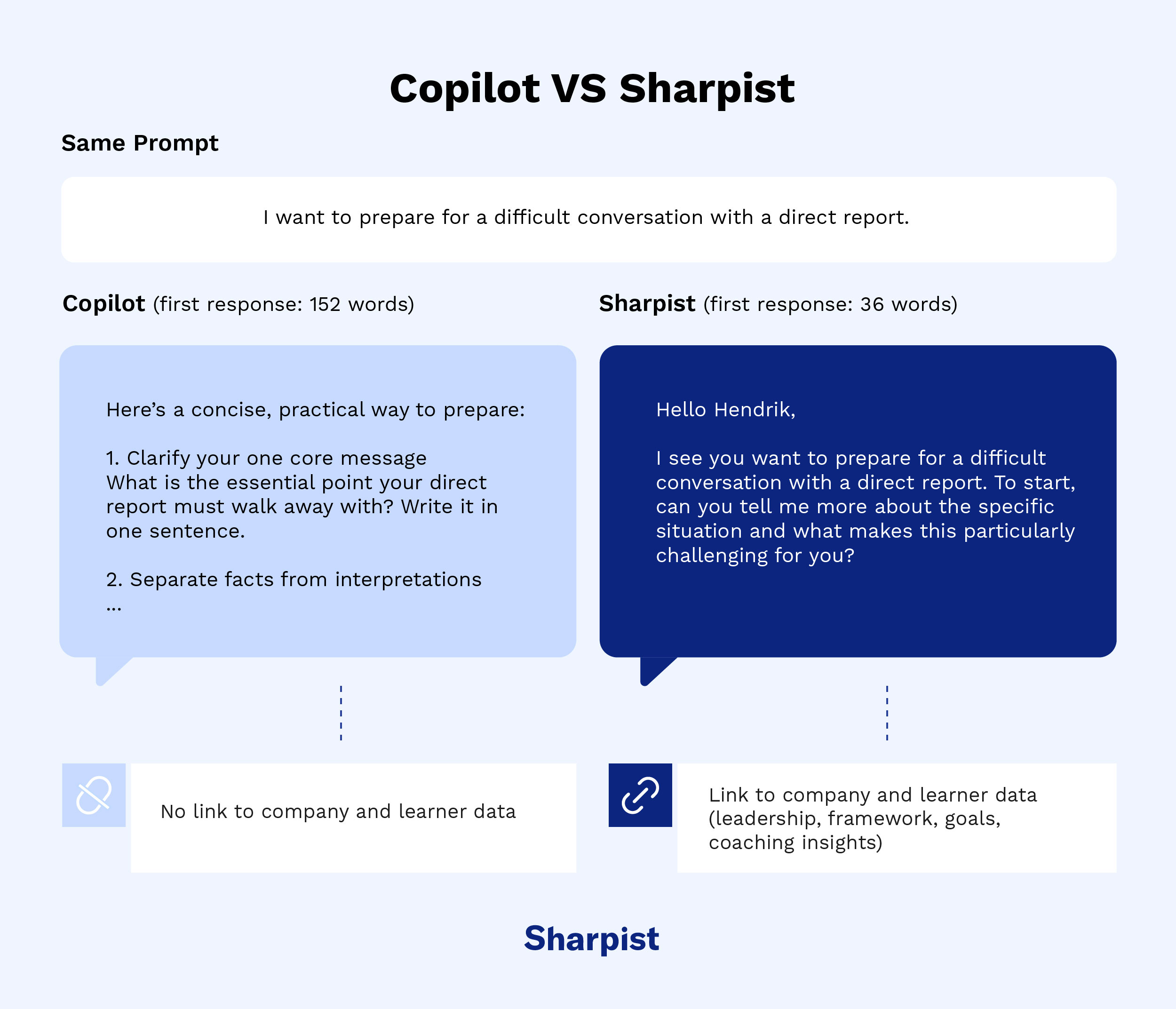
For structured leadership development, however, they lack four properties that no amount of prompt engineering can compensate for:
Five Criteria That Distinguish a Real AI Coach from a Chatbot
HR decision-makers evaluating AI-powered coaching solutions need a clear framework. The following five criteria separate professional AI coaching platforms from generic chatbots, regardless of how convincing a tool's interface appears.
1. Quality Assurance to ICF Standards
In November 2024, the ICF published an AI Coaching Framework across six domains, from ethics to data protection. It defines what a professional AI coaching system must deliver. ChatGPT and Copilot have no comparable mechanism: the conversation ends when the user is satisfied, not when a coaching process has been completed.
Sharpist automatically reviews every session with 16 QA Agents against ICF competencies: a "Coach Challenge Level Agent" ensures the AI actively challenges leaders. A "Validation Techniques Agent" prevents robotic repetition and excessive flattery.
2. Conversation Memory and Continuity
Coaching effectiveness develops over time through repeated engagement with one's own patterns and goals. ChatGPT resets every conversation; even the Memory feature offers no structured integration of human coach sessions.
The Sharpist AI Coach remembers the entire coaching journey: human coach sessions are transcribed, insights and action items tracked, and context preserved. If a leader discusses a team conflict on Monday, the AI Coach follows up specifically on Friday.
3. Personalisation Through Organisational Context
ChatGPT knows neither your leadership principles nor your strategic priorities. Responses are generic and, while useful as a first impulse, are not anchored in what matters in your organisation.
Sharpist integrates company-specific leadership competencies, goals, and frameworks directly into the AI Coach. A leader's development is not viewed in isolation, but in the context of their specific role and the organisation's expectations.
4. GDPR-Compliant Operation
Coaching content belongs to the most sensitive company data. As soon as an external service processes it, a DPA under Art. 28 GDPR is mandatory. OpenAI only offers this for Business versions (Team, Enterprise, API) – ChatGPT Free and Plus are not legally usable for this purpose.
Sharpist operates its platform GDPR-compliantly and ISO 27001-certified: EU data storage, no AI model training with customer data, full data deletion capability, and a DPA in place.
5. Hybrid Model: AI and Human Coaches as a System
The ICF recommends a hybrid approach: AI complements human coaches, but does not replace them. Human coaches provide empathy, situational judgment, and guidance through complex transformations. AI delivers 24/7 availability, seamless documentation, and scalable continuity between sessions.
Sharpist implements this consistently: certified human coaches lead the deep sessions, the AI Coach reads the summaries, picks up on themes, and ensures that nothing is lost between appointments. ChatGPT and Copilot structurally cannot form this model.
What HR Decision-Makers Should Specifically Evaluate When Comparing Solutions
The following table summarises how generic AI tools and specialised AI coaching platforms differ across the five criteria. It is not a comprehensive market comparison, but a decision framework for HR teams evaluating AI-powered coaching solutions.
Three questions HR teams should ask at every evaluation:
Anyone who puts these questions to ChatGPT or Copilot will find: as an occasional reflection tool, they are useful. As a structured coaching solution for organisations, they lack the substance.
How Sharpist Closes the Gap That ChatGPT and Copilot Leave Open
ChatGPT and Microsoft Copilot are useful tools for drafting texts, research, or quick impulses. As a structured coaching solution, they lack what professional coaching requires: continuity, quality standards, organisational context, and data protection. Those who do not actively make this decision effectively leave it to their employees – with all the risks that entails.
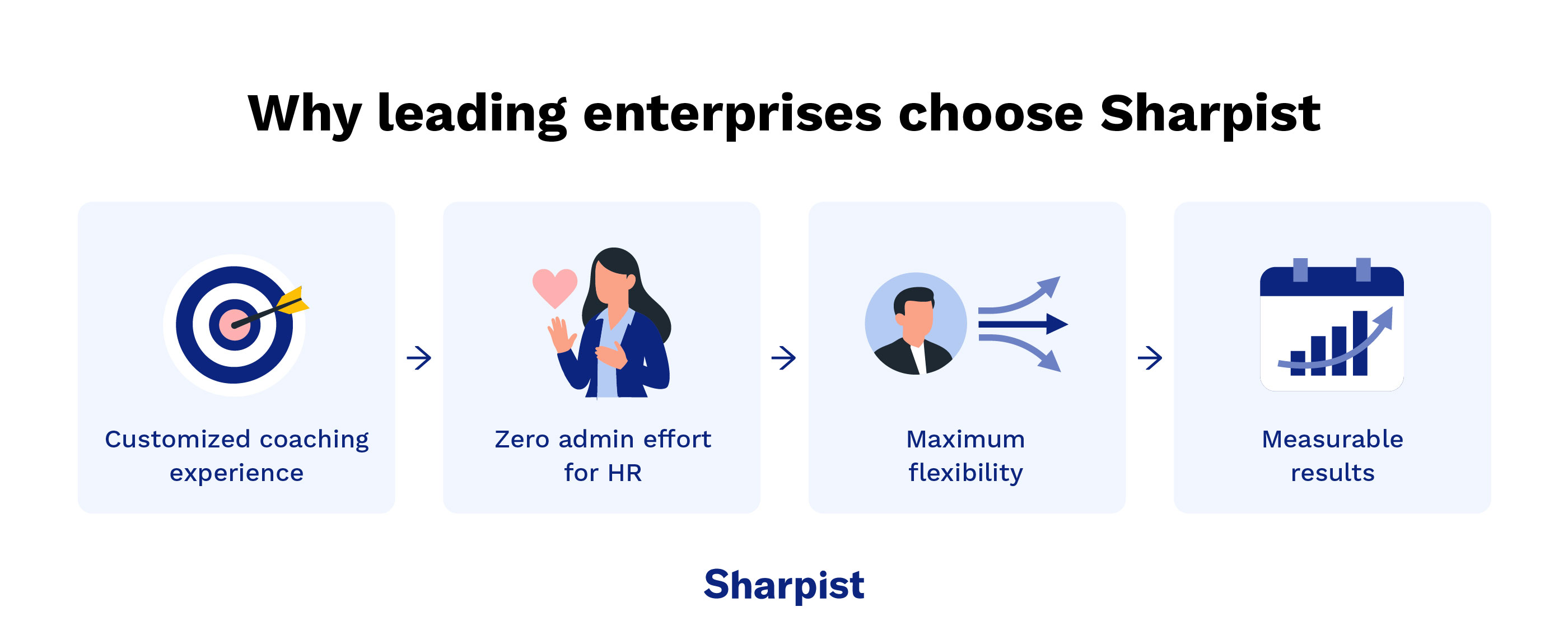
Sharpist was built from the ground up for organisation-wide leadership development. Not as a chatbot with coaching features, but as a hybrid platform that brings together what generic AI tools structurally keep apart:
Sharpist customers such as LVMH recorded +18% in leadership competencies; at IKEA Switzerland, the leadership index improved by 8–10%. Find out in a personal demo how Sharpist makes leadership development scalable and measurable in your organisation. Book a Demo Now.
FAQ
Why is ChatGPT insufficient for leadership development in my organisation?
ChatGPT lacks four structural prerequisites for professional leadership development: conversation memory (every session starts from scratch), quality assurance to coaching standards (no ICF framework), organisational context (generic responses without knowledge of your organisation), and GDPR-compliant operation for personal data (no DPA for Free/Plus). As an occasional reflection tool it is useful – as a structured coaching solution it is not sufficient.
What data protection risks arise when leaders use ChatGPT for coaching conversations?
As soon as leaders enter personal content into ChatGPT Free or Plus, a GDPR issue arises. OpenAI does not offer a Data Processing Agreement (DPA) under Art. 28 GDPR for these versions. Without a DPA, there is no legal basis for processing and liability falls on the company. GDPR fines can reach up to €20 million or 4% of global annual turnover.
How does a specialised AI Coach like Sharpist's differ from ChatGPT or Microsoft Copilot?
Five criteria make the difference: ICF quality assurance through 16 QA Agents per session, persistent conversation memory including human coach sessions, integration of organisational context and leadership principles, GDPR-compliant EU data storage without AI model training, and a hybrid model with ICF-certified human coaches as an integrated system. ChatGPT and Copilot meet none of these criteria without explicit enterprise configuration.
What are the risks of shadow AI in an HR context when employees use ChatGPT for coaching without approval?
Three risks stand out: GDPR liability through uncontrolled processing of sensitive HR data, qualitative blind spots without coaching standards or an audit trail, and loss of control over the development goals and content of leaders. Organisations that do not create a structured framework effectively hand the decision to their employees – with all the consequences that follow.
Can an AI Coach replace human coaches, and what does the ICF recommend?
No – the ICF explicitly recommends a hybrid approach: AI complements human coaches, it does not replace them. Empathy, situational judgment, and guidance through complex transformations remain core human competencies. Sharpist implements this principle consistently: certified human coaches lead the deep sessions, while the AI Coach ensures continuity and quality assurance between appointments. The best results come from combining both models.
What measurable results does professional AI coaching deliver for leaders?
The results that Sharpist customers achieve are specific and attributable: customers such as LVMH recorded an 18% improvement in leadership competencies; at IKEA Switzerland, the leadership index rose by 8–10%. These figures are produced by the hybrid model of certified human coaches and AI-powered continuity – not by a generic chatbot.
.avif)







.svg)


%20(1).avif)