



.png)
.png)
.svg)

.png)
.png)


.png)


.png)


.svg)


.svg)

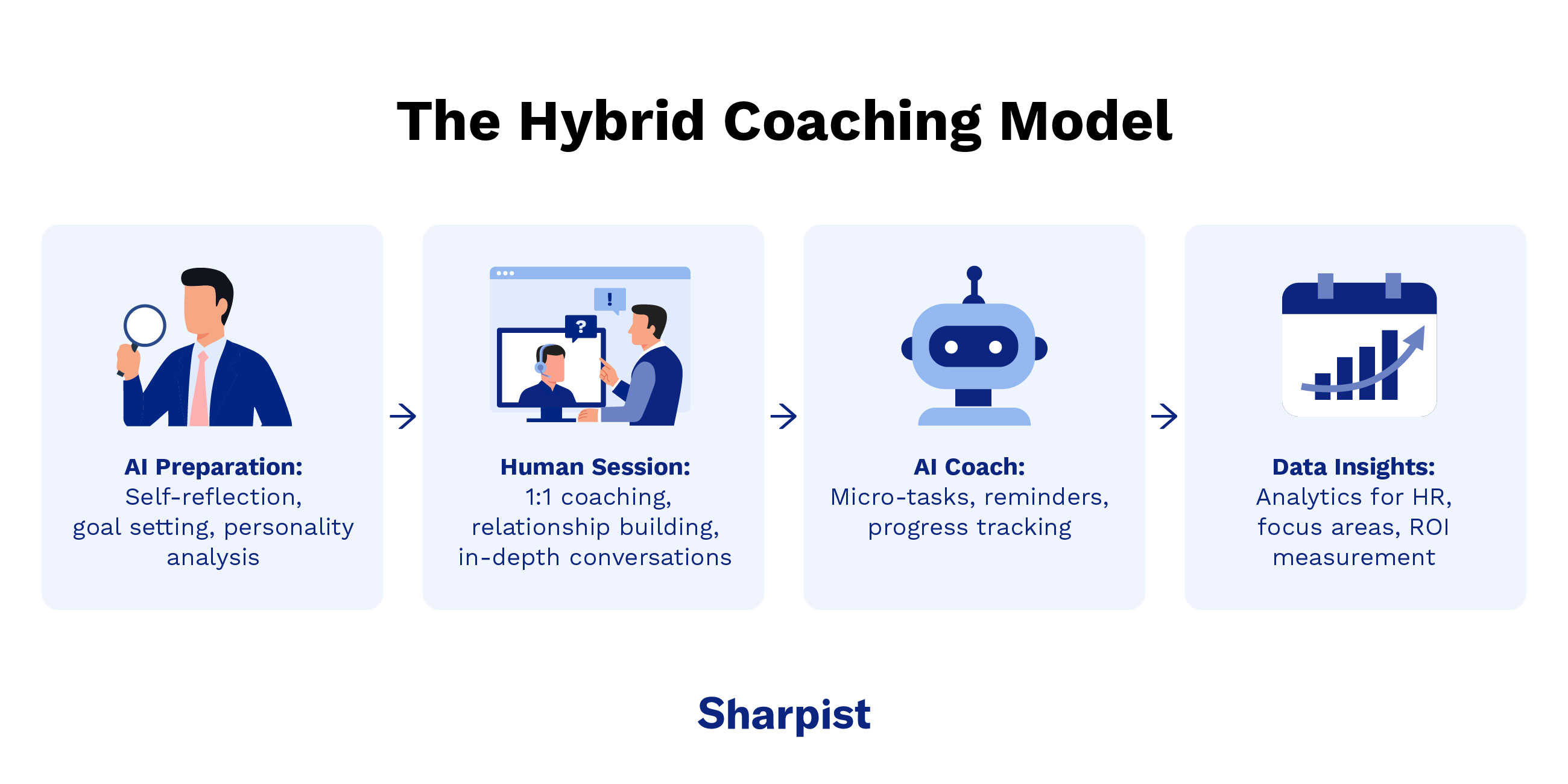
How many of your leaders have access to real coaching today – and how many are left to navigate urgent questions alone because the next session isn't for another two weeks? AI-powered coaching can help solve this problem. But there is a world of difference between a generic chatbot and a quality-assured AI coach. Sharpist combines human coaching and AI coaching in a hybrid approach.
The Topic in a Nutshell
What AI Coaching Really Means Today
AI coaching is not a uniform concept. The spectrum ranges from a simple reflection chatbot to a fully integrated, quality-assured AI coach that operates within an ongoing coaching program. This distinction is central for HR decision-makers because it determines what expectations are realistic and what risks arise.
From Chatbot to AI Coach: Comparing the Different Models
Three models shape the market, and they differ fundamentally in quality, use case, and outcome:
Stefan Kreil, responsible for global coaching services at SAP and author of a book on the future of business coaching, tested ChatGPT as a coach himself. His verdict is precise: "AI can coach at a foundational level, asking useful but not yet truly deep questions." He compares the current state to the first automobile: a Karl Benz moment in conversational AI. Powerful for certain tasks, still far from what will be possible in ten to twenty years.
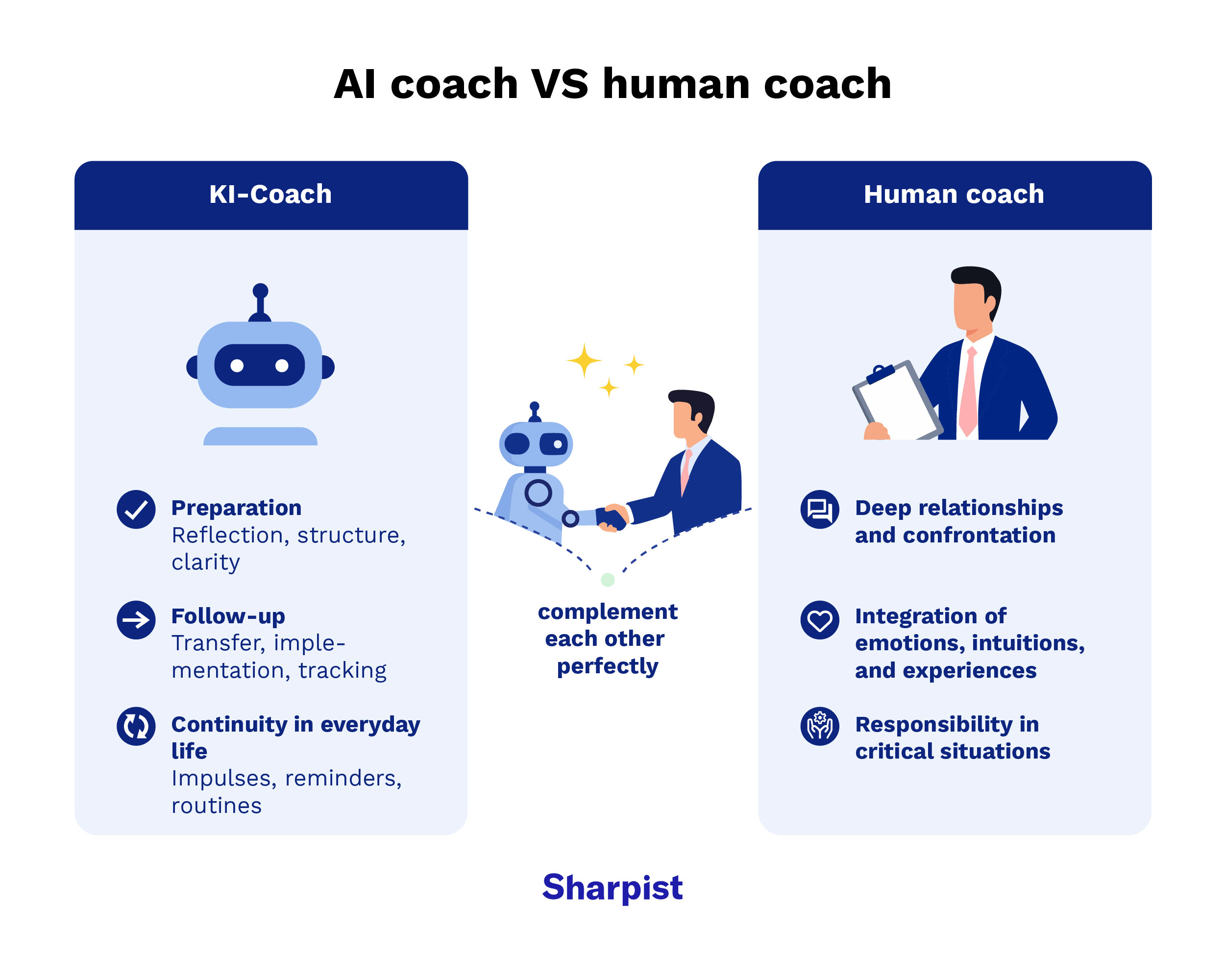
Understanding the difference between an AI coach and a human coach leads to better purchasing decisions and avoids both overestimation and blanket rejection.
Where AI Creates Real Value in Coaching
AI coaching solves concrete problems that human coaching structurally cannot: availability, scalability, and continuity. For organizations with hundreds or thousands of leaders, these are not comfort factors but strategic requirements.
1. Preparation for Difficult Conversations
A leader needs to conduct a feedback conversation tomorrow that could escalate. An AI coach enables situational practice without requiring advance scheduling. At TSR, a Sharpist customer with 29 commercial and shopfloor leaders, this exact use case achieved a rating of 4.5/5 stars and measurably improved stress management.
2. Reflection and Micro-Learning Between Sessions
The transfer of coaching content into daily work often fails because too much time passes between two sessions. An AI coach keeps the learning thread alive, poses reflection questions, and connects new situations to previous insights. Sharpist's micro tasks library with over 2,000 tasks and a maximum of five minutes per unit complements this function and achieves 95% positive ratings.
3. Onboarding New Leaders
Nussbaum Media deployed the Sharpist AI coach for ten leaders transitioning into new roles. Within three weeks, the program achieved 100% AI adoption and 100% retention in the new roles – including among participants who were initially skeptical about AI-powered coaching.
4. Democratization of Coaching
Traditional 1:1 coaching typically reaches only the top 5–10% of the leadership hierarchy. Activation rates for pure e-learning platforms are 10–20%. Sharpist customers such as Breitling achieve 96% activation rates in the first week and 80% continuous engagement throughout the entire program with structured digital coaching.
Where AI Reaches Its Limits
Honesty about the limitations of AI coaching is not an admission of weakness – it is a prerequisite for good decisions. Those who understand these limits deploy AI where it excels, while protecting the quality of leadership development where human depth is indispensable.
An AI may simulate different tones and appear to respond empathetically, but it is uniformly correct, always patient and friendly. Real relationships, however, thrive on imperfection, confrontation, and mutual learning.
The following coaching scenarios therefore require a human coach:
Roland Lechner, Head of HR EMEA at Palfinger, describes the role of the human coach in times of crisis as follows: "Coaching as a release valve during times of sustained stress – a neutral, confidential space where leaders can set down topics without carrying them home or into the next leadership meeting." AI does not create this space.
The Decision Framework: Which Coaching Format Fits When?
The decisive question for HR leaders is not "AI or human," but which method works best at which point. The following framework is oriented around the complexity of the coaching need and the organization's scalability requirements.
During a restructuring with simultaneous layoffs, Miro selected 120 strategic culture multipliers and deployed targeted coaching from Sharpist. The result: 100% retention of all participants and a 25% increase in optimism throughout the transformation phase. Three principles made the program effective: entirely voluntary, content-wise confidential, and external career development was explicitly permitted as a legitimate topic.
Quality Assurance: What Distinguishes a Real AI Coach from a Chatbot
The market for AI coaching tools grew significantly between 2024 and 2026. The decisive question for HR decision-makers is no longer whether a platform offers AI, but how that AI is quality-assured.
1. ICF Competency Calibration
Is the AI tested against the eight core competencies of the International Coaching Federation? Sharpist's AI coach is monitored by 16 specialized QA agents, including an ICF Competencies Agent, a Coach Challenge Level Agent that ensures the AI actively challenges learners rather than simply validating them, and a Validation Techniques Agent that prevents excessive mirroring.
2. Corporate Context Integration
Does the AI work with the leadership framework, development goals, and insights from previous coaching sessions? Generic LLMs do not have access to this context.
3. Data Privacy and Compliance
In the DACH region, GDPR compliance and ISO 27001 certification are not optional features but baseline requirements. Sharpist meets both. Siemens explicitly cited IT security and data privacy as decisive criteria when selecting a coaching platform.
AI-Powered Coaching for Enterprise Organizations with Sharpist
At Sharpist, the AI coach handles scaling, continuity, and ad-hoc support, while over 1,500 ICF/DBVC-certified coaches in 55+ languages ensure depth of work. Both levels are integrated in one platform, with seamless context between human coaching sessions and the AI coach.
Schedule a demo to see what the hybrid approach can look like in your organization.
FAQ
Can an AI Coach Fully Replace a Human Coach?
No – AI coaching scales reflection, preparation, and continuity between sessions, but cannot build a real coaching relationship. Deep leadership development, crisis support, and complex relationship work continue to require human coaches. The hybrid approach combines the strengths of both.
How Do I Ensure That an AI Coach Is GDPR-Compliant?
Check whether the provider is ISO 27001-certified, whether all data is encrypted and stored on EU servers, and whether clear data processing agreements pursuant to Art. 28 GDPR are in place. Sharpist meets all three requirements and has been explicitly evaluated against these criteria by enterprise customers such as Siemens and Airbus.
How Do I Measure the ROI of AI Coaching Compared to Traditional Formats?
Relevant KPIs include activation rates, engagement over the program duration, behavioral changes in employee surveys, and retention rates. Sharpist's L&D dashboard delivers this data in real time with industry benchmarks.
Which Target Groups Benefit Most from Getting Started with AI Coaching?
First-time leaders, leaders transitioning into new roles, and shopfloor employees benefit most, as they previously had little access to coaching and AI coaching closes exactly this gap. For senior leaders, a hybrid approach with a human coach as anchor is recommended.
.avif)







.svg)


%20(1).avif)