



.png)
.png)
.svg)

.png)
.png)


.png)


.png)


.svg)


.svg)

What happens when a top performer is suddenly expected to lead a team – but has never learned how? The scenario is common: a promotion is made based on technical performance, yet uncertainty quickly sets in due to a lack of leadership competencies. Sharpist's coaching for first-time leaders guides new leaders through the initial phase – from early self-doubt to becoming an effective leadership personality.
The Topic in a Nutshell
Typical Challenges for First-Time Leaders and Why Many Fail Without Support
The transition from individual contributor to leader is one of the most critical career steps of all. Yet according to a study by the Chartered Management Institute (CMI), 82% of all managers begin their new role without any formal leadership training. No onboarding, no training, no guidance. What follows are avoidable mistakes, uncertainty, and in the worst case: failure. The most common challenges reveal the stumbling blocks that keep coming up.
1. Technical Competence Alone Is Not Enough
Most promotions are based on technical excellence. But what makes someone successful as an individual doesn't automatically translate into effective leadership. The decisive shift: away from "doing the work yourself" toward "enabling others to do the work." New leaders suddenly need emotional intelligence, strong communication skills, and the ability to delegate. At the same time, many leaders struggle with impostor syndrome – the feeling of not being up to the new role.
2. The Most Common Mistake: Simply Doing More of What Worked Before
Many first-time leaders fall into a familiar pattern: they try to have all the answers themselves and continue to take on operational tasks, even though their responsibilities have shifted. Their focus remains on tasks rather than on the people in their team. This pattern is not an isolated case.
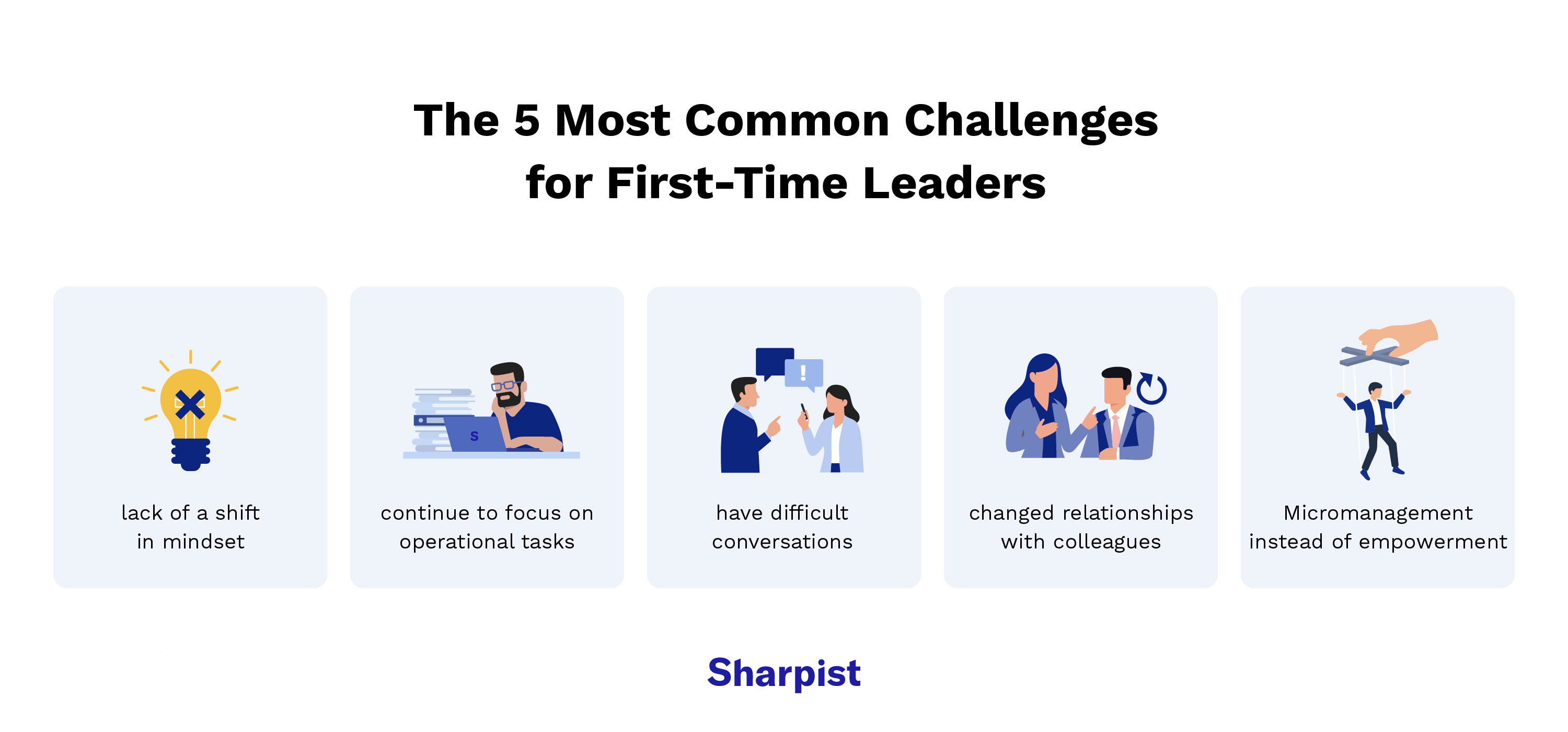
3. Having Difficult Conversations: Giving Feedback and Addressing Conflicts
Few things are harder for first-time leaders than uncomfortable conversations. Whether it's underperformance, team conflicts, or personal challenges – many avoid these situations out of fear of rejection or simply due to a lack of practice. The result: problems escalate, trust within the team erodes, and the leader loses effectiveness.
Typical conversation situations that challenge first-time leaders:
4. From Team Member to Leader: Relationships Change
Someone who was working as a peer yesterday must today make decisions that affect the entire team. Friendships shift, loyalty conflicts arise, and suddenly you find yourself on the other side of the table. This emotional transition is one of the most underestimated aspects of the new leadership role.
The uncertainty is understandable: How much closeness is still appropriate? How do I establish a leadership presence without losing my connection to the team? Without support from a coach or mentor, many first-time leaders navigate this tension on their own – and pay a high price for it.
5. Micromanagement vs. Empowerment: Finding the Right Balance
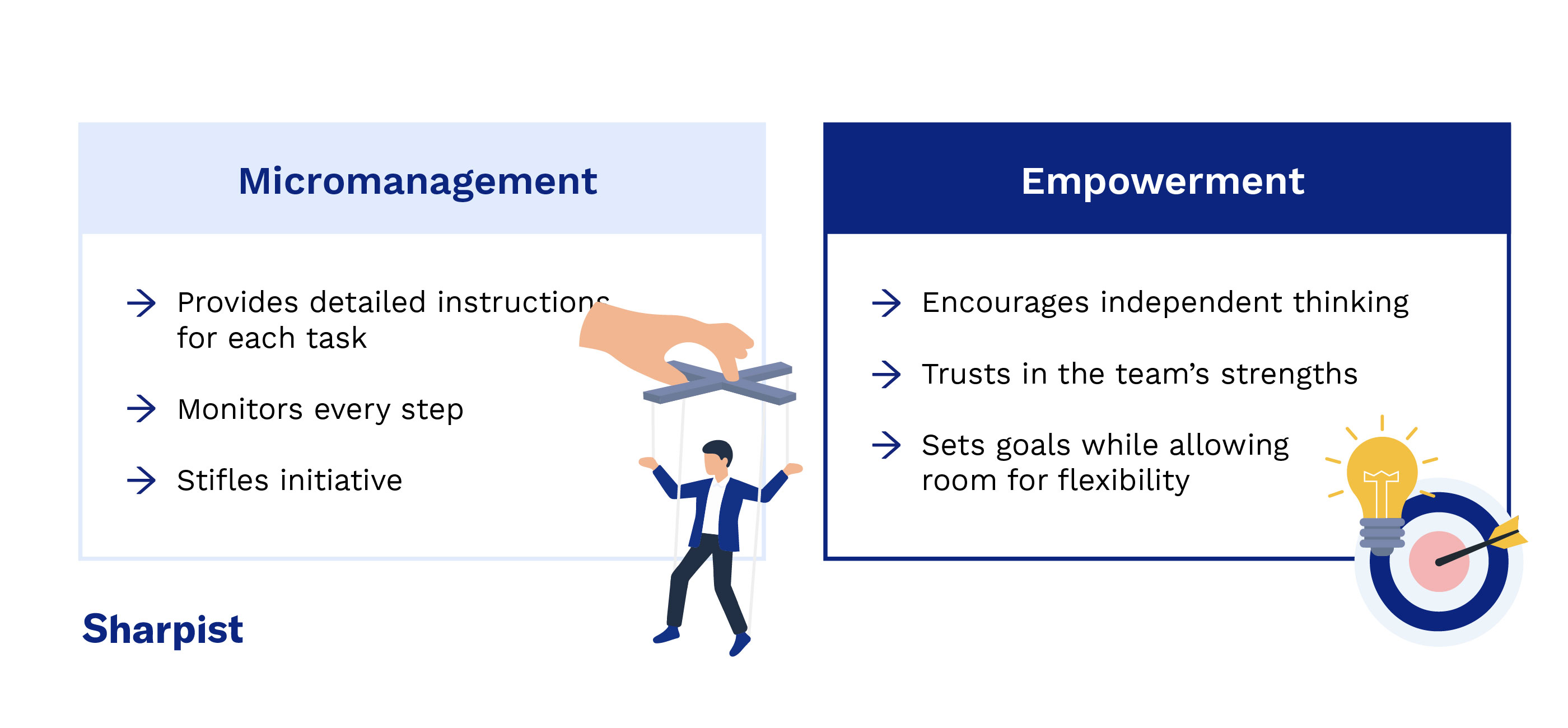
The pendulum often swings to one of two extremes for new leaders: either they control every step their team takes (micromanagement) or they step back entirely and leave the team to fend for itself (laissez-faire). Both extremes harm the team and the leader's own effectiveness.
Micromanagement typically stems from insecurity and a lack of trust in the team. Complete hands-off leadership, on the other hand, signals disinterest and leaves employees without direction. Finding the right balance between control and empowerment is a leadership competency that cannot be developed through trial and error. This is precisely where targeted coaching for first-time leaders from Sharpist comes in: it helps build this balance consciously and step by step.
What Can Coaching for First-Time Leaders Concretely Achieve?
Seminars, lectures, e-learnings: traditional leadership development conveys knowledge. But knowledge alone does not develop effective leaders. Coaching, on the other hand, enables first-time leaders to apply what they have learned in their own context.
Concretely, coaching for first-time leaders delivers impact in the following areas:
Sustainable Growth with Sharpist's Coaching for First-Time Leaders
Sharpist combines 1:1 video coaching with over 1,500 certified coaches and personalized micro tasks into an approach that guides first-time leaders through their transition with precision. The principle: coaching for all leadership levels, not just the C-suite. The algorithmic coach matching finds the right coach on the first attempt in 97% of cases – so the collaboration delivers impact from the very first session.
Sharpist clients such as LVMH recorded an 18% improvement in leadership competencies. At Miro, retention during role transitions was 100%. And while traditional e-learning programs achieve activation rates of 10–20%, Sharpist consistently delivers 80–90%.
For HR teams, Sharpist additionally offers a flexible credit system that directs resources precisely where they have the greatest impact. The L&D dashboard provides real-time analytics with ROI tracking – making the success of every program measurable and demonstrable to senior leadership.
FAQ
What Is Coaching for First-Time Leaders and Who Is It For?
It is professional support for specialists and managers who are taking on people leadership responsibility for the first time. The program is designed for anyone who wants to successfully navigate the transition from individual contributor to leadership role – across all industries and at every level of the hierarchy.
Why Is Technical Competence Alone Not Enough to Successfully Take on a Leadership Role?
Leadership demands skills such as communication, delegation, and emotional intelligence. These competencies differ fundamentally from technical expertise. When they are absent, conflicts, overload, and declining team performance follow.
When Is the Best Time to Start Coaching for a New Leadership Role?
Ideally, you begin before or immediately at the point of the role transition. The first 90 days are decisive for leadership success. Early coaching prevents unfavorable behavioral patterns from becoming entrenched.
What Specific Topics Are Covered in Coaching for First-Time Leaders?
Typical content includes feedback and conflict competence, delegation, self-leadership, emotional intelligence, role clarity, and building trust within the team. The focus areas are individually tailored to the coachee's situation.
How Long Does a Coaching Process for First-Time Leaders Take and How Does It Work?
A typical process spans three to six months with regular sessions. At Sharpist, it includes 1:1 video coaching and micro tasks between sessions.
.avif)








.svg)


%20(1).avif)