



.png)
.png)
.svg)

.png)
.png)


.png)


.png)


.svg)


.svg)

56% of all managers suffer from burnout – yet they determine 70% of the variance in team engagement. Resilience is not an innate trait, but a learnable skill. Through 1:1 digital coaching, managers at Sharpist systematically develop mental resilience: with over 1,500 certified coaches, evidence-based methods, and measurable results.
What Is Resilience Coaching for Managers?
Resilience coaching is a specialized form of leadership development that aims to systematically strengthen the mental resilience and adaptability of leaders. Unlike general coaching, this approach focuses specifically on the ability to remain capable of acting under high pressure, emerge stronger from crises, and use change as an opportunity for growth. A resilience coach helps people develop their mental resources and use them effectively in challenging situations.
The coaching approach is based on the scientific finding that resilience is not an innate trait, but a learnable skill. Through a combination of reflection, evidence-based methods, and practical exercises, managers develop concrete strategies for dealing with stress, pressure, and uncertainty. This is not about superficial stress management techniques, but rather profound changes in attitude, thought patterns, and behavior that take effect in various areas of life.
How Resilience Coaching Works
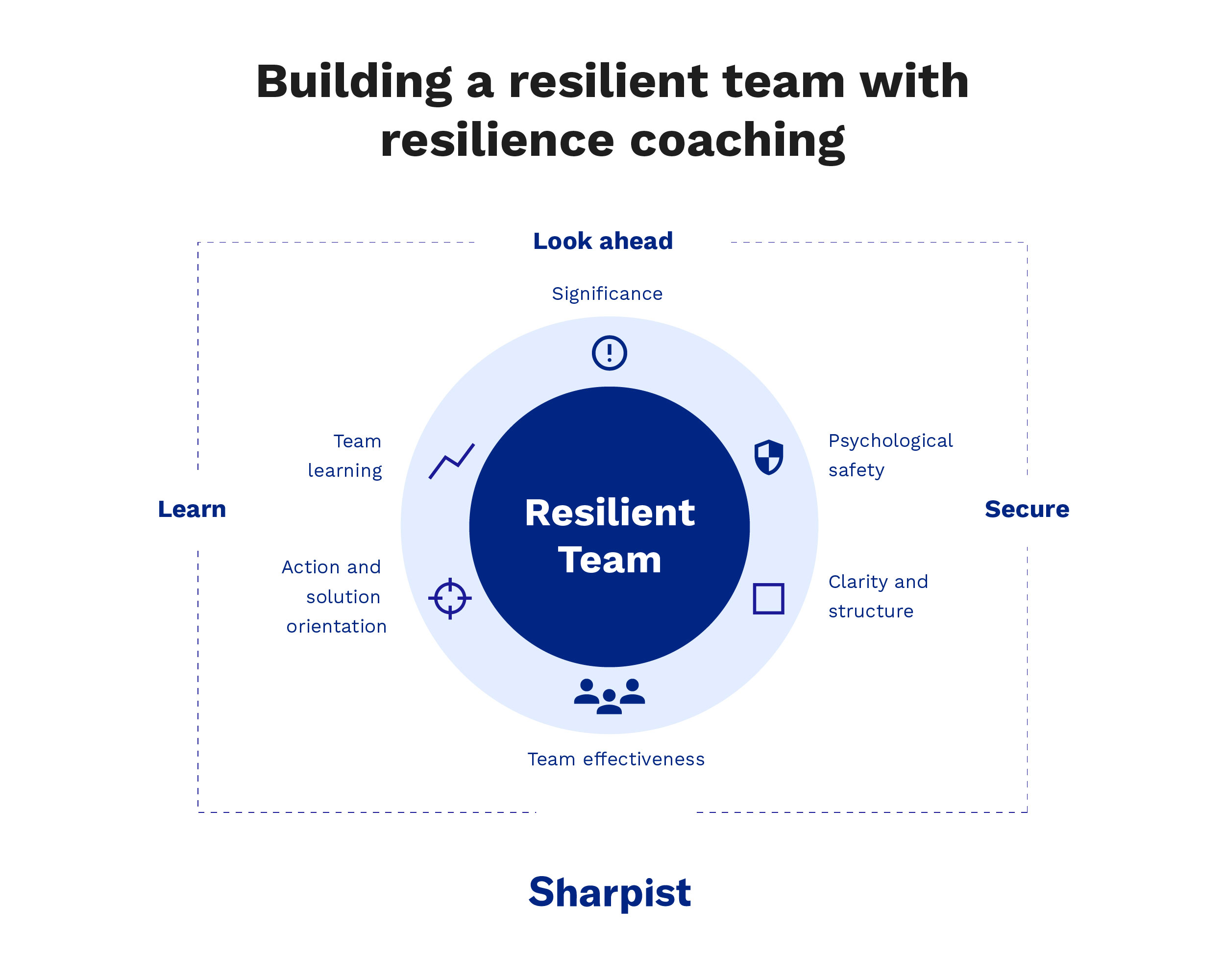
Professional resilience coaching follows a structured process that combines individual needs with evidence-based methods. The coach first works with the manager to analyze their current situation, stressors, and existing resilience factors. Based on this, individual development paths with clear goals are created that are tailored to the specific challenges in the client's work and life. At its core, resilience coaching works with three elements:
At Sharpist, executives also get access to a 24/7 coach chat for spontaneous support in challenging moments. Schedule a personal demo of our coaching platform now.
The 7 Pillars of Resilience in a Leadership Context
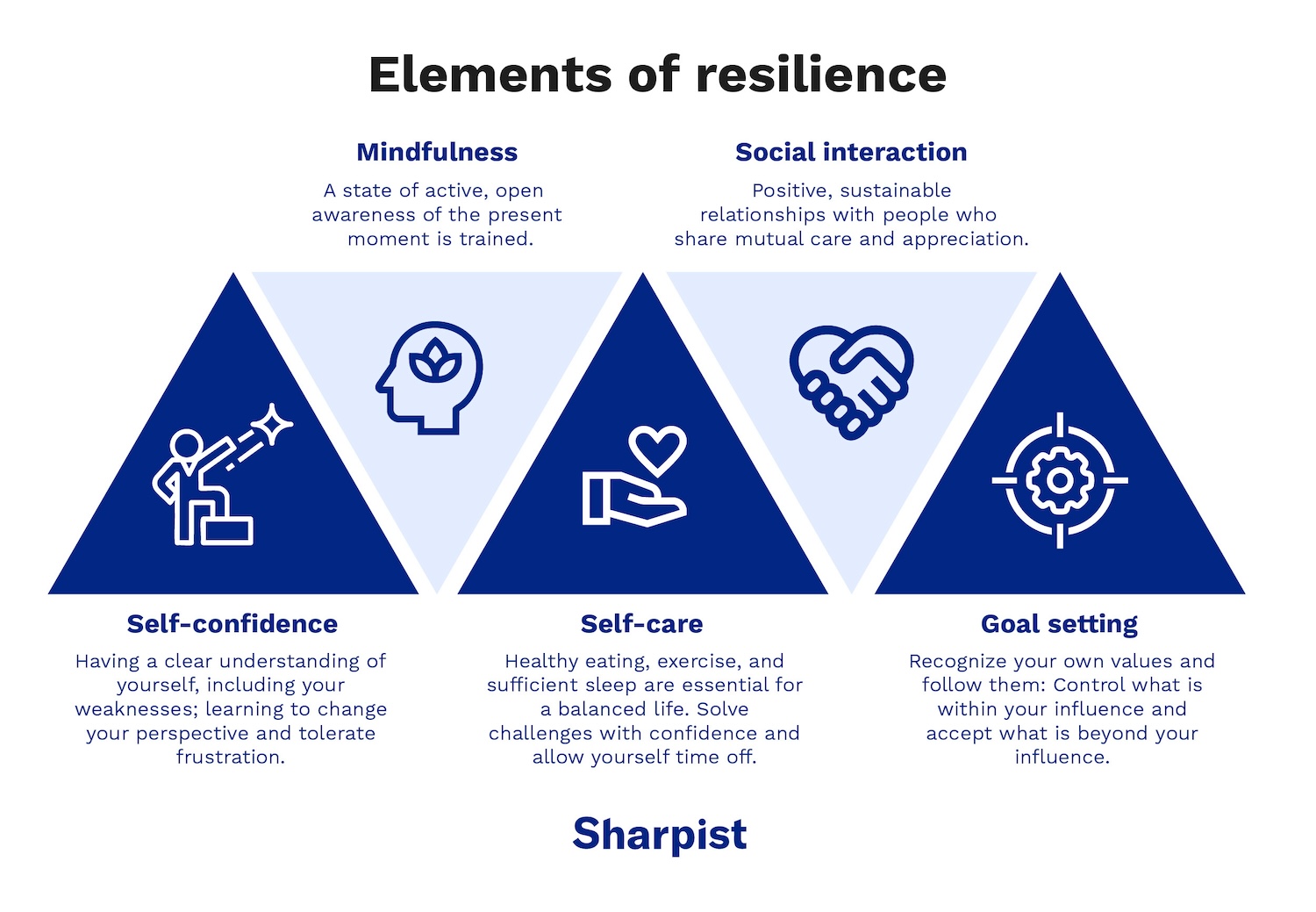
The established 7-pillar model of resilience provides a scientifically sound framework for the systematic development of resilience. Each pillar addresses a specific aspect of resilient behavior and is developed in a targeted manner during the coaching process. An anti-burnout resilience trainer uses this approach to protect people in companies from excessive demands and promote their long-term health.
These resilience factors are not taught theoretically in coaching, but are developed through targeted exercises and reflection in the individual leadership context. Sharpist offers specific micro tasks for each pillar in various modules that managers can implement in their everyday lives. These topics are addressed in a practical manner and are geared toward the specific needs of clients in their particular areas of life.
Why Resilience is a Critical Leadership Skill
The demands placed on managers have changed dramatically in recent years. Permanent transformation, hybrid working models, skills shortages, and geopolitical uncertainty create an environment of constant pressure. At the same time, employee expectations have risen: they demand authentic, empathetic leadership and psychological security – especially in turbulent times. These changes require people in leadership positions to develop new skills in dealing with stress and pressure.
Managers thus find themselves in a sandwich position: on the one hand, they must implement the strategic goals of the organization, and on the other hand, they must manage the emotional needs of their teams. Without strong resilience, this double burden leads to excessive stress, burnout, and ultimately to performance losses at all levels. Studies show, that 70% of team engagement variance can be attributed to the manager—resilient managers create resilient teams and thus protect the health of their employees.
The data is clear: manager engagement has fallen from 30% to 27%, and among young managers by as much as five percentage points. This development not only jeopardizes individual health, but also the productivity of entire companies. An anti-burnout resilience coach is therefore becoming a strategic necessity for organizations that want to be successful in volatile times. Promoting resilience through professional coaching is no longer a nice-to-have measure, but a business enabler.

The 5 Success Factors for Effective Resilience Coaching
Not all resilience coaching achieves the desired effect. The difference between superficial intervention and sustainable resilience development lies in five critical success factors. These determine whether managers actually strengthen their mental resilience or whether the coaching remains just another wellbeing offering with no measurable effect. Organizations that want to systematically develop resilience should prioritize these factors when selecting their coaching solution.
1. Professional Coach Matching With Leadership Experience
The relationship between coach and manager is the strongest predictor of coaching success. Trust is essential, especially in resilience coaching, which involves personal vulnerability and profound change. However, not every qualified coach is suitable for every manager – the chemistry must be right, and the coach must be familiar with the specific challenges of management from their own experience.
Qualification criteria should not be negotiable: ICF or DBVC certification, at least ten years of leadership experience, proven specialization in resilience, and a sound understanding of DACH corporate culture. At Sharpist, all 1,500+ coaches undergo a rigorous selection process that tests both their professional qualifications and their interpersonal skills. The result: 97% match success on the first attempt, typically within two hours. Unlike "dating app" approaches, matching is done specifically by algorithms that combine psychology and pragmatism.

2. Individual Development Paths Based on Evidence-Based Methods
A one-size-fits-all approach does not work in resilience coaching. A young leader with initial leadership experience requires different support than a senior executive with 20 years of leadership experience. While the former often work on self-efficacy and stress management, the latter focus on strategic resilience and the balance between performance and regeneration. A professional resilience coach adapts their approach to the individual needs of their clients.
Evidence-based methodological diversity is crucial: the 7-pillar model provides structure, cognitive behavioral therapy (CBT) addresses obstructive thought patterns, mindfulness exercises promote self-regulation, and systemic approaches broaden perspectives. Sharpist offers 32 focus areas across four categories: self-leadership, team leadership, organizational leadership, and strategic leadership. This diversity makes it possible to tailor the coaching process precisely to the manager's situation.
3. Integration Into Everyday Management Through Micro tasks
The 70-20-10 model of personnel development states that 70% of learning takes place "on the job," 20% through social interaction, and only 10% through formal training. Resilience coaching that is limited to face-to-face meetings thus wastes 70% of its potential. Micro tasks close this gap and translate insights from coaching into concrete behaviors in everyday life.
Micro tasks are short, practical exercises lasting no more than five minutes that are carried out between coaching sessions. They translate insights from coaching into concrete behaviors: a mindfulness exercise before difficult conversations, a reflection journal for stress triggers, a gratitude routine to strengthen optimism.
The effect is measurable: Sharpist data shows a 20% increase in learning efficiency through micro tasks. The 24/7 coach chat complements this approach: managers can spontaneously request support when challenges arise in everyday life – precisely when transfer is most important. This combination of structured coaching and flexible support makes the difference between knowledge and actual behavioral change.

4. Measurability and Tracking Through Real-Time Analytics
"You can't manage what you don't measure" – this management principle also applies to resilience coaching. Without measurability, coaching investments remain a matter of trust; without data, HR teams lack the basis for argumentation vis-à-vis the CFO. Professional resilience coaching makes development visible on three levels and provides concrete information about clients' progress.
The Sharpist L&D Dashboard offers real-time analytics with industry comparisons across 32 focus areas. HR teams can see not only how intensively coaching is being used, but also what organizational patterns are emerging. If many managers are working on "dealing with uncertainty" at the same time, this indicates systemic challenges. Pre-post comparisons after three, six, and twelve months document development and provide ROI evidence for the investment in resilience.
5. Scalability Without Loss of Quality
How can we systematically develop the resilience of 1,000+ executives without compromising quality and individuality? Traditional approaches – hiring external coaches individually, organizing in-person training sessions – reach their limits at this scale: administrative costs skyrocket, quality varies greatly, and costs are difficult to calculate. An anti-burnout resilience coach cannot support hundreds of people at the same time.
Digital coaching platforms act as scaling enablers: automated matching connects hundreds of executives with suitable coaches within hours. Flexible resource allocation through credit models enables needs-based allocation. Zero admin for HR means no appointment coordination, no invoice management, and no coach acquisition.
All Sharpist coaches are ICF or DBVC certified, with 99% satisfaction with coaching sessions and free coach changes if dissatisfied. The result: scaling without loss of quality, with measurable ROI and full transparency for HR. Organizations can thus systematically develop the resilience of their managers – from ten to a thousand people, without compromising on the quality of support or the impact of coaching.

Implement Resilience Coaching in a Scalable Way – With Sharpist
The effects of resilience coaching are evident on several levels: it strengthens the individual resilience of managers, systematically reduces burnout risks and, when implemented correctly, establishes a resilient leadership culture throughout the company. The key to success isn't the coaching itself, but how it's done in a way that's organized and can be scaled up. Sharpist is a digital coaching platform that brings together all five things you need for effective resilience coaching:
Schedule a personal consultation now and learn how Sharpist can transform your leadership development with systematic resilience coaching and measurable ROI.
FAQ
What is Resilience Coaching for Managers?
Resilience coaching is a specialized form of leadership development that systematically strengthens mental resilience. Through one-on-one coaching, evidence-based methods, and practical exercises, leaders develop the ability to remain capable of acting under pressure, emerge stronger from crises, and use change as an opportunity for growth.
Why Do Managers Need Special Resilience Coaching?
Managers find themselves caught between organizational goals and employee needs. They are under constant pressure, and their resilience directly influences team engagement (70% variance). Manager engagement has fallen from 30% to 27%—without targeted support, this jeopardizes the productivity of entire organizations.
What is the ROI of Resilience Coaching?
The average ROI of resilience coaching is 5–7x (ICF Global Study: 7:1, Manchester Inc.: 5.7x, PwC: 7x). 86% of companies report that they have recouped their investment in coaching. Preventive resilience coaching delivers a 6:1 ROI, while the cost of a burnout case among managers is EUR 31,000 plus 200 days of absence. Additional measurable business impacts: Organizations with a coaching culture see 51% lower turnover among highly engaged teams (Gallup), +29% self-efficacy, +39% stress management, and +40% motivation (BetterUp). The economic and human dimensions make resilience coaching a strategically sound investment.
How Long Does Resilience Coaching Take, and How is it Implemented?
Typical resilience coaching programs run for three to twelve months with regular sessions (every two to four weeks). At Sharpist, coach matching takes place within two hours, and after a digital kick-off, managers can start immediately. The minimum contract term is three months, after which monthly cancellation is possible.
.avif)







.svg)


%20(1).avif)