



.png)
.png)
.svg)

.png)
.png)


.png)


.png)


.svg)


.svg)

Why do so many AI rollouts fail not because of the technology, but because of the people behind it? Anyone who ignores AI fears within their team risks seeing million-dollar tool investments go to waste because nobody actually uses them. Sharpist demonstrates how coaching creates psychological safety and turns that into measurable AI adoption — with concrete results from practice.
The Topic in a Nutshell
Why AI Fears Should Be Taken Seriously
According to the EY European AI Barometer 2025, more than a third of German employees are concerned about the negative impact of AI on their jobs. At the same time, active AI usage in German companies doubled within a single year. This gap between technological progress and emotional readiness is the real problem underlying most AI transformations.
What lies behind this is not irrational resistance. Our brains are evolutionarily wired to initially classify the unknown as a potential threat. AI is perceived as particularly threatening — as a "black box" — because it challenges three fundamental psychological needs simultaneously:
Anyone who fears being replaced by a system that writes reports faster or analyzes data more precisely is not only questioning their job, but their professional identity. Sharpist addresses exactly these three dimensions through targeted 1:1 coaching that re-anchors competence, autonomy, and belonging in the context of AI.
From a neuroscientific perspective, this has direct consequences: when the brain perceives a social threat, cognitive resources are diverted away from the areas responsible for problem-solving. Psychological safety is therefore not a cultural nice-to-have — it is a physiological prerequisite for people to learn and embrace new things at all.
The Hidden Costs of Ignored Fears
When AI fears are not actively addressed, they rarely manifest as open rejection. More commonly, a subtle but costly form of resistance emerges: employees withhold their experiential knowledge from AI systems in order to preserve their indispensability. Tools are formally introduced but never seriously used.
In fear-driven cultures, mistakes in handling AI are covered up, leading to costly correction loops. How change management coaching breaks through these dynamics is a question of the right framework — not the right training slide. Sharpist helps companies recognize these dynamics early, with data-driven progress tracking and more than 1,500 certified coaches.
Psychological Safety: What It Really Means
The concept of psychological safety was significantly shaped by Harvard Professor Amy Edmondson. It describes a work climate in which employees can take interpersonal risks without fearing negative consequences. A common misconception is equating it with "niceness" or the absence of conflict. In reality, psychological safety means the opposite: high standards combined with high openness. Professional objections — even to AI-driven management decisions — are not treated as personal attacks, but as contributions to collective intelligence.
For AI transformations, this distinction is crucial. Teams with high psychological safety adapt new AI processes significantly faster, because they can openly address and collectively resolve mistakes when working with new tools. As stated in the Infosys/MIT study, psychological safety is not a soft metric — it is a central success factor for AI implementation.
Why Classic Approaches Are Not Enough for AI Fears
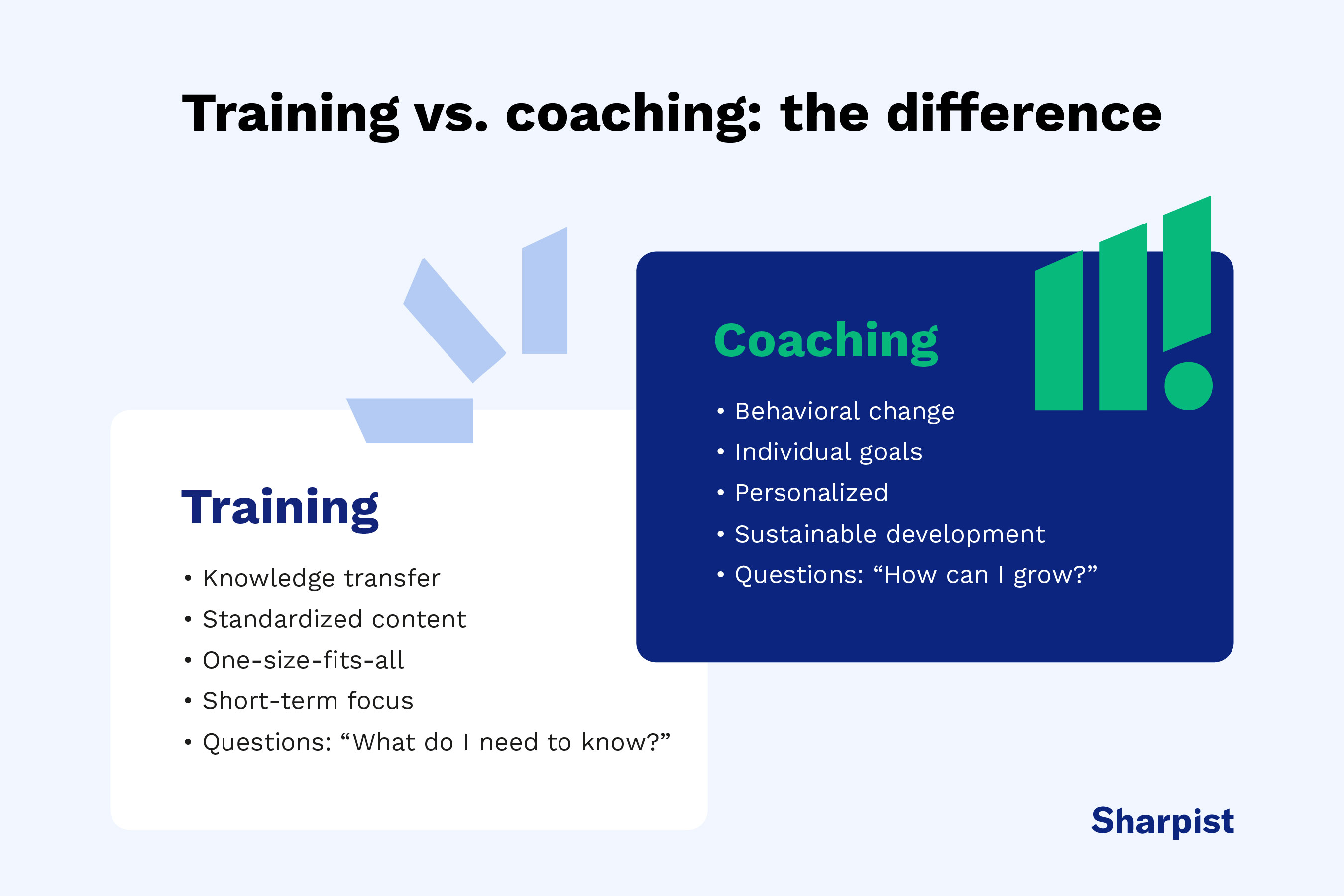
Most companies respond to AI resistance with the same toolkit they use for any other change: information campaigns, town halls, half-day training sessions. This falls short for a structural reason: AI change is fundamentally different from traditional change. Traditional change management works with defined phases and a clear endpoint. AI adoption has no endpoint. It is a continuous process in which the technology evolves faster than any training program can keep up.
Training addresses knowledge gaps. But AI fears are not a knowledge gap — they are an emotional processing problem. Someone who spends three hours learning how an AI tool works may come away with more knowledge, but not necessarily less fear. Even more problematic is the middle management issue: two thirds of executives neither have sufficient technological competence nor transformation experience for AI projects. They cannot guide their teams through an uncertainty they have not yet processed themselves.
Coaching as the Key: Building Psychological Safety Structurally
Coaching works on two levels simultaneously in the AI context. First, it creates the safe reflective space in which leaders can work through their own uncertainties, feelings of loss of control, and questions of identity around AI — without risking loss of face. Second, it empowers them to create exactly that space for their teams. Leaders who have experienced psychological safety themselves can pass it on.
AI Coaching as a Double Lever
Here lies an approach many HR teams are not yet utilizing: AI is simultaneously the source of fear and the solution instrument. Employees who first encounter AI in a non-judgmental, supportive context develop a fundamentally different relationship with the technology than those who have AI imposed on them directly as a work tool. Sharpist's AI Coach provides exactly this space: a personalized virtual coach available 24/7, operating with full encryption and capable of communicating in five different coaching styles. Someone who first experiences AI as support when preparing for a difficult conversation carries a very different set of expectations into the next AI rollout.
In addition, personalized micro tasks help integrate learning into everyday work without creating extra burden. Tasks of no more than five minutes, linked to real-life situations, replace large-scale training sessions with continuous, practical reflection.
From the Status Quo to Implementation: A Five-Phase Plan
How can this be operationalized in practice? The following framework is based on proven change management practice, adapted to the specific characteristics of AI transformations.
Turning AI Fears into Measurable AI Acceptance — with Coaching from Sharpist
Sharpist addresses the core problem of AI transformation on multiple levels simultaneously. The hybrid model combining 1:1 video coaching with certified business coaches and the AI Coach delivers both the emotional depth and the scalability that HR decision-makers need for company-wide transformations. Leaders receive the safe reflective space they need to work through their own AI uncertainties and anchor psychological safety within their teams. Employees experience AI first as a supportive tool before encountering it in their specific area of work.
With coaching from Sharpist, you bring technology and employees together successfully — scalable, data-driven, and with measurable impact.
FAQ
How does AI change differ from classic change management?
Classic change management works with defined phases and a clear endpoint. AI adoption has no endpoint: the technology evolves continuously, keeping employees in a permanent state of adaptation. This requires continuous support rather than one-off training measures, and leaders who have themselves learned to navigate uncertainty.
Why aren't training sessions alone enough to reduce AI fears?
Training addresses knowledge gaps, not emotional resistance. AI fears arise from identity threats, loss of autonomy, and uncertainty about one's own future — dimensions that no training program systematically works through. Coaching creates the reflective space needed to process these emotions and translate them into constructive action.
How can psychological safety be measured within an organization?
Psychological safety can be quantified using validated instruments. The measurement tool by Fischer & Hüttermann (2020) is freely available via GESIS and captures team perception through concrete statements. Short pulse surveys following rollout phases are also appropriate, as is the analysis of digital tool usage data as an indirect signal of genuine acceptance.
How do you scale coaching-based AI support to hundreds of leaders?
The key lies in the multiplier principle: leaders who have experienced psychological safety through 1:1 coaching pass on that mindset to their teams. In addition, digital coaching platforms like Sharpist enable scaling without loss of quality — with 80–90% activation rates and real-time tracking of progress at the organizational level.
What is the EU AI Act and what obligations does it create for HR?
The training obligation under Article 4 of the AI Regulation has been in effect since February 2025. It requires companies to ensure that employees have a sufficient basic understanding of AI. From August 2026, penalty frameworks will apply. Coaching goes beyond mere compliance: it anchors not just knowledge, but the willingness to use AI competently and reflectively.
.avif)







.svg)


%20(1).avif)