



.png)
.png)
.svg)

.png)
.png)


.png)


.png)


.svg)


.svg)

Digital coaching is not a one-size-fits-all product – and it shouldn't be. Whether a program works depends on more than just the price. Learn which cost factors truly matter, which costs are often overlooked, and why coaching from Sharpist adapts to your organization's culture, processes, and specific development goals.
The Topic in a Nutshell
What Influences the Cost of Digital Coaching?
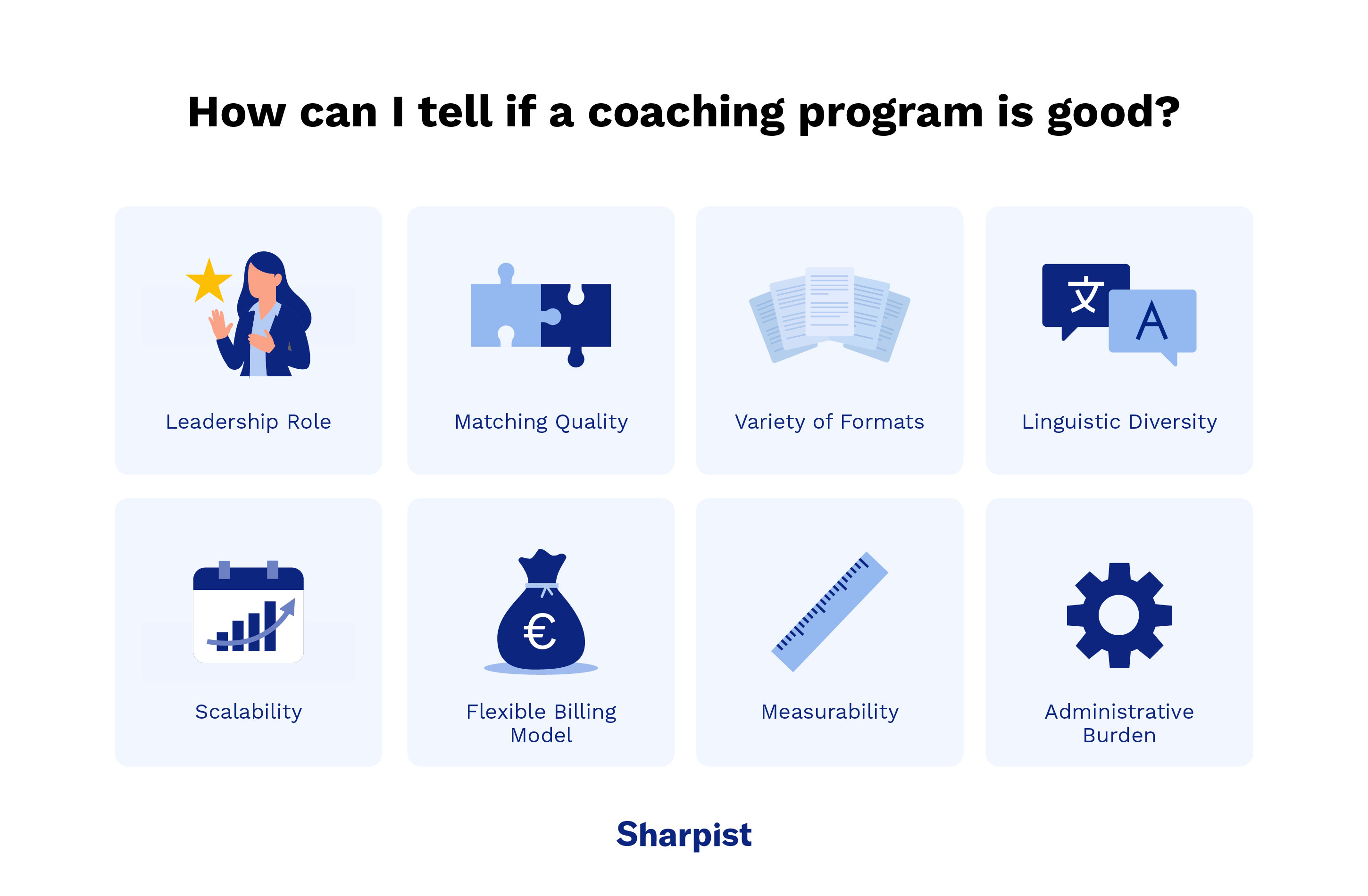
The cost of digital coaching varies considerably. There's a world of difference between a freelance coach at €173 per hour and an enterprise platform with a credit model. But scalable enterprise solutions operate on different pricing models. The following four factors influence the price.
1. Coach Qualifications and Certification
A coach's experience and certification directly influence the price. ICF- or DBVC-certified coaches undergo rigorous training standards, which are reflected in higher hourly rates.
At the same time: prices that seem too low should also raise red flags. Quality within the coach pool is not a question of luxury – it is a prerequisite for effectiveness. That's why Sharpist relies on over 1,500 certified coaches and achieves a coach matching success rate of 97% on the first attempt. This means not just that your leaders get a good coach – but the right coach for their specific situation, industry, and company culture.
2. Program Format and Scope
Not every coaching format costs the same. What matters is which methods a program combines and how extensive the program is. The following table provides an overview of typical formats and their cost structures:
3. Scalability – Coaching for 10 or 1,000 Leaders
As the number of participants grows, the billing model becomes the decisive cost factor. Many providers rely on rigid flat-rate models. The problem: companies that buy 100 licenses but only actively use 30 are financing 70% idle capacity. The money flows, while development stalls.
Sharpist's credit system works differently. Credits are transferable between employees and can be flexibly applied to different session formats – whether 30 or 60 minutes, 1:1 or group. Unused resources are redistributed rather than wasted. True scalability doesn't simply mean "more users" – it means smarter resource allocation. This way, you maintain cost control even as your program grows from 10 to 1,000 leaders.
4. Language and Regional Coverage
International companies require coaching in multiple languages and time zones. Without this coverage, expensive parallel solutions emerge: local coaching agencies in each country, separate contracts, inconsistent quality standards. This drives both costs and administrative overhead upward.
Sharpist addresses this challenge with a global pool of over 1,500 coaches across 55+ languages. Coach matching happens within 2 hours. This is particularly relevant for DACH companies with international locations: hidden champions and large corporations rolling out their leadership development across sites avoid fragmented processes and maintain centralized access to the coaching platform across all regions.
Digital Coaching vs. Traditional Alternatives – A Comparison for Companies
Understanding the cost factors of coaching enables better comparison of offerings. But even the best offering can become a cost trap – if the program isn't adopted in practice. A coaching program that no one uses is expensive. The hidden costs of poor solutions frequently exceed the original purchase price by far. What matters is not the price per session alone, but the full equation of cost structure, efficiency, and measurable impact. The following comparison between in-person coaching, e-learning platforms, and digital coaching illustrates how significantly the individual models differ.
1. In-Person Coaching
In-person coaching offers intensive, personal support, but comes with high individual costs. Hourly rates range from €150–400, with additional travel, venue, and preparation costs. With in-person formats, travel and logistics significantly extend the actual time investment per session.
On top of that: coachee absences are difficult to compensate, results are nearly impossible to measure in a standardized way, and scaling beyond individual locations is organizationally demanding. For the individual development of senior executives, in-person coaching remains a strong method. For company-wide programs, it is simply not economically viable.
2. E-Learning and Content Libraries
Many providers appear inexpensive at first glance. Yet activation rates typically sit at only 10–20%. The majority of the invested budget evaporates without producing measurable behavioral change or learning progress.
The hidden costs are substantial: unspent budget, absent goal-setting, and no individual relevance to the challenges leaders actually face. The problem lies not in the content itself, but in the lack of personalization and the missing human element. A low license price is irrelevant when 80% of the investment produces no results.
3. Digital Coaching with a Platform
Digital coaching platforms combine the advantages of both worlds: as scalable as e-learning, as effective as personal coaching. Sharpist's hybrid approach combines 1:1 coaching with certified coaches, AI-supported coaching for everyday use, and personalized micro tasks between sessions.
Through this approach, Sharpist achieves activation rates of 80–90%. Utilization and impact are not left to chance – they are managed in real time via the L&D dashboard. HR teams receive evidence-based data rather than gut feeling.
The following overview summarizes the three methods:
Activation rates, scalability, and language coverage are important criteria. But the decisive factor is fit: Is the program tailored to the company's culture, processes, and concrete development goals – or is a standard package simply rolled out?
Sharpist is built from the ground up for the former. It starts with coach matching that incorporates industry experience and company context, and extends to the program structure, which is aligned with the specific leadership goals of your organization.

The Hidden Costs of Poor Coaching Solutions
What a coaching program costs is rarely stated in full in any proposal. Yet the costs generated by poor coaching place the greatest burden on companies. The following factors are therefore essential for HR teams to understand when evaluating their coaching investment.
1. Turnover and Talent Retention
Leaders who find no development opportunities within a company will seek them elsewhere. According to studies, the replacement cost for a leader amounts to 1.5 to 2 times their annual salary. At a salary of €120,000, that means €180,000–240,000 per departure.
That effective coaching counters these costs is demonstrated by a Sharpist client result: during a comprehensive restructuring at Miro, 100% of key personnel remained with the company. Coaching is therefore not simply an expense – it is an insurance policy against turnover costs. Those who cut back on employee retention measures pay a multiple of that cost elsewhere.
2. Low Utilization Rates and Evaporating Budgets
A company purchases 100 coaching licenses, but only 20 people actually use the offering. That means: 80% of the budget is financing non-usage. Per person actually coached, the company pays five times more than originally planned.
The difference between providers is stark. While e-learning platforms achieve activation rates of 10–20%, Sharpist operates at 80–90%. The credit system amplifies this effect further: unused credits can be flexibly redistributed to more active participants rather than expiring. This keeps the money where it creates impact.
3. Administrative Overhead as an Underestimated Cost Factor
Manual coach sourcing, scheduling, contract management, inefficient reporting: all of these processes cost HR teams valuable hours. At an average HR hourly rate, this overhead quickly accumulates into a significant hidden cost factor that appears in no coaching contract.
ROI Over Price – How Companies Should Evaluate Coaching Investments
It is not the cost of digital coaching that determines a program's success – it is the measurable added value. Companies that view coaching as an investment rather than a cost center steer their programs based on concrete metrics. Three of these are particularly meaningful – and Sharpist clients demonstrate how they can be measured in practice.
1. Measurable Leadership Competencies as a Success Criterion
Leadership development is only a compelling argument to senior management when progress can be expressed in numbers. This is precisely where many coaching programs fail: the right tools for systematic tracking are missing.
Sharpist relies on a transparent dashboard: at LVMH, leadership competencies increased by +18%; at IKEA, the leadership index improved by +8–10%. Both results were captured through data-driven tracking in the L&D dashboard – not through subjective assessments. For CHROs who need to defend their budgets, this is decisive: those who cannot measure the impact of coaching cannot justify it to the board.
2. Performance and Engagement as Business Impact
Coaching reaches far beyond soft skills. It influences measurable business outcomes that directly contribute to operational performance. Engaged leaders make better decisions, retain their teams more effectively, and reduce turnover. They create a work environment where people want to stay and grow. Coaching is therefore not a "nice-to-have" alongside day-to-day operations. It is a lever for operational performance that manifests in productivity, employee retention, and company culture.
3. The L&D Dashboard as a Management Tool
Evidence-based decisions replace gut-feel budgeting – provided the right data is available. Good digital coaching should therefore make concrete results visible and traceable. Sharpist's L&D dashboard delivers exactly that:
For HR leaders who need to justify coaching investments, this is the difference between "We believe coaching works" and "We can show that coaching works."
Achieving Sustainable Change Through Digital Coaching with Sharpist
The cost of digital coaching is not a fixed value. It depends on coach qualifications, program format, scalability, and above all, the value created. Companies that focus solely on price overlook the truly relevant question: what does it cost when coaching doesn't work? Turnover, evaporating budgets, and administrative overhead are the real cost drivers.
Sharpist delivers the answer in numbers:
Rather than opting for the cheapest provider, the focus should be on proven impact.
FAQ
How do I know whether a digital coaching offering is worth its price?
Look for activation rates, coach certifications (ICF/DBVC), measurable results, and a transparent billing model. Low utilization rates are the clearest warning sign. They indicate that the program isn't working – regardless of the price.
How can the ROI of a coaching program be calculated for companies?
Relevant metrics include leadership competency development, engagement rates, turnover costs, and productivity gains. Tools such as Sharpist's L&D dashboard and ROI calculator help capture these figures systematically and translate them into a concrete business case.
What is the difference between a credit system and a flat-rate model?
With a flat-rate model, companies pay a fixed amount – regardless of actual usage. With Sharpist's credit system, credits are distributed flexibly and can be transferred between employees and formats. This prevents unused budget.
How many employees can participate in a digital coaching program simultaneously?
Digital coaching platforms like Sharpist are designed for companies with hundreds to thousands of participants. Thanks to the global coach pool with over 1,500 coaches across 55+ languages, programs can be rolled out across locations and languages.
.avif)







.svg)


%20(1).avif)