



.png)
.png)
.svg)

.png)
.png)


.png)


.png)


.svg)


.svg)

The real question is no longer "human coach or AI coach" but: when should organizations use which solution – and when is the combination of both the smartest approach? This article gives you clear guidance – and shows how you can achieve measurable results with Sharpist's hybrid coaching approach that neither pure AI nor pure human coaching solutions can deliver.
The Topic in a Nutshell
What Is AI Coaching?
AI coaching describes the use of artificial intelligence in coaching conversations – from text-based chatbots to voice-controlled coaching avatars. Two forms can be distinguished: simulators, used alongside human business coaching, and expert systems, which conduct coaching conversations independently – entirely without a human coach.
Current AI coaching systems are based on so-called "weak AI" It works efficiently on clearly defined tasks, but does not think like a human. According to Harvard Business Review, therapeutic support, life organization, and the search for meaning rank among the three most common AI use cases – all of them coaching-relevant.
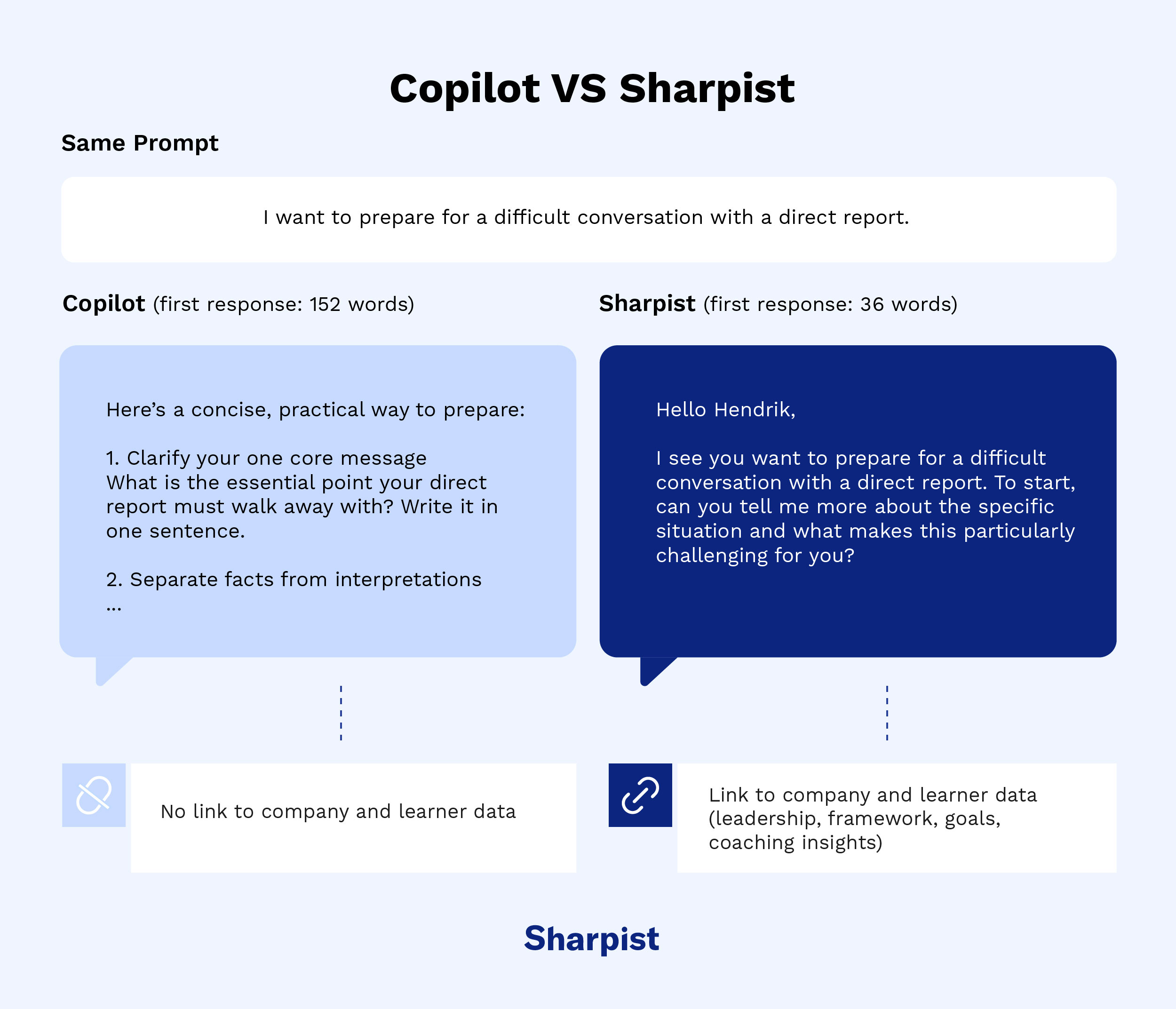
The Sharpist AI coach is an example of a specialized, coaching-native AI coach. Unlike generic tools such as ChatGPT or Claude, it was developed specifically for real coaching conversations – with five selectable coaching styles, structured session summaries, and continuous journeys that preserve the context of previous conversations.
Strengths and Weaknesses of AI Coaches
AI coaches bring clear strengths that human coaches simply cannot offer. At the same time, there are limitations and risks you should be aware of. An honest look at both sides helps you make the right decision for your organization.
Around-the-Clock Availability
A leader is preparing for a difficult feedback conversation the next morning. Thoughts are racing, and the next coaching appointment is two weeks away. This is where an AI coach demonstrates its greatest practical advantage: it is available around the clock, with no scheduling required.
According to a Conference Board study, 90% of respondents find AI coaching easy and convenient to use. The Sharpist AI coach, for example, draws on the context of previous conversations so that reflection can continue seamlessly.
Scalability and Lower Costs
For a long time, coaching was a privilege reserved for senior leadership. For hundreds or thousands of employees, the resources simply weren't there. AI is fundamentally changing this reality. Suddenly, employees who have never benefited from coaching gain access to it. With its AI coach, Sharpist brings the power of business coaching from the boardroom to the shop floor.
Neutrality and Objectivity
A human coach cannot notice every detail or retain all information during a multi-hour session. AI coaches leverage all input from sessions and recognize patterns that humans miss. They can also avoid confirmation bias – the tendency to only hear what confirms one's own opinion.
At the same time: AI is neutral, but not impartial in the human sense. It calculates probabilities. At Sharpist, 16 quality assurance agents automatically review every session against ICF competencies and professional standards to guarantee one hundred percent quality.
Personalization Through Data and Progress Tracking
True personalization goes far beyond generic chatbot responses. The Sharpist AI coach links data from human coaching sessions (transcribed and anonymized), learning progress, and organizational context to address personal goals. This gives rise to continuous journeys: the AI coach knows your board meeting was last Thursday and proactively asks how it went. Session summaries with concrete action items round off every session.
Risks: Data Privacy, Bias, and Lack of Accountability
As promising as AI coaching is – there are risks you should know about:
Sharpist addresses these risks directly: enterprise-grade privacy in accordance with GDPR requirements, no use of data for AI training, complete deletion capability, an encrypted personal data vault, and data hosted within the EU.

The Strengths of Human Coaches
Despite all advances in AI coaching, there are areas where human coaches clearly remain superior. Especially when it comes to genuine relationships, emotional depth, and accountability, artificial intelligence reaches its limits. The following three aspects illustrate why the human coach remains indispensable even in an era of powerful AI tools.
Genuine Empathy and Human Connection
The relationship between coach and coachee is the most important factor for coaching success. A human coach brings personal investment, embodied resonance, and authentic perspective. This creates a shared relational space that AI cannot generate.
AI may sound empathetic, but it cannot build real connections. Humor, metaphors, lived experience – all of this is absent. AI conversations remain on a level that is helpful for everyday reflection, but does not reach the deeper layers of human development. This is precisely why Sharpist relies on the hybrid approach rather than pure AI solutions.
Handling Complexity and Depth
Human business coaching becomes indispensable when it comes to inner conflicts, ambivalent decisions, or deeply personal topics. Coaching leaders who are torn by inner conflicts is not something currently entrusted to any AI. Human expertise remains critical for emotionally charged or values-based discussions. For genuine transformation – the moment when perspectives fundamentally shift – the human element is still essential.
Accountability in Critical Situations
A human coach assumes responsibility within the relationship. They recognize when someone is in crisis, can escalate, set boundaries, and refer to therapeutic support. Generic AI such as Copilot cannot do this.
At Sharpist, the human coach remains as an anchor point in the hybrid model. Clear escalation paths ensure that empathy and accountability are not simply delegated to a machine, but remain where they belong: with the human.
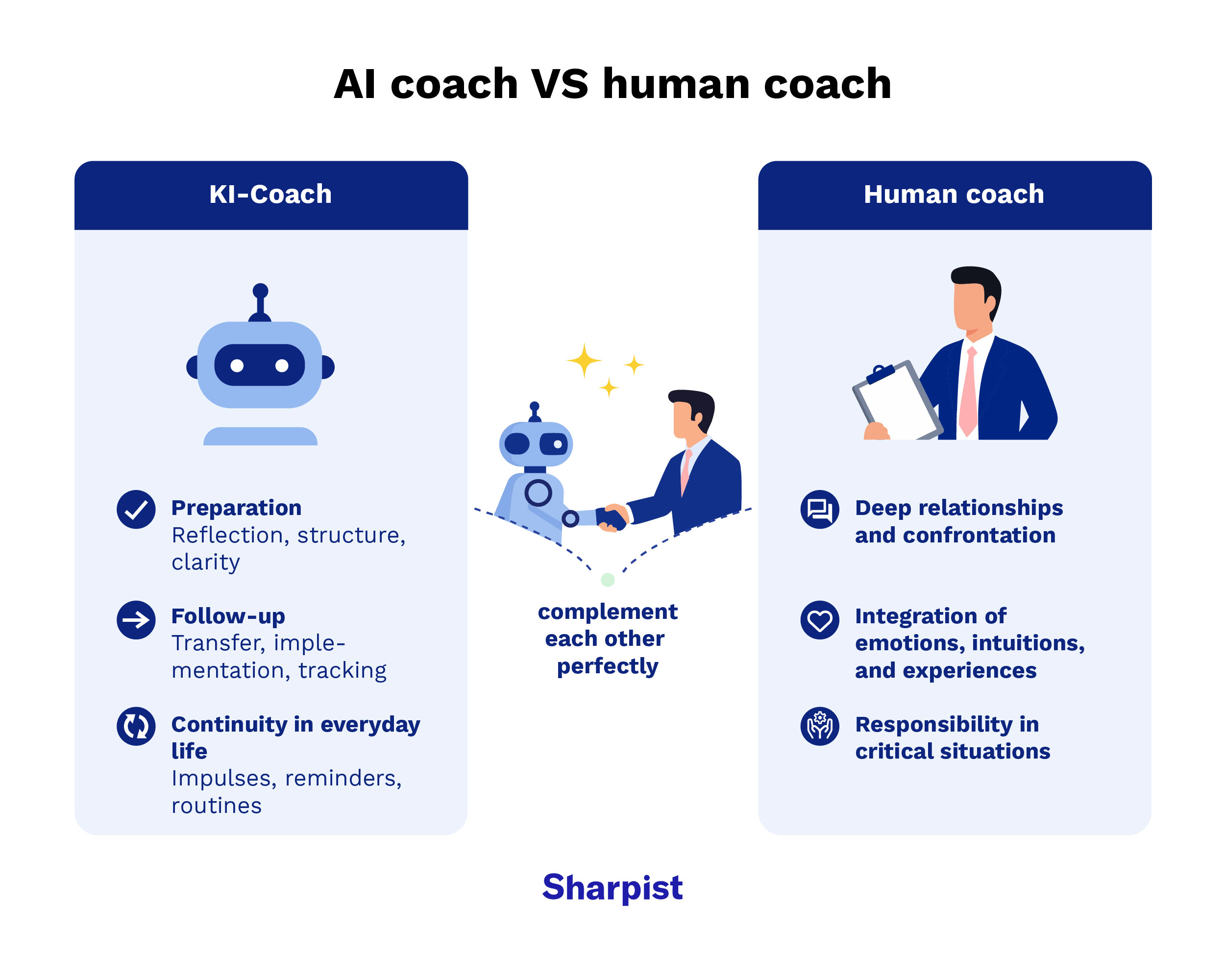
AI Coach vs. Human Coach: When Is Each Solution the Right Choice?
Whether an AI coach, a human coach, or a combination of both is the best choice depends on the specific use case. The following overview shows when each approach plays to its strengths.
A critical point that pure AI solutions often overlook: retention remains a challenge. With pure AI providers, the average session duration is just 7 minutes. The hybrid model addresses this problem directly. The human coach creates commitment, connection, and depth, while the AI ensures continuity, availability, and data-driven impulses around the clock.
AI Coach and Human Coach as a Team – How Your Organization Benefits with Sharpist
When it comes to coaching, the choice should not be between an AI coach and a human coach – because the most effective model is a hybrid solution combining both. Sharpist is among the first platforms to seamlessly unite AI and human coaching in a single hybrid journey. The process is clearly structured:
The results speak for themselves:
FAQ
What Is the Difference Between an AI Coach and a Human Coach?
An AI coach is an AI-powered system that conducts coaching conversations around the clock and provides data-driven impulses. A human coach brings genuine empathy, personal experience, and the ability to navigate complex emotional situations. Both complement each other ideally.
Can an AI Coach Fully Replace a Human Coach?
No. AI coaches cover up to 90% of everyday coaching functions. For emotionally charged, values-based, or politically sensitive topics, however, human expertise remains indispensable. The hybrid model delivers the best results.
Which Employees Benefit Most from AI Coaching?
AI coaching is suitable for all employees in an organization who need everyday reflection, onboarding support, or quick impulses. The Sharpist AI coach can also serve as a mentor or sparring partner.
How Secure Is My Data with AI Coaching?
That depends on the provider. At Sharpist, all data is encrypted, hosted on servers in Germany, and is not used for AI training.
What Is Hybrid Coaching?
Hybrid coaching combines human 1:1 coaching with AI-powered coaching. The AI handles everyday reflection, preparation, and follow-up, while the human coach contributes depth, empathy, and accountability. Sharpist seamlessly connects both in a single platform.
.avif)







.svg)


%20(1).avif)