



.png)
.png)
.svg)

.png)
.png)


.png)


.png)


.svg)


.svg)

Can algorithms develop leaders? The question sounds provocative, yet it keeps HR teams worldwide busy. As digitalization advances, AI coaching is gaining rapid traction – but practice shows that neither pure AI solutions nor exclusively human coaches deliver optimal results. The future lies in the intelligent combination of both approaches. This article shows when each approach works, where AI reaches its limits, and how hybrid coaching makes leadership development scalable without sacrificing human depth.
The Topic in a Nutshell
What Is AI Coaching?
AI coaching, also known as AI-coaching, refers to digital coaching systems based on artificial intelligence that are capable of conducting personalized coaching conversations autonomously. The technological foundation consists of natural language processing and machine learning. Currently, these are so-called "weak AI" systems – tools that operate efficiently within a clearly defined problem space but cannot perceive changes outside that framework.
An AI coach can, for example, conduct goal clarification through targeted questions: "What exactly would you like to achieve over the next three months?" This type of structured goal setting can be fully automated. Typical use cases include personality assessments, practice exercises between sessions, and push notifications that prompt new behaviors.
The Sharpist AI Coach is an example of a specialized, coaching-native AI coach. Unlike generic tools such as Copilot or ChatGPT, it was purpose-built for real coaching conversations. Five selectable coaching styles – ranging from analytical to energizing – enable individual adaptation to the personality and needs of each learner.
In addition, there are structured session summaries with concrete action items and Continuous Journeys that preserve the context of previous conversations. Furthermore, the AI coach can be linked to a company's specific leadership principles – meaning it speaks the same language as the organization and integrates seamlessly into existing leadership frameworks. The result is not an isolated one-off session, but a coherent learning journey.
AI Coach vs. Human Coach: The Key Differences
For HR teams introducing organization-wide coaching programs, the structural differences between AI-powered and human coaching are highly relevant. An AI coach is available around the clock and ready to use instantly, with no waiting times. Human coaches, by contrast, work by appointment and have limited capacity. In terms of scalability, AI can work simultaneously with the entire workforce, whereas human coaching depends on coach availability.
The most important difference becomes apparent at the relationship level. While AI can simulate empathy, genuine connection remains the domain of human coaches. Studies show that relationships with AI coaches take longer to develop and are more susceptible to loss of trust. Contextual understanding also differs between the two approaches: AI is limited to programmed scenarios, while human coaches can grasp complex organizational dynamics.
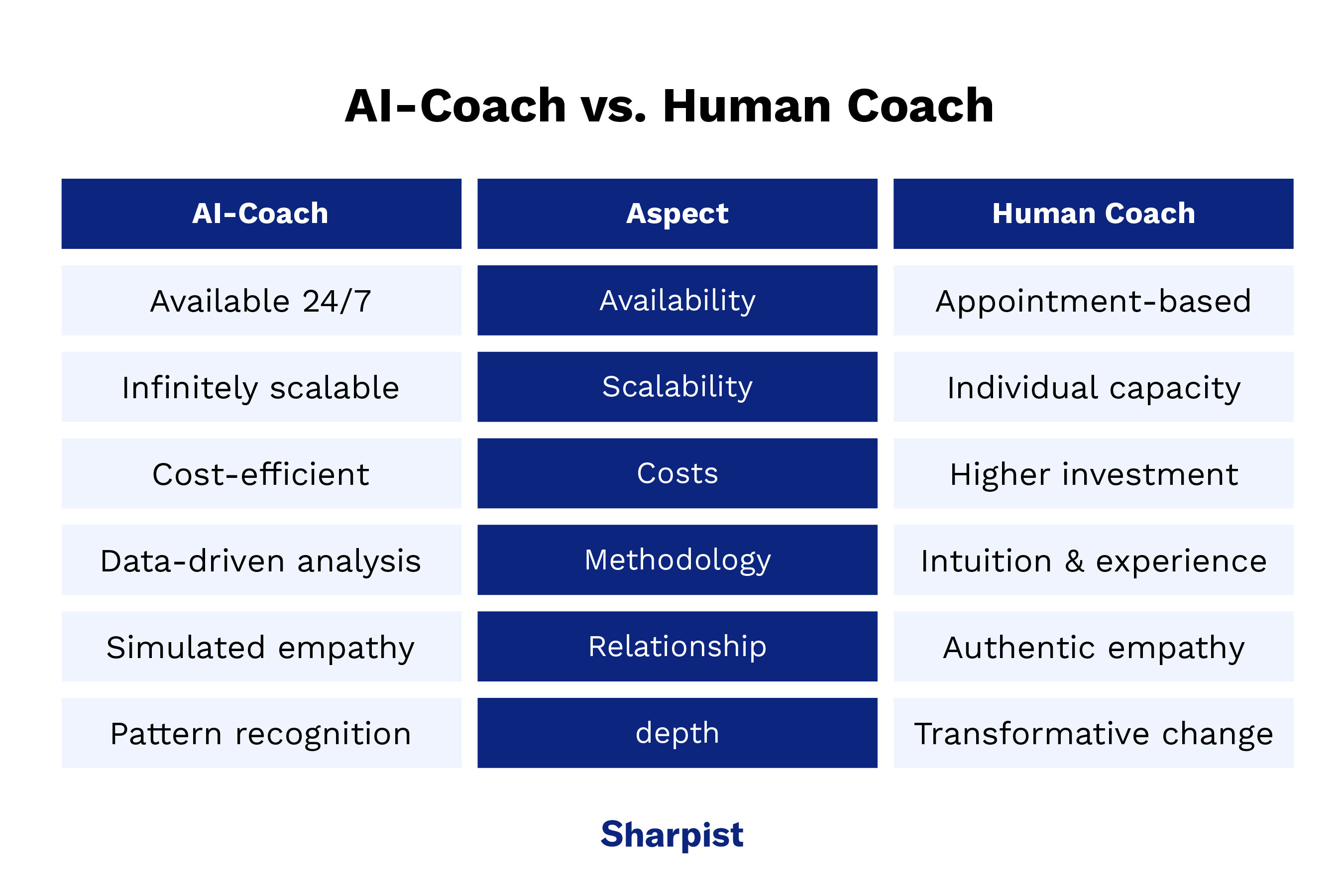
The strength of modern AI tools lies in data analysis and consistency. They identify patterns across large datasets, deliver aggregated insights, and ensure reproducible quality across all organizational units. At the same time, the AI coach is available to learners precisely when the human coach is not: between sessions. They can pick up where the last conversation left off, reflect on their insights, and receive concrete guidance based on their active goals. Human coaches, by contrast, bring subjective perceptions and individual coaching styles.
The flexible credit model from Sharpist enables HR teams to combine both approaches as needed: AI-powered micro tasks support continuous learning, while human coaches guide strategic transformation processes.
What Can AI Do in Coaching – and What Can't It?
Successfully integrating AI in business coaching requires HR teams to accurately assess the actual capabilities and limitations of this technology. Only when strengths are deliberately leveraged and weaknesses are offset by human coaches does measurable added value emerge.
Strengths of AI in Coaching
AI coaching offers clear advantages in the scalable delivery of development programs:
Research underscores the potential: AI-powered coaching elements have been shown to measurably increase productivity and employee engagement.
Limitations of AI in Coaching
HR teams must account for the following limitations when integrating AI:
A study by the Lucerne University of Applied Sciences found that without human oversight, AI frequently produces inappropriate responses and loses the thread of the conversation. Coaches must continuously review AI-generated content.
Hybrid Coaching: The Best of Both Worlds
Hybrid coaching – also referred to as "blended coaching" – combines AI-powered tools with human coaches into an integrated system. This approach leverages the scalability of AI while human coaches contribute empathy and strategic guidance. In practice, hybrid coaching operates as a cycle of four phases. During preparation, AI handles tasks such as personality assessments, goal clarification, and scheduling – so the coachee arrives at the session well-prepared.
Delivery rests with the human coach, who enables deep reflection through empathetic conversation, strategic interventions, and contextual framing. Between sessions, AI steps in again, assigning micro tasks, sending reminders, and tracking progress to keep development moving forward continuously. Finally, the data collected provides HR teams with aggregated analyses to inform strategic decisions.
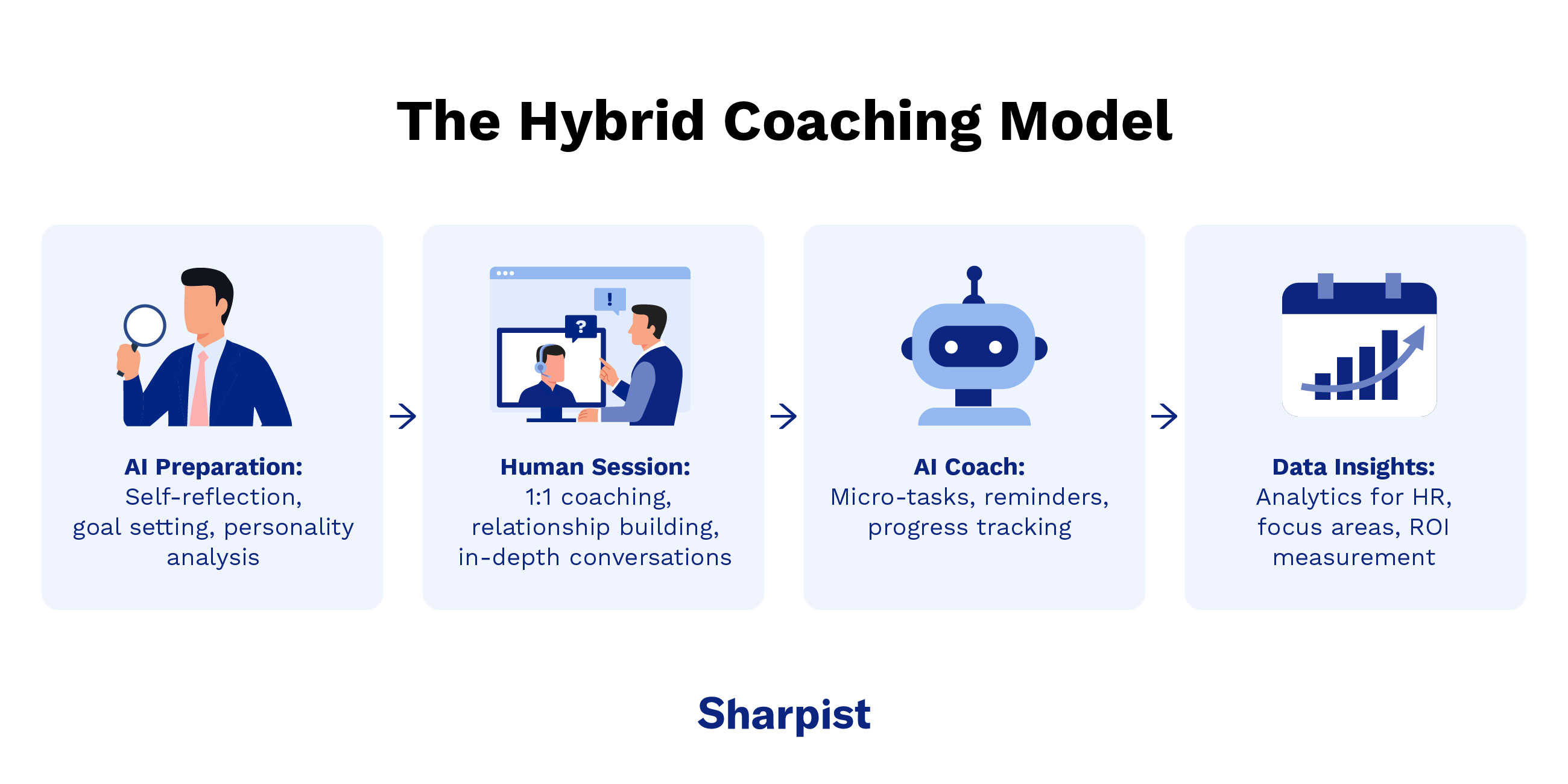
Sharpist achieves activation rates of 80 to 90 percent with hybrid learning approaches, while pure e-learning platforms reach only 10 to 20 percent. This combination leads to a lasting improvement in leadership structures – not merely isolated one-off measures.
AI in Coaching: Which Approach, and When?
HR teams need clear criteria for choosing the right approach. The decision depends on the coaching objective, the target group, and the level of complexity required.
Examples from coaching practice illustrate the decision logic: Onboarding new leaders with standardized competencies is ideally suited to AI coaching. Supporting C-level executives through organizational crises, by contrast, requires human coaching with empathy and contextual understanding. Leadership development in middle management, change accompaniment, and systematic skill-building such as feedback competencies all benefit from hybrid models.
Hybrid Coaching with Sharpist: Scalable, Measurable, Human
The future of leadership development lies neither in pure AI nor in exclusively human coaching. The hybrid approach resolves a central dilemma for HR teams: how to roll out coaching across the entire organization without compromising on quality. Sharpist demonstrates how this works in practice – with 1:1 video coaching from over 1,500 certified coaches and over 2,000 AI-powered micro tasks for continuous learning between sessions.
The Benefits for HR Teams:
The high satisfaction scores from coaching sessions clearly demonstrate that the human element remains at the center. Artificial intelligence serves as a supporting tool – it does not replace the human.
The Sharpist AI Coach: Professional Coaching, Not a Simple Chatbot
While generic AI chatbots like ChatGPT are designed for open-ended dialogue, the Sharpist AI Coach is purpose-built for professional business coaching. Rather than generic prompts, Sharpist employs coach-specific personalities with five distinct coaching styles – from analytical to supportive.
12 quality assurance agents review every conversation against the standards of the International Coaching Federation (ICF). A "Coach Challenge Level Agent" ensures that the AI is not merely "nice" but actively challenges leaders. A "Validation Techniques Agent" prevents robotic repetition and excessive flattery.
What Sets the Sharpist AI Coach Apart from Simple Chatbots?
FAQ
What Is an AI Coach?
An AI coach is a digital system based on artificial intelligence that conducts personalized coaching conversations autonomously. It uses language models and programmed coaching methods to support employees with standardized development tasks. It is available around the clock and infinitely scalable.
What Is Hybrid Coaching?
Hybrid coaching combines human coaches with AI-powered tools. Coaches handle empathetic conversation and accompany complex change processes, while artificial intelligence takes over repetitive tasks, micro learning, and data analysis. Sharpist implements this approach by combining 1:1 video coaching sessions with more than 2,000 micro tasks.
Will Coaches Be Replaced by AI?
No, AI coaching complements human coaches but does not replace them. Empathy, contextual understanding, and the ability to guide complex transformations remain core human competencies. Artificial intelligence takes over scalable tasks, enabling coaches to focus more intensively on strategic aspects.
How Is AI Used in Human Resources?
AI supports HR teams across recruiting, onboarding, talent development, performance management, and employee retention. In coaching, AI enables scaling to the entire workforce, promotes continuous learning between sessions, and delivers data-driven insights for strategic decisions.
How Does Hybrid Training Work?
Hybrid training combines different learning formats: video sessions with human coaches that offer interactive elements, and digital self-directed learning phases supported by AI-powered micro learning tools. This combination increases learning effectiveness and promotes sustainable transfer of learning into everyday work.
.avif)







.svg)


%20(1).avif)