



.png)
.png)
.svg)

.png)
.png)


.png)


.png)


.svg)


.svg)

How do you decide whether an AI solution in your people development creates real value – or is just another tool nobody uses? According to a BCG study, 67% of employees in Germany already work regularly with generative AI, yet only 36% feel prepared for it. For HR teams, this means the question is no longer whether AI will be integrated into leadership development, but how. Sharpist combines AI-powered coaching with human expertise into a hybrid model that operationalizes exactly this decision.
The Topic in a Nutshell
Why 2026 Is the Decision Year for AI in People Development
After years of pilot projects and isolated experiments, HR is at a turning point. A large proportion of companies in the DACH region see AI and adaptive learning systems as a major lever for successful people development. At the same time, according to the Randstad-Ifo HR Survey, 64% of German HR executives rate the usefulness of AI for HR tasks as "low" or "rather low."
This discrepancy reveals a structural problem: many HR teams are already using AI, but it runs parallel to their actual work. Employees copy data from their HR software, formulate prompts in generic chat tools, and transfer results back into the system. The real potential remains untapped. Even more critically, 54% of employees say they would use AI applications without their employer's approval if in doubt. This "shadow AI" creates compliance risks and prevents HR from maintaining control over quality and data privacy.
What AI in People Development Can Achieve – and Where It Reaches Its Limits
AI in people development is not a monolithic concept. The spectrum ranges from simple automation to complex coaching interactions. For sound decision-making, HR teams must understand which application areas deliver the highest impact and where human expertise remains indispensable.
If your leadership development shows any of these patterns, a strategic realignment is overdue:
The Four Application Areas with the Highest Impact
Personalized learning paths are among the most mature AI applications. Adaptive systems analyze competency profiles, learning behavior, and business objectives to create individual development plans. Sharpist implements this with more than 2,000 personalized micro tasks, individually assigned by coaches, each taking a maximum of five minutes.
AI-powered coaching goes beyond learning paths: here, the AI conducts real coaching conversations, asks reflective questions, and provides structured feedback. Quality assurance is critical. A study published in the International Coaching Psychology Review shows that specialized AI coaching agents can reach competency levels at ICF ACC and PCC level when developed and supervised accordingly.
Real-time skill gap analyses replace the annual, often Excel-based inventory with continuous monitoring. And predictive analytics identify attrition risks and development needs before they become problems.
Chatbot vs. Specialized AI Coach: How to Tell the Difference
Not every AI tool capable of conducting conversations is a coach. The table below shows the key quality differences:
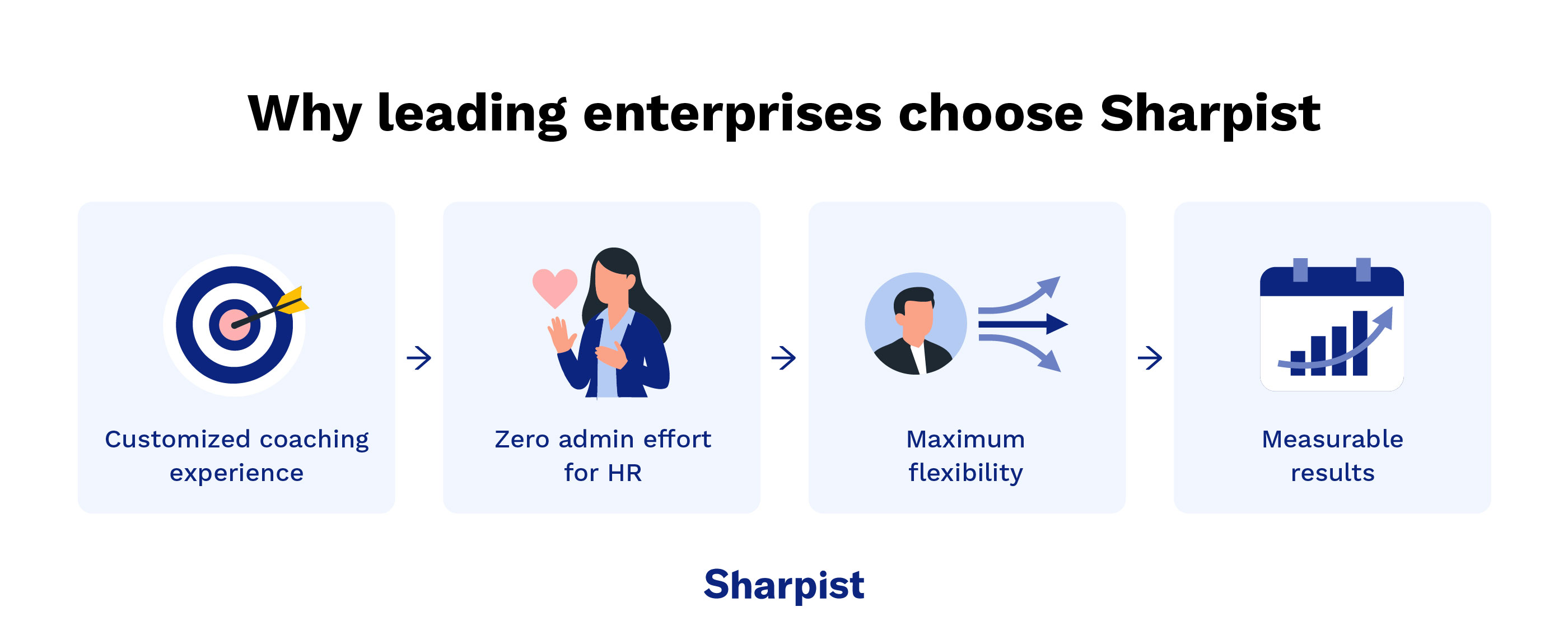
The Sharpist AI Coach illustrates this difference concretely: 16 specialized AI agents review every conversation, including an ICF Competencies Agent, a Coach Challenge Level Agent, and a Validation Techniques Agent.
The Decision Framework: When AI, When Human, When Both?
The central question for HR teams is not "AI or human?" but "Which combination fits which scenario?" The following 3-level framework provides clear guidance.
Level 1: Purely AI-Powered
AI alone is suited for high-frequency scenarios with medium complexity. These include preparation for feedback conversations, daily reflection and journaling, quick decision support in day-to-day leadership, and onboarding new leaders into their roles.
Level 2: Hybrid – AI Plus Human Coaching
For most leadership development programs, the hybrid model is the most effective approach. Human coaches handle the in-depth video sessions, while the AI coach is available 24/7 between sessions for follow-ups, ad-hoc challenges, and continuous reflection. Sharpist's hybrid approach combines both in a single platform: assessment and goal-setting, algorithmic coach matching with a 97% success rate, regular video sessions with certified coaches, and permanent access to the AI coach for everything in between.
Sharpist clients such as LVMH recorded a +18% improvement in leadership competencies, and IKEA a +8–10% improvement in their leadership index using this model.
Level 3: Purely Human
Certain situations require exclusively human coaches: acute crisis situations, profound personal change processes, highly political conflicts at C-level, and topics involving significant emotional burden. Sharpist's network of over 1,500 ICF/DBVC-certified coaches covers these scenarios in 55+ languages.
The Business Case: How AI-Powered People Development Pays Off
The most common barrier to AI in people development is not the technology but budget approval. HR teams need a transparent business case that holds up in board presentations.
Calculation Example: 300 Leaders, Traditional vs. Hybrid
The hybrid model reaches 10 times more leaders while simultaneously delivering continuous progress data. According to the ICF, 87% of organizations report a positive ROI from coaching, with an expected range of 3 to 7 times the investment.
Quality Criteria: What to Look for When Selecting a Solution
Not every AI solution delivers on its promises. The following criteria support systematic evaluation.
1. ICF Standards as the Quality Benchmark
The International Coaching Federation has defined standards across six domains in the ICF AI Coaching Framework: fundamental ethics, relationship building, effective communication, promoting learning and growth, quality assurance, and technical factors such as data privacy. Every AI coaching solution you evaluate should be measured against these standards.
2. Data Privacy and Compliance as a Knockout Criterion
In the DACH region, GDPR compliance and ideally ISO 27001 certification are non-negotiable. The EU AI Act classifies AI systems in employment contexts as high-risk applications, which entails additional documentation and monitoring obligations. Sharpist meets these requirements with full GDPR compliance and ISO 27001 certification.
3. Adoption Rate as the Decisive Success Metric
The best technology fails at a 5% usage rate. Define your adoption strategy before selecting a tool, not after. Sharpist achieves 80–90% activation rates, compared to 10–20% on traditional e-learning platforms. One key factor: deploying leaders as first users accelerates adoption across the entire organization.
Implementation: From Decision to Rollout in Five Steps
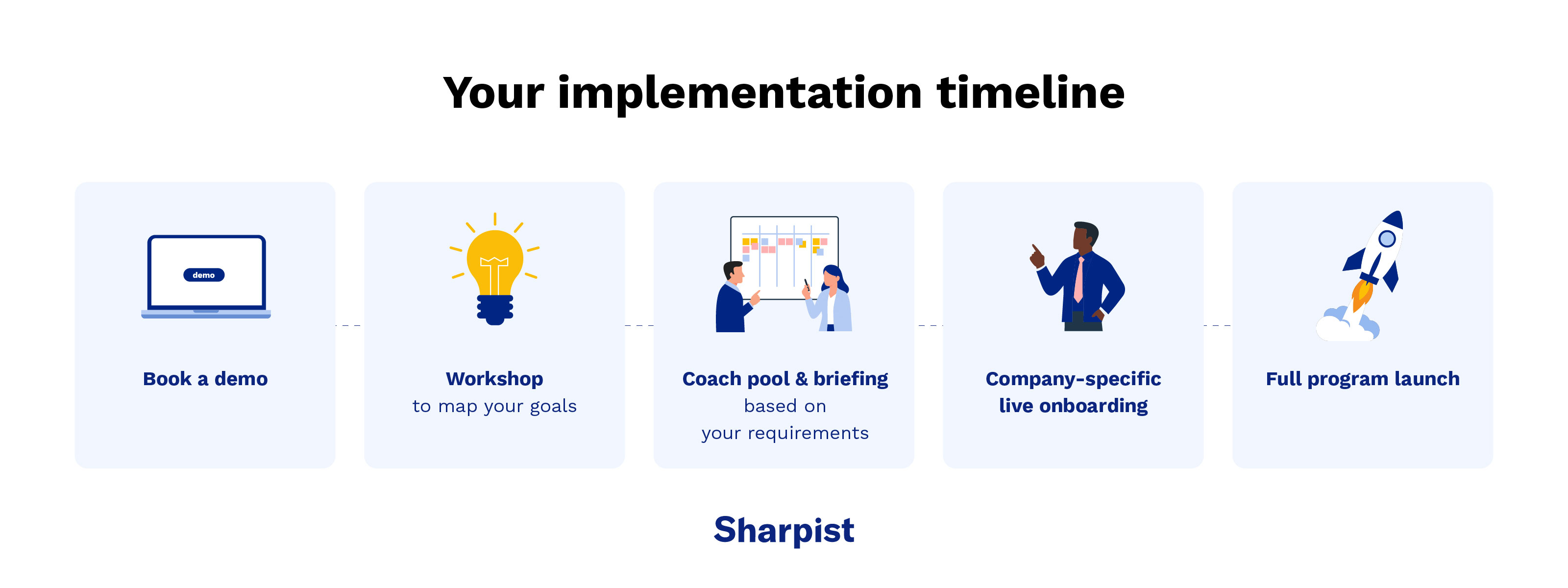
A successful introduction of AI in people development follows a clear process that connects technology, change management, and measurability.
Step 1: Take Stock and Define the Target State
Which leadership competencies are strategically relevant? Where are the biggest skill gaps? Which KPIs need to improve? Without this clarity, every AI investment becomes a shot in the dark.
Step 2: Select a Pilot Group and Define KPIs
Start with 20–50 leaders who are both motivated and representative of the broader organization. Define measurable targets: engagement rate, competency development, satisfaction.
Step 3: Evaluate the Platform and Ensure Compliance
Review using the quality criteria outlined above. Involve IT and data privacy stakeholders early.
Step 4: Actively Shape Change Management
Communicate the value, not the technology. Deploy leaders as first users.
Step 5: Measure, Learn, Scale
Use pilot data to build the business case for a company-wide rollout. Sharpist's L&D dashboard delivers real-time analytics with industry benchmarks that can be incorporated directly into board reporting.
How Sharpist Turns AI-Powered People Development from Framework to Practice
Sharpist's coaching platform unites all three levels of the decision framework in one integrated solution: the AI coach with 16 quality assurance agents and 24/7 availability for daily coaching impulses, 1:1 video coaching with over 1,500 ICF/DBVC-certified coaches for complex leadership situations, and more than 2,000 personalized micro tasks that ensure transfer into everyday working life.
Ready to use AI in your people development the right way? Schedule a no-obligation demo and discover how Sharpist's hybrid approach scales your leadership development.
FAQ
When Is an AI Coach Enough – and When Do I Need a Human Coach?
An AI coach is suited for high-frequency scenarios with medium complexity: daily reflection, conversation preparation, decision support, and onboarding guidance. Human coaches are indispensable in acute crisis situations, profound change processes, highly political conflicts, and situations with significant emotional burden. For most leadership development programs, the combination of both formats delivers the highest impact.
How Do I Tell a Generic Chatbot Apart from a Real AI Coach?
Check three criteria: first, whether the tool operates according to recognized coaching standards such as ICF core competencies and substantiates this through specialized quality assurance. Second, whether it enables continuous learning journeys with context from previous conversations. Third, whether enterprise-grade data privacy with GDPR compliance and ideally ISO 27001 is guaranteed.
How Do I Justify the Investment in AI Coaching to the Board?
Use the scalability argument: a hybrid model reaches 10 times more leaders than traditional coaching at significantly lower cost per coachee. Support this with the industry-standard ROI range of 3 to 7 times according to the ICF, and with concrete activation rates that reach 80–90% on specialized platforms.
How Do I Ensure That AI Coaching Is GDPR-Compliant?
Request evidence of ISO 27001 certification, local data storage within the EU, and full encryption of all coaching data. Clarify whether conversation content feeds into the training of the AI model. Involve your data protection officer and IT security team early in the evaluation process.
What Activation Rates Can I Realistically Expect?
Traditional e-learning platforms typically achieve 10–20% activation. Specialized digital coaching platforms like Sharpist achieve 80–90% activation rates because they offer personalization, low-barrier access, and the combination of AI and human coaching. Deploying leaders as first users and communicating value rather than technology are decisive factors for high adoption.
.avif)







.svg)


%20(1).avif)