



.png)
.png)
.svg)

.png)
.png)


.png)


.png)


.svg)


.svg)

When you promote a specialist to a leadership role, you solve one talent problem – and often create a new one. The new leader was excellent as an individual contributor, but now faces tasks no one has prepared them for: delegating instead of delivering, mediating conflicts instead of avoiding them, giving feedback instead of receiving it. Whether this transition succeeds is determined in the first few months – and that is exactly where structured first-time manager coaching with Sharpist comes in.
The Topic in a Nutshell
Why the Transition into a First Leadership Role Is So Critical
The move from specialist to leader is one of the most profound role transitions in professional life – and at the same time one of the least supported. What makes the transition so difficult is not a competency gap, but an identity shift.
The Identity Shift as the Core Challenge
New leaders must let go of what they excelled at before: their own specialist work, their immediate impact, the recognition for personal achievement. In its place comes responsibility for the performance of others – a mode that feels fundamentally different and cannot be fully conveyed through any seminar curriculum.
There is also the so-called sandwich position: new leaders are caught between the expectations of their team and those of management. The team expects conflict resolution and direction; management expects autonomous goal achievement. Those who are unprepared for this dual pressure respond with the most common first-time leadership mistakes: micromanagement, avoidance of difficult conversations, and failure to delegate.
What the Numbers Say About the Scale of the Problem
The data is clear. According to a Gartner survey of HR leaders, leadership development tops the priority list for the third consecutive year, and 75% of HR leaders surveyed report that their managers are overwhelmed by the growing scope of their responsibilities. At the same time, the Gallup State of the Global Workplace Report 2025 shows that 70% of the variance in team engagement is directly attributable to the manager.
For companies that promote 30 new leaders per year, a failure rate of 40–60% conservatively translates to 12–18 mismatches, each with downstream costs of €100,000 to €150,000 for recruiting, onboarding, and team turnover. A structured coaching program that cuts this rate in half will, in most cases, pay for itself within the first year.
Why Classic Measures Are Not Enough
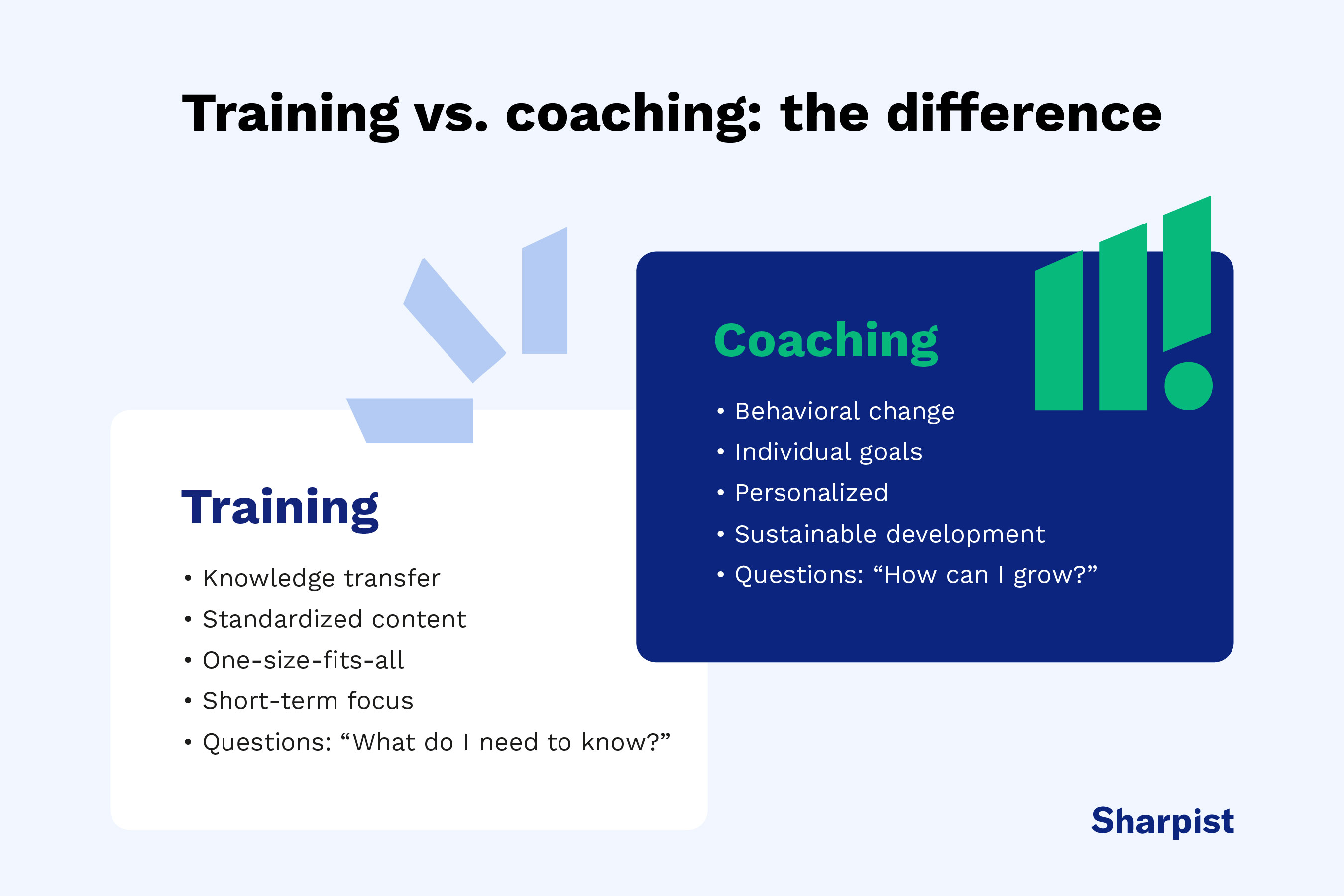
Most companies respond to the first-time manager transition with the same formats: a two-day leadership seminar, occasional mentoring by the direct supervisor, or an e-learning module. None of these formats address the actual problem.
Coaching, Seminar, Mentoring, E-Learning: An Evidence-Based Comparison
Gartner confirms that traditional seminars and lecture-style formats are not only ineffective but have a demonstrably negative effect on leadership development. Yet according to Gartner, over 75% of organizations are increasing their spending on leadership programs – without seeing measurable results. The problem is not the budget, but the format.
Migros Industrie knows this pattern from their own experience: workshops initially generate high motivation, but in day-to-day work the bridge to actually apply what was learned is missing. Working with Sharpist, Migros Industrie embedded learning as a fixed part of work – without creating additional burden for leaders.
What Makes an Effective First-Time Manager Coaching Program
A program that actually works does not consist of a single format, but of an integrated system that connects different learning moments: deep reflection in the 1:1 session, rapid transfer through micro tasks, and support precisely when a critical situation arises unexpectedly. This is why Sharpist relies on a hybrid approach that combines these different methods.
The Ideal Timeframe: Before Day One Through the End of the First Year
Structured support should not begin only once problems become visible. Effective coaching programs like Sharpist start before the official role begins and follow a clear rhythm:
This rhythm addresses a key finding: over 70% of coaching initiatives only start when external pressure arises – a conflict, a stalling project, first self-doubt. Proactive programs reverse this logic.
The Most Important Coaching Topics in the First 12 Months
The content that occupies new leaders most in practice can be grouped into four areas, which are also reflected in Sharpist's structured development paths:
What matters is that these topics are not worked through as a curriculum, but situationally – at the specific leadership moment the new leader is currently experiencing. A coach who asks "What was the most difficult conversation you had this week?" generates more transfer than a seminar module on the topic of feedback conversations.
How to Build a Scalable Program
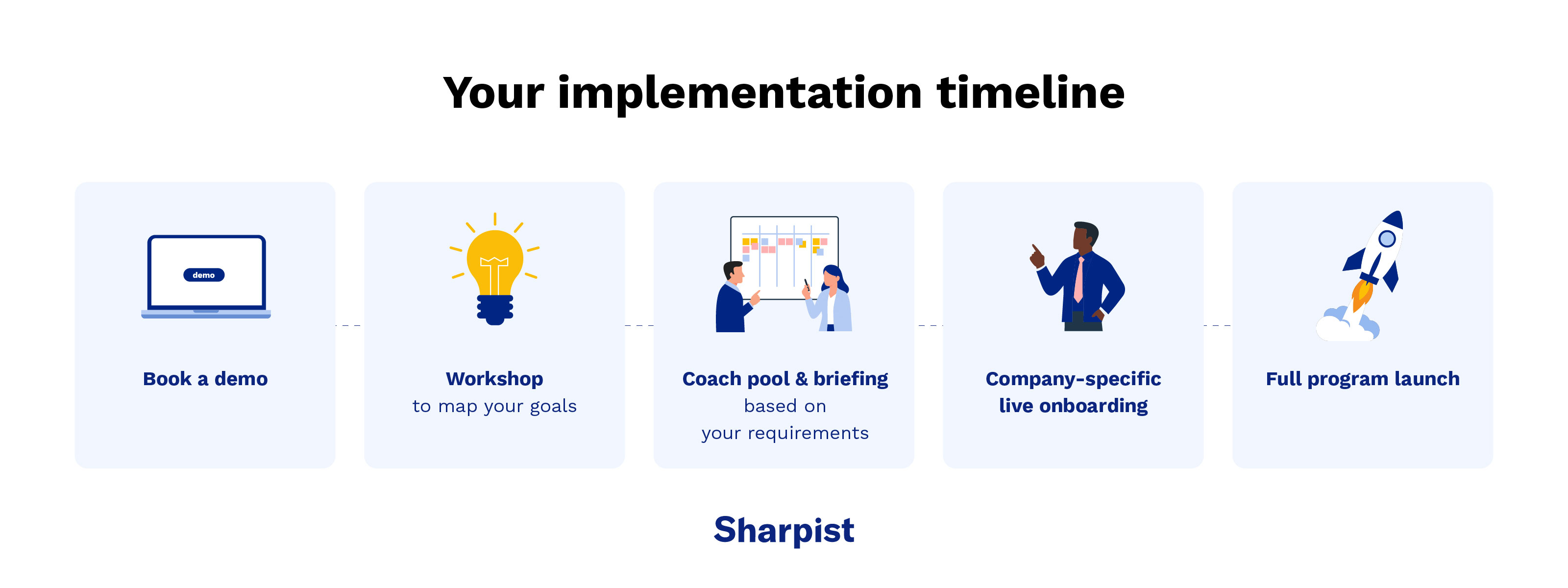
The biggest operational challenge for HR teams is not the individual coaching conversation, but the question: how do we support 50 new leaders simultaneously without needing proportionally more resources? Building a scalable program follows five steps.
Breitling achieved an activation rate of 96% across 1,800+ employees using this approach – through a structured process from needs assessment to ongoing engagement management. Typical e-learning platforms, by comparison, achieve activation rates of 10–20%.
Sharpist as a Partner for Scalable First-Time Manager Coaching
The transition into a first leadership role is too complex for one-off measures and too frequent for individual standalone solutions. Sharpist combines 1:1 video coaching with over 1,500 certified coaches, daily micro tasks for transfer into everyday leadership, and an AI coach available 24/7. The L&D dashboard makes progress visible to HR teams in real time, and the flexible credit system ensures that no budget goes unused.
Book a Demo now and see what a first-time manager program for your cohort can look like in concrete terms.
FAQ
What Distinguishes Coaching from a Leadership Seminar?
A seminar imparts knowledge in a group setting; coaching supports the individual application of that knowledge in real leadership situations. The decisive difference lies in transfer: coaching picks up exactly where seminars leave off – at the specific leadership moment the new leader is currently experiencing.
How Long Should a First-Time Manager Program Run?
Effective programs run for at least six to twelve months and ideally begin before the official role start. A three-month seminar or a single workshop is simply too short for the profound identity shift that the role transition requires. What matters is not the duration of individual sessions, but the continuity of support across critical leadership moments.
How Do I Measure the Success of a Coaching Program for New Leaders?
Relevant KPIs include activation rate, retention of new leaders after 12 months, team engagement scores in the supported teams, and qualitative progress reports from coaching sessions. Sharpist's L&D dashboard aggregates this data in real time and enables comparison with industry benchmarks – without manual reporting effort for HR teams.
Can the AI Coach Replace Human Coaching?
No – and that is not its purpose. The Sharpist AI coach complements 1:1 coaching with a certified coach by being available for the moments between sessions: the unplanned escalation, preparation for a difficult conversation, reflection after a critical decision. Deep reflective work and building a trusted coaching relationship continue to require human coaches.
.avif)






.svg)


%20(1).avif)