



.png)
.png)
.svg)

.png)
.png)


.png)


.png)


.svg)


.svg)

Hierarchical instructions from above or participatory involvement from below? The question of the right leadership approach is preoccupying companies more than ever. While top-down leadership relies on clear hierarchies and central control, bottom-up management enables participation and draws on the expertise of employees. Learn when each approach works, how you can combine the two, and how Sharpist can help you develop the right leadership style for your team.
The Topic In A Nutshell
What do top-down and bottom-up mean?
Top-down and bottom-up describe two fundamentally different directions in which decisions, communication, and planning flow within companies. They are therefore two completely different management styles.
The definition of top-down and bottom-up refers to hierarchical levels: top-down starts at the management level and moves downwards, while bottom-up starts with employees and moves upwards. Both approaches shape not only management styles, but also project management, strategy development, and change processes.
Top-down approach: definition and characteristics
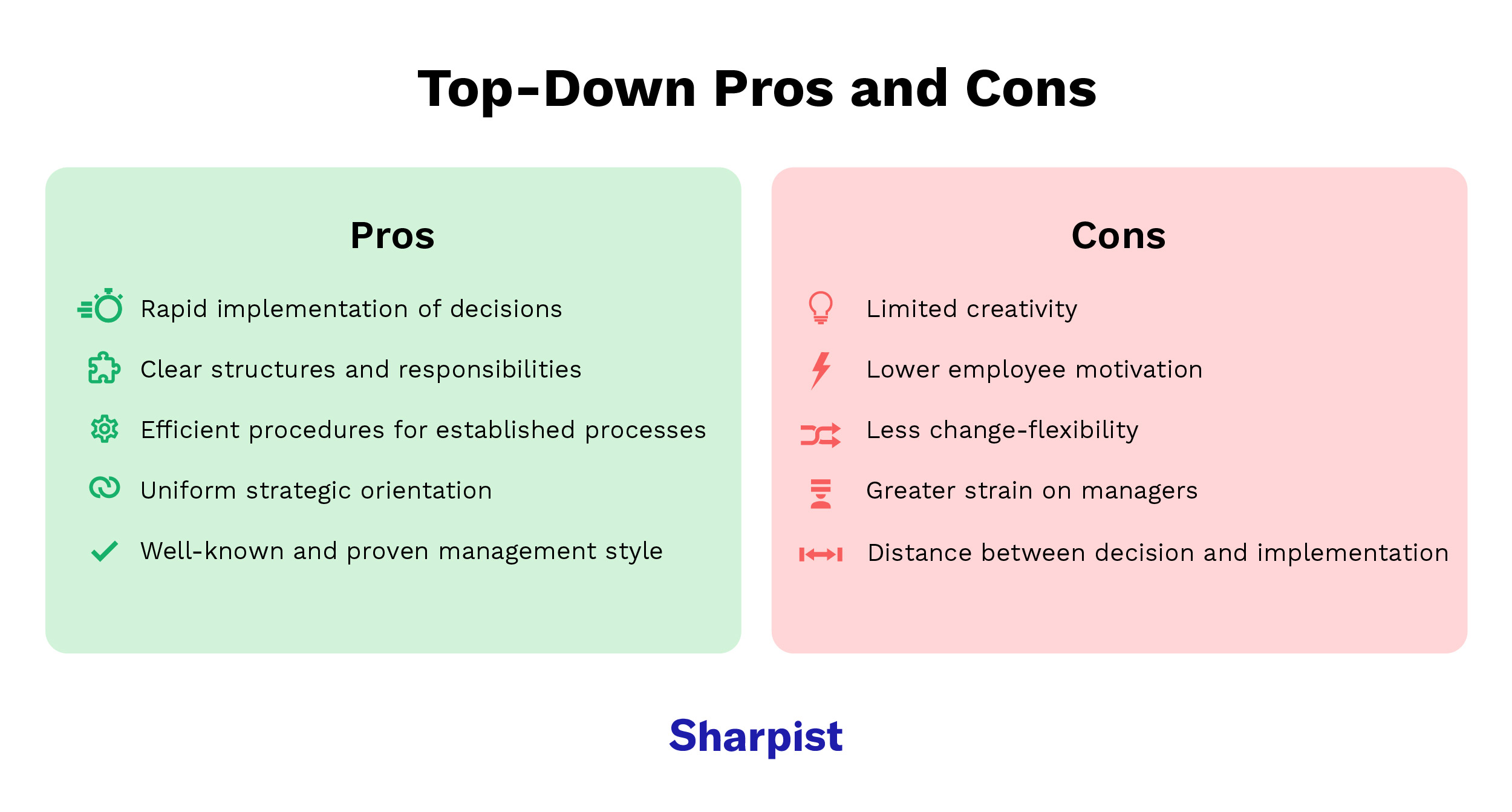
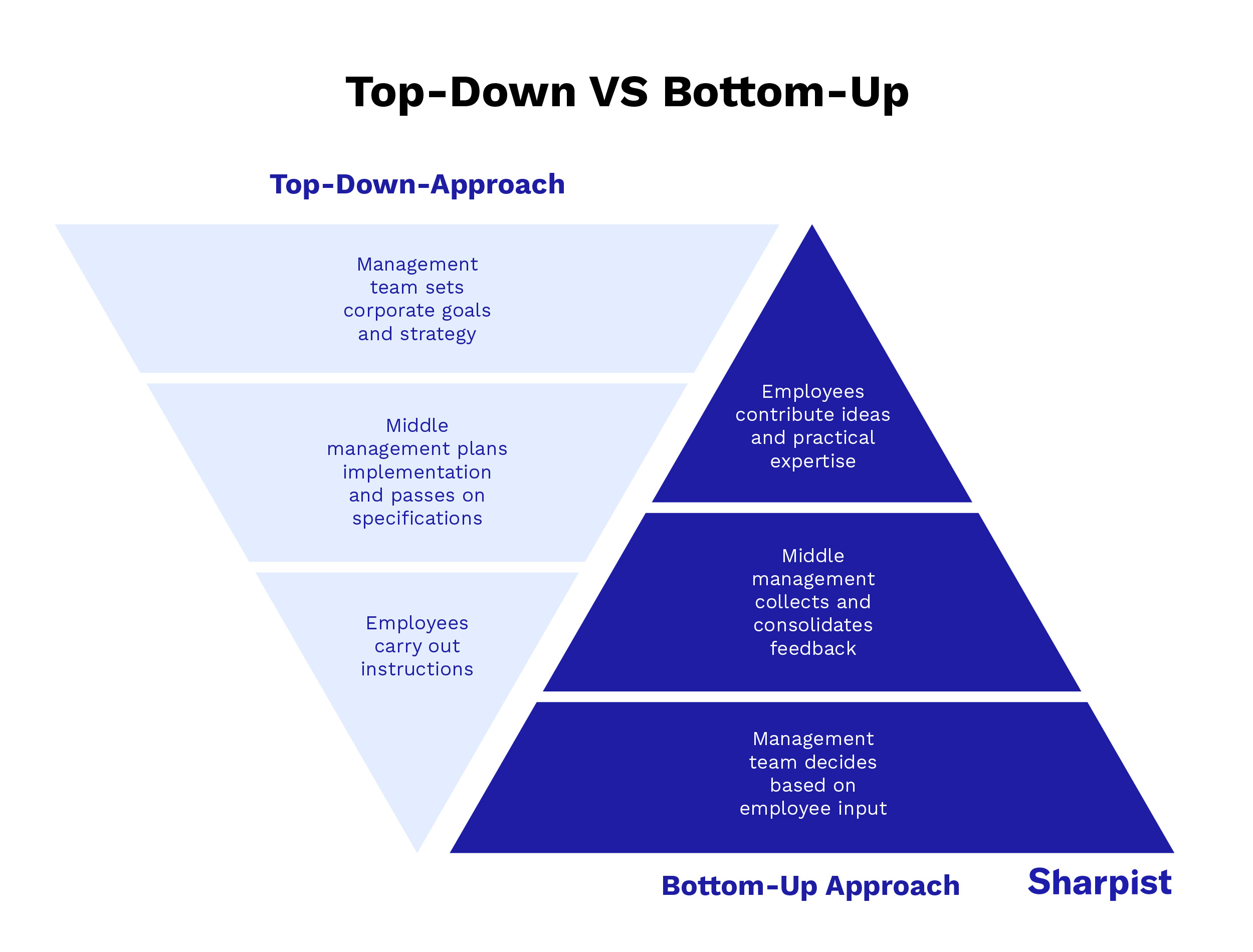
The top-down method follows the classic hierarchical principle: top management develops strategies, makes decisions, and passes these on to employees via middle management. Top-down management, on the other hand, is characterized by clear chains of command. This means that all employees at all levels know exactly what is expected of them.
Decisions are consistently made at the highest level and communicated downward via established channels. Clear hierarchies and defined responsibilities provide structure and orientation. Standardized processes and uniform guidelines ensure consistent procedures throughout the organization. Employees implement the specified strategies, but do not actively participate in shaping them.
Bottom-up approach: definition and characteristics
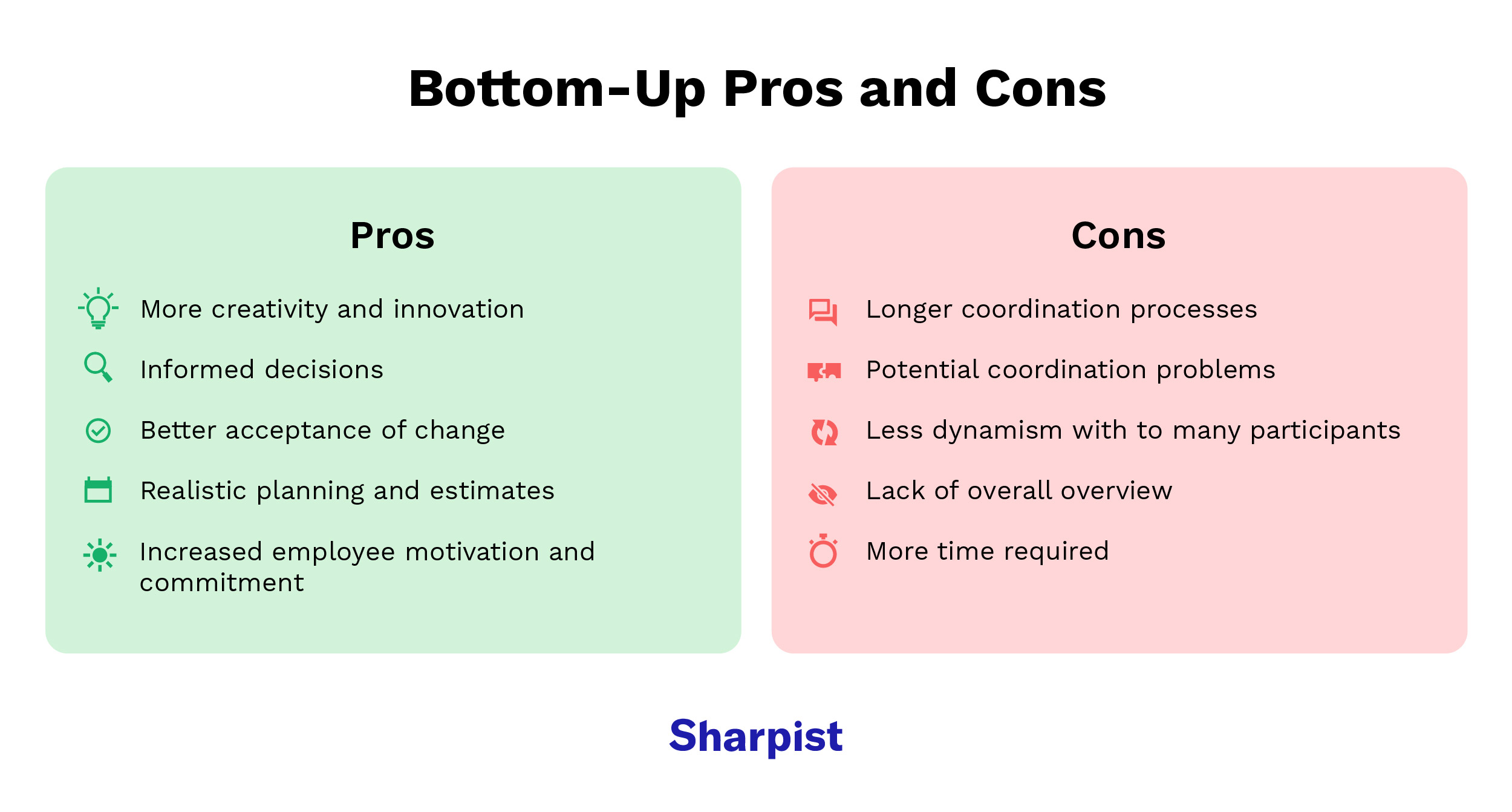
The bottom-up approach, on the other hand, reverses the hierarchy: ideas, feedback, and decision-making criteria come from the employees who work closest to the products, processes, and customers. Middle management collects and consolidates this input before senior management makes strategic decisions based on it.
Employees actively contribute ideas and expertise and help shape decision-making processes in a participatory manner with broad involvement. Communication enables direct upward feedback and systematically utilizes the knowledge of all hierarchical levels. Teams assume greater personal responsibility and are given significantly more say and creative freedom in their areas of work.
The main difference between top-down and bottom-up
The difference between top-down and bottom-up lies not only in the direction of communication, but fundamentally in the distribution of power and responsibility. While top-down relies on control and efficiency through central management, bottom-up focuses on participation and innovation through decentralized intelligence.
However, top-down vs. bottom-up is not an either/or decision. Most successful organizations combine both approaches, depending on the situation. This concept is known in project management as the counterflow method, which combines strategic guidelines with operational feedback.
Top-down and bottom-up in practice
Both leadership approaches demonstrate their strengths and limitations particularly clearly in practical application. Choosing the right approach depends heavily on the context.
Top-down and bottom-up in project management
The difference is particularly evident in project management. Top-down projects begin with a clear vision from management: goals, budgets, and milestones are defined centrally and communicated to project teams. This approach works extremely well for projects with fixed requirements, clear deadlines, or regulatory requirements.
Bottom-up planning in project management, on the other hand, starts with the teams. They estimate costs, identify risks, and develop implementation proposals. Management consolidates this input into an overall plan. This approach delivers more realistic schedules and greater acceptance, but requires more coordination.
A top-down/bottom-up example from practice: When introducing a new software architecture, top management defines strategic goals and budget frameworks (top-down), while the development teams propose specific technical solutions and plan implementation details (bottom-up).

The approaches as leadership styles
The top-down leadership style corresponds to classical authoritarian or directive leadership models. Managers give clear instructions, monitor results, and make decisions independently. This style offers security in crisis situations or with inexperienced teams that need a clear structure.
The bottom-up leadership style, on the other hand, uses participatory or democratic leadership elements. Managers moderate, coordinate, and develop rather than instruct. They create conditions in which teams can act independently. This style works particularly well with experienced, independent employees and in environments that require creativity and innovation.
Modern leadership development through coaching is increasingly focusing on situational leadership: the ability to switch flexibly between top-down and bottom-up approaches, depending on the situation, team maturity, and task at hand.
Bottom-Up and Top-Down in Change-Management
When it comes to change processes, the choice between top-down and bottom-up approaches is particularly critical. Top-down change management works when rapid, far-reaching changes are needed, as is the case with mergers, restructuring, or strategic realignments, for example. Management clearly communicates the need for change, defines the vision, and centrally controls implementation.
Bottom-up change, on the other hand, relies on participation and persuasion. Employees are involved at an early stage, can help shape changes, and act as change agents. This significantly increases acceptance, but takes more time and requires a strong coaching culture.
In practice, successful change management models usually combine both approaches: the strategic vision comes from above, while operational implementation and concrete solutions are developed from below. This countercurrent approach combines strategic clarity with operational expertise.
Comparing the advantages and disadvantages of top-down and bottom-up approaches
Both leadership approaches have specific strengths and weaknesses. The following table provides an overview of the direct comparison between top-down and bottom-up leadership:
The table shows that top-down excels in terms of speed, clarity, and strategic alignment. Bottom-up impresses in terms of innovation, motivation, and acceptance. No method is superior per se. Which approach is chosen therefore depends heavily on the respective context.

When to use which leadership style?
The trick is knowing when which leadership approach will lead to success. Managers often only develop this diagnostic skill through targeted reflection and professional transformation support. Here are a few clear points of reference:
Ideal application scenarios for the top-down method
The top-down method is particularly effective when the need for speed, clarity, or uniform standards outweighs the desire for participation. This applies to five classic situations:
Ideal application scenarios for the bottom-up approach
While top-down management scores highly in terms of speed and strategic consistency, bottom-up management demonstrates its superior strengths in completely different contexts. The participatory approach unfolds its full potential particularly in five areas:

Hybrid approaches: The best of both worlds
The preceding sections show that both top-down and bottom-up approaches have their clearly defined strengths. However, the key insight from practical experience is different: The most successful organizations do not limit themselves to one approach. Instead, they use hybrid leadership models that combine top-down and bottom-up approaches depending on the situation, thus combining the advantages of both approaches. Proven hybrid approaches are:
However, knowledge of these models alone is not enough. The decisive factor is the ability of managers to apply them in practice.
Develop the right leadership style with Sharpist
The choice between top-down and bottom-up is not a one-time decision, but rather an ongoing leadership skill. Successful leaders switch flexibly between the two approaches depending on the situation, team maturity, and task at hand. This situational leadership skill can be developed systematically.
Sharpist supports executives through individualized 1:1 digital coaching, helping them to reflect on and further develop their personal leadership style. Over 1,500 certified coaches work with managers on specific challenges:
The Sharpist coaching platform combines structured development paths with flexible, individual support. The result: managers who are not tied to one style, but can choose the optimal approach for each situation.
FAQ
What are the disadvantages of the top-down approach in the modern working world?
In today's working world, purely top-down leadership is increasingly reaching its limits. The biggest challenge: Highly qualified specialists want to help shape the future, not just carry out instructions. The shortage of skilled workers is reinforcing this trend, as talented individuals specifically choose companies with a participatory culture. Top-down structures also restrict innovation. In tech and knowledge work in particular, the best ideas often come from teams, not management. In remote and hybrid working models, classic top-down control is more difficult to implement and requires new approaches. In addition, top-down organizations react more slowly to market changes, as feedback loops take longer and the distance between decision-making and operational reality is greater.
Can you combine top-down and bottom-up approaches in one team?
Yes, and it is precisely this combination that is often most successful in practice. The key is to clearly define the scope of decision-making. The following principle has proven effective: the manager defines the goals, the framework, and the criteria for success (top-down), while the team decides independently on the methods, processes, and specific implementation (bottom-up). In concrete terms, this could mean: "We must increase customer satisfaction by 15% by Q3" comes from above. How the team achieves this, i.e., through which measures, with which distribution of tasks and in which order, is up to them to decide. This combination combines strategic clarity with operational expertise and creates ownership.
It is important to communicate transparently about which decisions are made at which level. Digital coaching helps teams and managers to find this balance and continuously adjust it.
Which approach is more suitable for change processes?
The nature of the change determines the optimal approach. In the case of radical, time-critical transformations, such as existential crises, M&A projects, or fundamental business model changes, a top-down approach is often indispensable. Management must quickly provide guidance and set the course. For cultural changes and behavioral changes, bottom-up is superior. When people are asked to change their way of working, values, or collaboration, genuine participation is required. Change that is merely imposed remains superficial. The most successful change projects use a phased approach:
Change management coaching supports managers in optimally shaping these phase transitions.
How can I determine which leadership style suits my corporate culture?
To identify the right leadership style for your corporate culture, analyze five key indicators:
.avif)







.svg)


%20(1).avif)