



.png)
.png)
.svg)

.png)
.png)


.png)


.png)


.svg)


.svg)

Individual measures in leadership development often fizzle out without impact. In practice, only structured management coaching programs create measurable leadership improvements at the organizational level. This guide shows when management coaching makes sense, which success factors are decisive, and how to implement coaching scalably with Sharpist.
The Topic in a Nutshell
What Is Management Coaching?
Management coaching is more than a personnel development measure. It is a strategic lever for organization-wide leadership improvement and sustainable business success. For HR teams that want to drive structural change in decentralized organizations, understanding the differences between various coaching formats is critical to success.
Definition and Distinction
Management coaching is the individual accompaniment of experienced leaders to optimize their management competencies and leadership qualities. Unlike business coaching, which addresses all employees, management coaching focuses on the specific challenges of leadership positions.
The key distinction: While business coaching promotes personal career and development, management coaching targets structural leadership improvements that impact the entire organization.
A detailed overview of coaching methods and typical content can be found in our article on executive coaching.
The Coach as Sparring Partner
A management coach acts as an objective sparring partner at eye level. Unlike a trainer who imparts knowledge or a consultant who prescribes solutions, the coach accompanies coachees in developing new perspectives.
Prerequisites for this role include solid leadership experience, methodological competence, and the ability to address difficult topics. For HR teams, this means: Selecting qualified coaches with demonstrable management expertise is critical to success. Certifications such as ICF or DBVC provide orientation, but practical leadership experience makes the decisive difference.
Sharpist works exclusively with certified experts who have extensive leadership experience. We draw on a network of more than 1,500 coaches operating in over 55 languages.

When Does Management Coaching Make Sense?
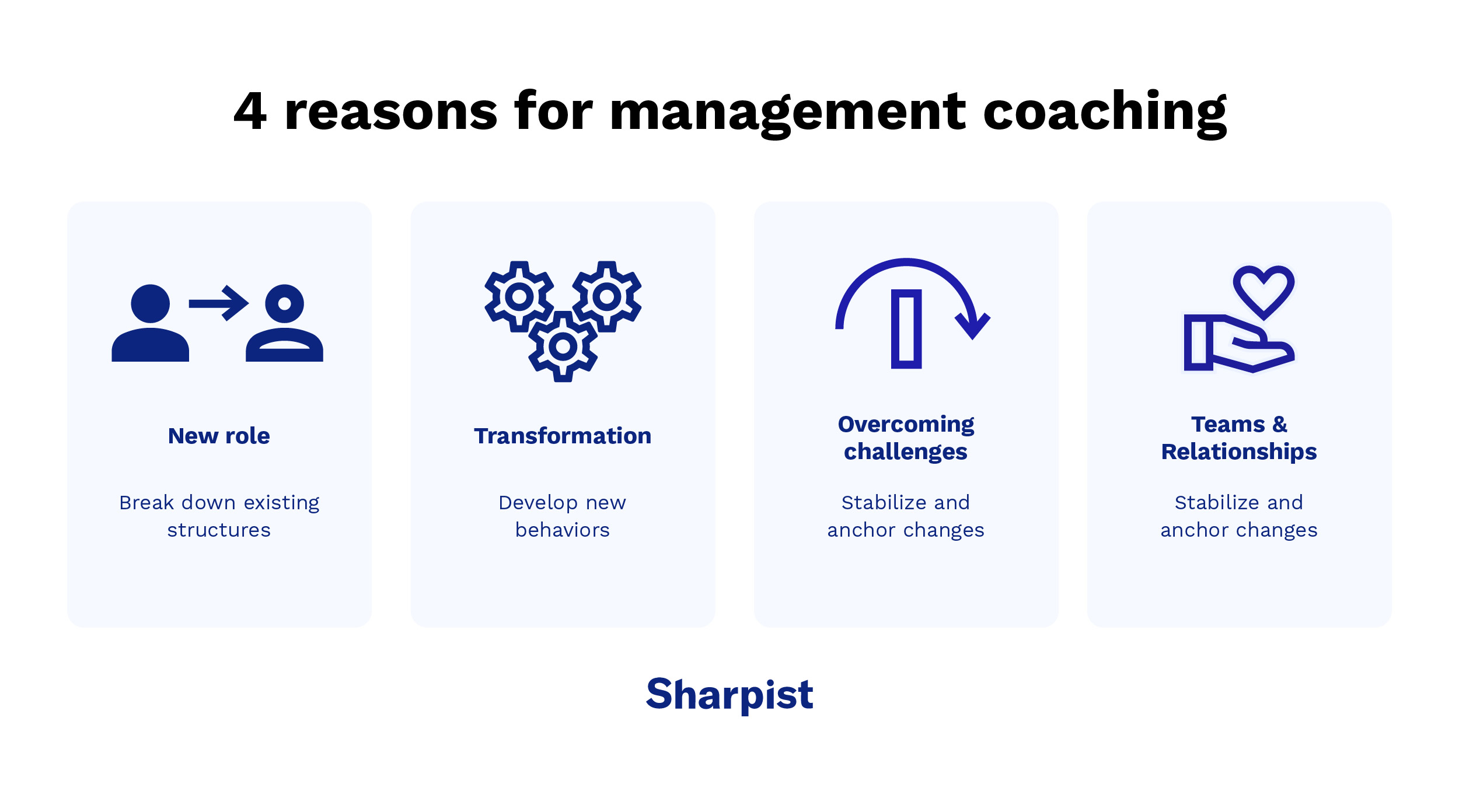
Management coaching is particularly effective in specific situations that HR teams should systematically identify. The investment pays off primarily when managers are taking on a new position or when structural leadership challenges are weighing on the organization.
Beyond these typical use cases, there are further situations in which management coaching is especially valuable. During transformation processes such as restructuring, digitalization, or cultural change, leaders are the key figures. Change management coaching supports them in not merely managing change, but actively shaping it.
Finally, the relationship dimension plays a decisive role. Employee retention, stakeholder management, and constructive feedback are frequently the key to leadership success. Management coaching specifically develops these competencies. Regardless of the specific occasion, certain framework conditions determine whether management coaching reaches its full potential.
Success Factors for Implementing Management Coaching
The successful implementation of management coaching depends on several critical factors that HR teams should consider from the outset.
Finally, flexibility matters more than one-size-fits-all solutions. Different leadership levels have different requirements. A credit-based model allows HR teams to deploy resources according to actual needs – from intensive support during the onboarding of leaders in a new role to occasional sparring sessions for experienced managers.

Implementing Successful Management Coaching
Beyond these substantive success factors, the implementation process itself determines the success of management coaching. In practice, the following five steps have proven effective:
With a structured implementation process, HR teams lay the foundation. But lasting success only emerges when coaching grows beyond individual measures and becomes part of the leadership culture.
Establishing Coaching as a Leadership Style
The most sustainable impact of management coaching unfolds when it is understood not as an isolated measure, but as part of the leadership culture. A proven concept for this is the so-called coaching cascade: Leaders who are coached themselves increasingly adopt a coaching leadership style with their own teams. Instead of prescribing solutions, they ask questions, encourage self-reflection, and actively develop their employees.
For HR teams, this creates concrete levers for systematically building this culture:
The key lies in scalability: The more leaders internalize coaching principles, the more firmly a coaching culture becomes anchored across the entire organization.

Scaling Management Coaching – with Sharpist
The impact of management coaching manifests on multiple levels: It shortens the onboarding time of new leaders, strengthens resilience during transformation phases, and – when implemented correctly – anchors a development-oriented leadership culture throughout the entire organization. The decisive success factor lies not in coaching itself, but in systematic execution. This encompasses everything from clear goal-setting and professional coach matching to measurable impact tracking.
The greatest challenge for HR teams is scaling management coaching in large organizations in a way that preserves quality while keeping administrative overhead manageable. Digital coaching platforms solve exactly this problem. Sharpist combines personal 1:1 coaching with digital learning formats and offers HR teams a scalable solution for systematic leadership development. Sharpist addresses the typical hurdles that HR teams face when introducing management coaching:
The ROI demonstration in particular – the greatest challenge for many HR teams – becomes tangible through the L&D dashboard: Learning hours, completion rates, and organizational insights show in real time which topics your leaders are addressing in coaching sessions. This enables data-driven decisions for strategic leadership development and allows you to concretely demonstrate the success of your management coaching investment.
FAQ
What Is Management Coaching?
Management coaching is the individual accompaniment of experienced leaders to further develop their management competencies. The management coach acts as an objective sparring partner who supports managers in gaining new perspectives and developing their own solutions to complex leadership challenges.
What Is the Difference Between Management Coaching and Executive Coaching?
Executive coaching is a specialized form of management coaching for C-level executives, top managers, and managing directors. While management coaching addresses all leadership levels, executive coaching focuses on strategic decisions and complex stakeholder relationships at the highest level.
When Does Management Coaching Make Sense?
Management coaching is particularly effective during transition phases: during onboarding into a new position, in transformation processes, or when scaling leadership in growing organizations. It also provides targeted support for specific challenges such as overload, team conflicts, or difficult stakeholder relationships. Experienced leaders also use coaching as a sparring partner for strategic decisions.
Can a Leader Act as a Coach Themselves?
Yes, a coaching leadership style is even desirable. Leaders can integrate coaching techniques into their everyday work – for example by asking questions rather than providing answers, in order to foster self-reflection and accountability within the team. For their own development, however, they require an external, neutral management coach as a sparring partner without a hierarchical relationship.
.avif)







.svg)


%20(1).avif)