



.png)
.png)
.svg)

.png)
.png)


.png)


.png)


.svg)


.svg)

Many companies invest significantly in leadership training, only to watch participants revert to old behavioral patterns a few weeks later. Not because the content was poor, but because training alone does not produce behavioral change. Those who want sustainable leadership development must structurally integrate training and coaching. Sharpist relies on a hybrid approach to achieve lasting results.
The Topic in a Nutshell
Why Isolated Training Fails to Close the Gap
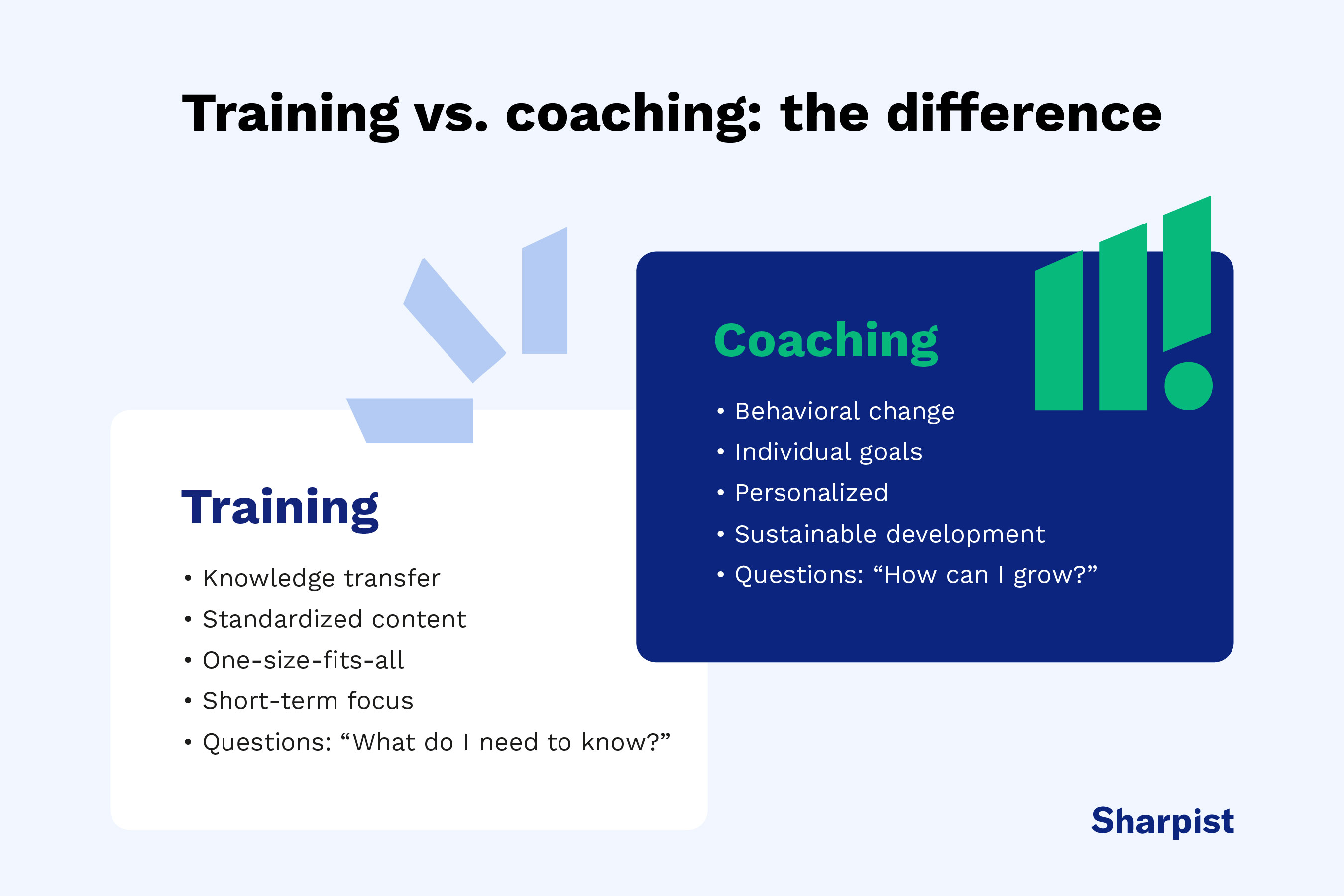
Immediately after a training, motivation is high and intentions are clear. Once the leader returns to day-to-day work, operational priorities push aside implementation plans. Multiple meta-analyses confirm that coaching has a measurable impact on self-efficacy, stress reduction, and goal attainment.
The decisive factor, however, is the combined effect: Leaders who completed only training improved their productivity by an average of 22.4%. Leaders who received both training and subsequent coaching reached 88%. In this context, coaching is not a luxury – it is the mechanism that turns knowledge into actual behavior.
The 6-Step Framework for Integrated Leadership Development
Leadership development only delivers lasting results when training and coaching are not left to chance, but follow a clear structure. The following framework shows how to integrate both approaches in six steps into a cohesive program: from needs analysis to company-wide scaling.
Step 1: Strategic Needs Analysis with Business KPIs
Which leadership competencies does the organization need to achieve its strategic goals? Stakeholder interviews with senior management and department heads, combined with 360° feedback as a baseline and current engagement data, provide a clear picture of actual development needs.
Define measurable business KPIs from the outset: turnover rate in leadership positions, engagement score, time to competence for new leaders, absenteeism rate. Without this baseline, you will have no foundation for demonstrating ROI to the board at the end of the program. Programs without process metrics quickly become "luxury projects."
Step 2: Program Architecture – Structurally Integrating Training and Coaching
A training module delivers the knowledge impulse and the conceptual toolkit. The subsequent coaching session translates that impulse into the leader's concrete day-to-day practice. Micro tasks between sessions keep the transfer alive.
The optimal program duration is 6 to 12 months. Shorter programs rarely achieve lasting behavioral change; longer ones lose momentum without clear milestones. Within this framework, a recommended sequence consists of a training module, two to three coaching sessions for deepening, micro tasks in day-to-day work, and a reflection round before the next module.
Step 3: The Right Coaching Model for Each Program Phase
Not every coaching format suits every program phase. 1:1 coaching is particularly well suited for individual reflection and working on personal leadership patterns. Group coaching or peer coaching formats promote the sharing of experience and collective learning, especially among leaders at similar levels. The AI coach bridges the gap between human sessions: it is available 24/7, enables reflection at the moment of need, and prepares leaders for difficult conversations – without scheduling.
When selecting external coaches, ICF or DBVC certification, demonstrated experience at the relevant leadership level, and language proficiency are the minimum criteria. Systematic coach matching based on development goals, industry experience, and personal preference significantly increases effectiveness. Sharpist's coach network of more than 1,500 certified coaches in 55+ languages achieves a matching success rate of 97% on the first attempt, with matching completed within two hours.
Step 4: Set Up a Pilot and Build Internal Evidence
Before rolling out a program company-wide, you need internal evidence. A pilot group of 30 to 50 leaders over six months generates sufficient data to validate the program design and build the business case for scaling. Define clear success criteria before launch – not just participant satisfaction, but at least one behavior- or outcome-related KPI.
Two prerequisites determine whether the pilot succeeds or fails: First, you need visible sponsorship from senior management. Programs that launch as HR initiatives without board backing face skepticism from the start. Second, coaching must be framed as a development tool, not a remedial measure. Leaders who perceive the program as a sign of insufficient competence will not engage with it.
Step 5: Measure Effectiveness and Demonstrate ROI
The Kirkpatrick Model remains the most sensible evaluation framework:
Most companies stop at level one. Anyone who wants to make the case to the CFO needs data at levels three and four. To systematically measure program success, a combination of six KPIs with clearly defined measurement points and data sources is recommended.
It is critical that all baselines are collected before the program begins – only then can a solid ROI be demonstrated at the end.
Step 6: Scale from Pilot to Company-Wide Program
Scaling rarely fails due to lack of will – it fails due to lack of infrastructure. Rigid coaching contingents that expire if a leader does not use them create frustration and wasted budget. Flexible credit systems like Sharpist's, where unused credits can be redistributed to more active participants, significantly increase overall utilization and make the program budgetable for senior management. Especially for international companies with complex rollout requirements, Sharpist provides the infrastructure to scale coaching programs seamlessly across borders with over 1,500 certified coaches in 55+ languages and matching within two hours.
Address governance questions before the rollout: Who manages the program, who decides on adjustments, how is quality ensured for external coaches, how does the coaching platform integrate with existing HR systems? Sharpist's coaching platform offers an L&D dashboard with real-time analytics, industry benchmarks, and automated reporting. This demonstrably saves HR teams more than 200 hours of administrative work per year.
Sharpist as a Partner for Integrated Leadership Development
Sharpist addresses the transfer problem structurally: through the combination of 1:1 coaching with certified coaches, an AI coach for the gap between sessions, and more than 2,000 micro tasks that reinforce transfer into day-to-day leadership practice. Sharpist customers such as LVMH recorded a +18% improvement in leadership competencies; at IKEA, the leadership index rose by 8 to 10%; and Miro retained 100% of key talent during a restructuring phase. Sharpist offers:
Book a personal consultation to see exactly what an integrated program for your leadership levels could look like.
FAQ
How Does Coaching Differ from Mentoring in the Context of Leadership Training?
Coaching aims to develop independent problem-solving capabilities through structured reflection. The coach does not provide answers but asks questions that lead to self-discovery. Mentoring, by contrast, is based on passing on experiential knowledge from a more experienced person. In the context of training programs, coaching is particularly well suited for reinforcing transfer and driving behavioral change, while mentoring is better for career orientation and organizational socialization.
How Large Should a Pilot Group Be for an Integrated Program?
30 to 50 leaders over six months is a proven pilot size. This group is large enough to generate statistically meaningful data, yet small enough to allow program design adjustments.
How Should Data Privacy and Confidentiality Be Handled in Coaching?
Coaching content is confidential – the coach does not report session content to the organization. What HR teams receive are aggregated progress data at the program level, not individual session records. Digital platforms must be GDPR-compliant and ideally ISO 27001-certified. Sharpist's platform meets both requirements; all AI coaching data is fully encrypted.
When Does Building an Integrated Coaching Program Become Economically Viable?
Economic viability depends heavily on the current turnover rate and replacement costs per leader. If your organization loses more than five leaders per year and replacement costs per person are €80,000 or more, a structured coaching program pays for itself through even moderate reductions in turnover. Productivity and engagement effects add further value, though they are harder to isolate.
.avif)







.svg)


%20(1).avif)