


.png)
.png)
.svg)

.png)
.png)


.png)


.png)


.svg)


.svg)

Change is the only constant in the modern working world. But how can change be shaped systematically and sustainably? This guide compares key change management models from Lewin to Kotter to Kübler-Ross and shows which approach is right for your company. Sharpist supports you with modern leadership coaching to empower your managers for successful change processes.
What Are Change Management Models And Why Do We Need Them?
Change management models – also known as change management frameworks – are, according to the common definition, scientifically based frameworks that break down complex change processes into clear phases and provide guidance for companies. They are key tools for organizational development and help to reduce complexity, make progress measurable, and establish uniform standards even in decentralized organizations. Their greatest strength is that they enable predictability and proactive action instead of reactive crisis management.
A good change management model always considers three key levels:
The human aspect in particular is often underestimated, but it is crucial for sustainable success. Modern coaching platforms such as Sharpist help to anchor change models in leadership in the long term, systematically support the change management process, and promote individual behavior.

An Overview Of The Six Most Important Change Management Models
The landscape of change management approaches and methods offers different perspectives on organizational change. Linear models such as Lewin or Kotter work with clearly defined, sequential phases. Agile approaches focus on flexibility, iterative development, and constant adaptability.
The choice of the appropriate model depends on the size of the organization, its culture, resources, and the scope of change. A combination of different approaches is often most effective in practice, as no single model covers all requirements.
Kurt Lewin's 3-Phase Model
Lewin's three-stage model is considered a fundamental theory of change management and, as the origin of modern approaches, offers a linear, easily understandable framework for change.
The clear structure makes Lewin's model particularly valuable for fundamental transformation projects or organizations with little experience of change. The refreezing phase should be viewed critically: In dynamic markets, lasting stability is becoming increasingly unrealistic as continuous change becomes the norm. Nevertheless, the 3-phase model remains relevant as a basis for more complex approaches and is particularly suitable for initial change experiences in medium-sized organizations.

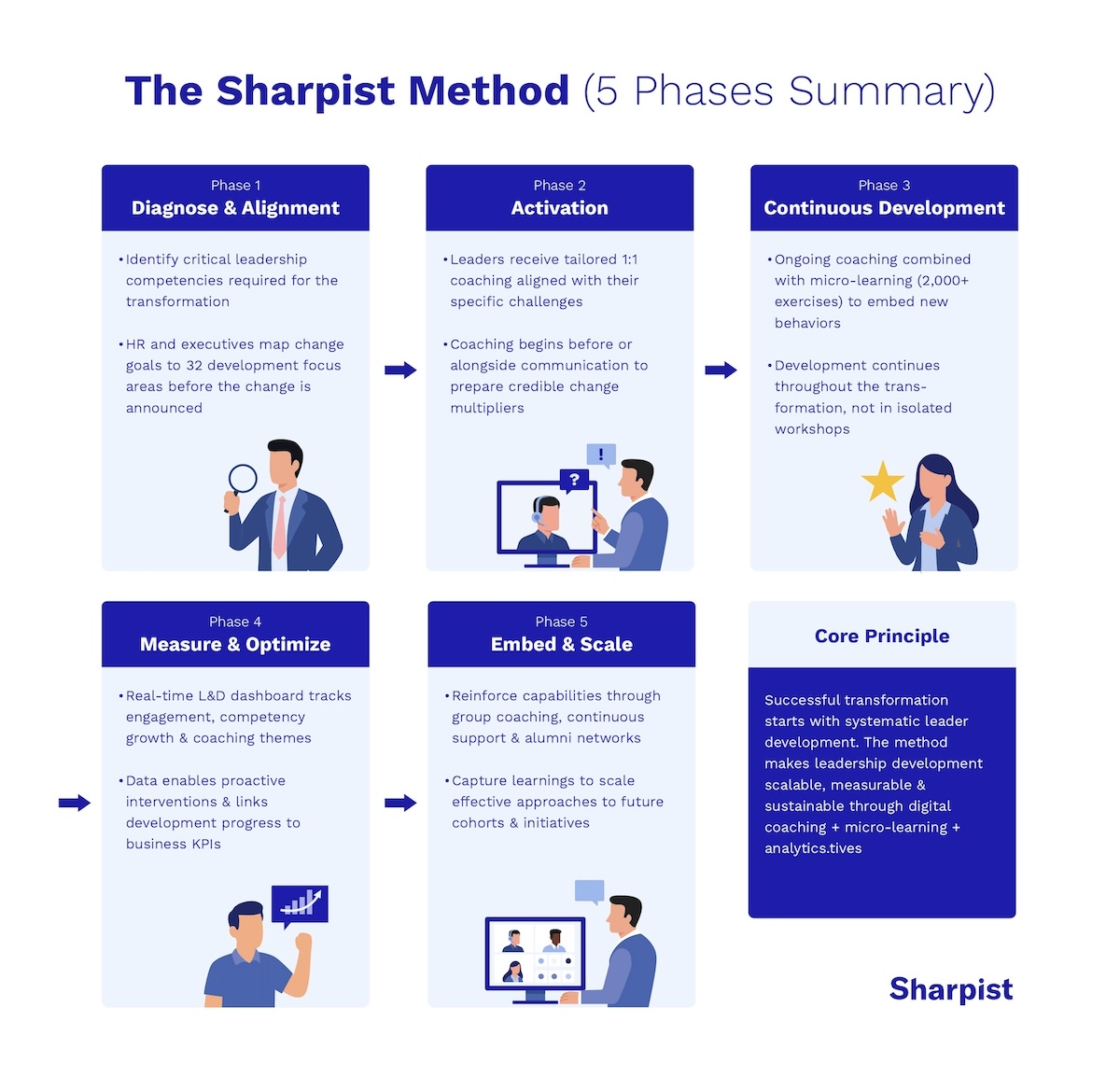
The Sharpist Method
The Sharpist Method – Strategic Human-centered Alignment for Resilient Proactive Innovation focuses on systematic leadership development as the primary lever for successful transformation. The key difference to reactive approaches: The method can be used both preventively before and during the change process. Many organizations realize too late that they need continuous support during the transformation – the Sharpist method addresses this need with a flexible entry point in every phase of change.
The approach combines individual 1:1 coaching, continuous microlearning, and data-driven performance measurement into a scalable framework. Especially for HR managers in companies with 1,000 or more employees, the method offers an answer to how hundreds of managers can be developed simultaneously – with measurable ROI. The five phases are:
The method is particularly suitable for organizations that use leadership development as a strategic lever for change and rely on scalability and measurable results. The flexible entry point — whether in the planning phase or during ongoing transformations — also makes the method valuable for companies that recognize a need for support after the fact. The approach complements classic change models with the systematic empowerment of executives as change multipliers.
Prosci's ADKAR Model
The ADKAR model developed by Jeff Hiatt places individual behavior at the center of the change process. The acronym describes five consecutive steps that each person must go through. The model is particularly effective when accompanied by active support such as communication or professional change management coaching. The five steps:
The ADKAR model enables the identification of resistance and shows where targeted support can be effectively applied. This approach provides structure and measurable success, especially in decentralized organizations. The person-centered perspective makes it ideal for HR teams that want to systematically integrate individual development into change processes.

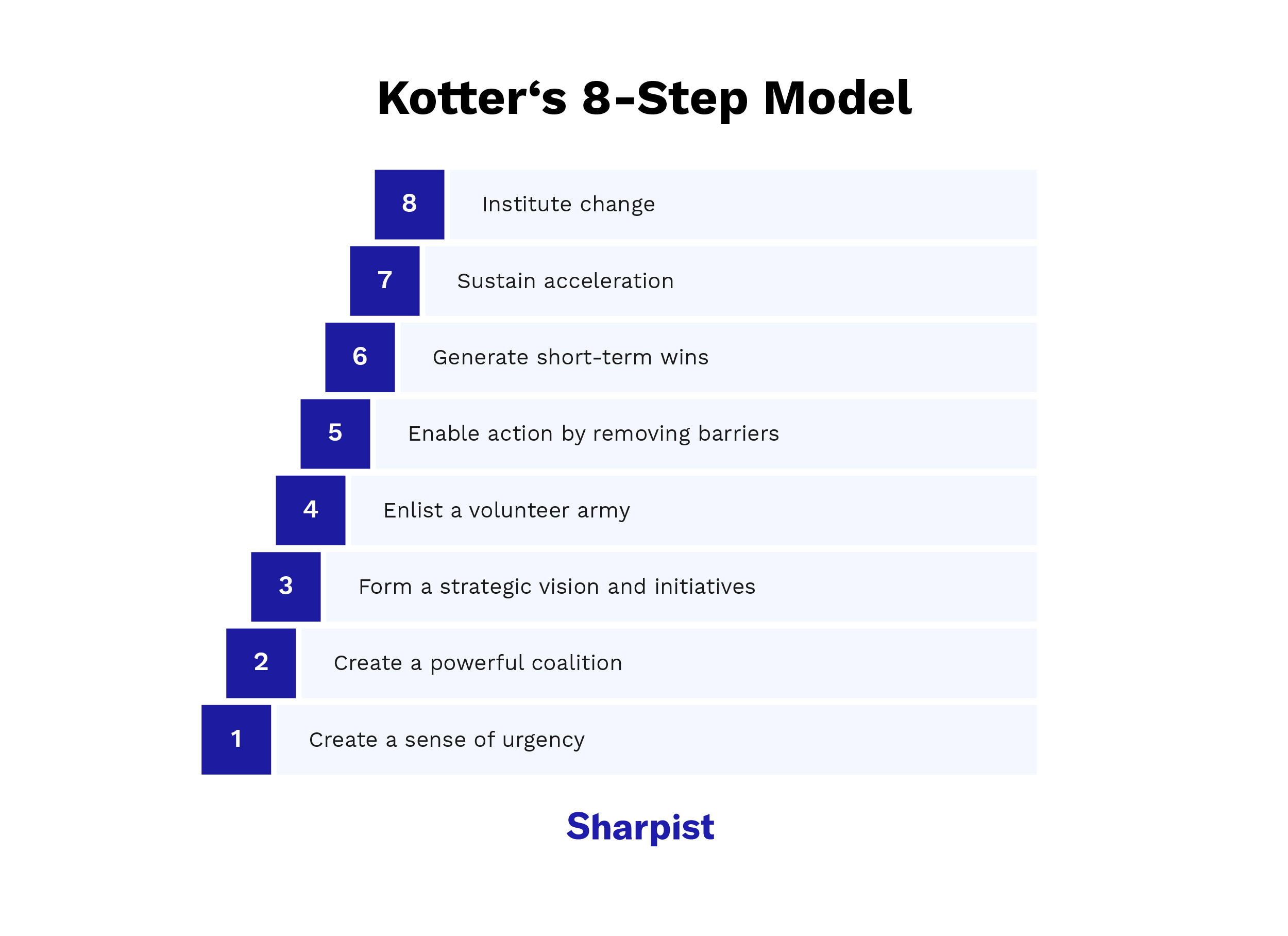
Kotter's 8-Phase Model
Kotter's 8-phase model is one of the most influential change management approaches for large organizations. His research involving over 100 companies showed that more than half of all transformations fail because critical stages are skipped. Kotter's contribution lies in his emphasis on leadership rather than management. Successful transformations require emotional leadership, not just rational process control. The eight stages are:
The 8-phase model is particularly suitable for strategic transformations in established companies with complex hierarchies. The explicit emphasis on a leadership coalition and continuous communication addresses typical weaknesses of traditional top-down approaches.
The Change Curve According To Kübler-Ross
The change curve applies psychiatrist Elisabeth Kübler-Ross's grief research to organizational change. The key insight here is that performance and morale initially decline before rising again. The "valley of tears" is not a failure, but a natural part of any transformation. The seven phases, which are traversed in curve form, are:
The change curve is particularly suitable for restructuring, mergers, or strategic realignments with high emotional impact. It helps HR teams set realistic expectations and plan phase-specific coaching interventions for different emotional phases. Professional coaches support managers in constructively guiding employees through the "valley of tears."

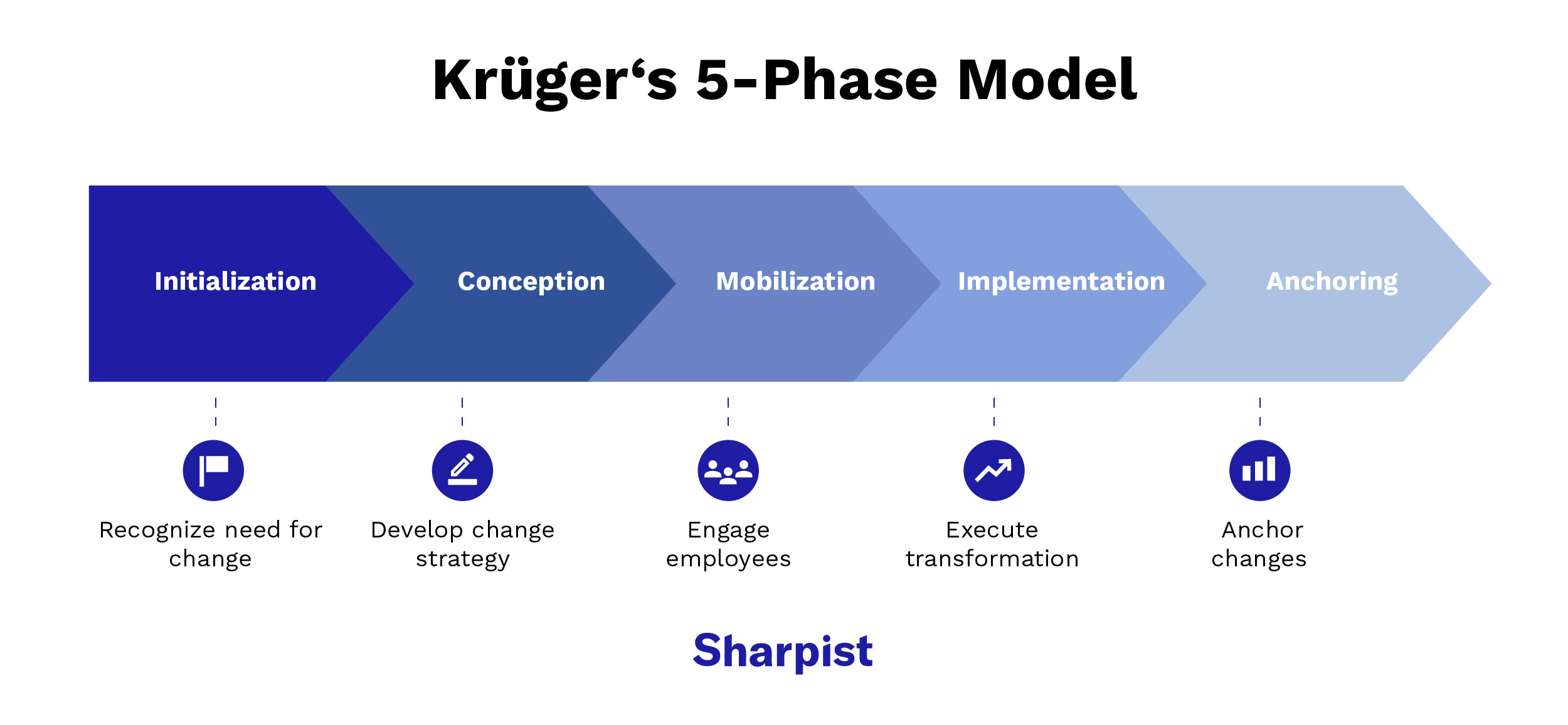
The 5-phase model according to Krüger
Krüger's 5-phase model offers a practical framework that balances structure and flexibility. Krüger's particular contribution is the explicit mobilization phase for communication and gaining acceptance, which is an often underestimated but critical success factor. The five phases comprise:
The model is suitable for medium to large organizations that want to combine structured change projects with adaptability. The dedicated mobilization phase makes it ideal for HR teams that want to systematically integrate leadership development into change processes and specifically prepare change agents for their roles.
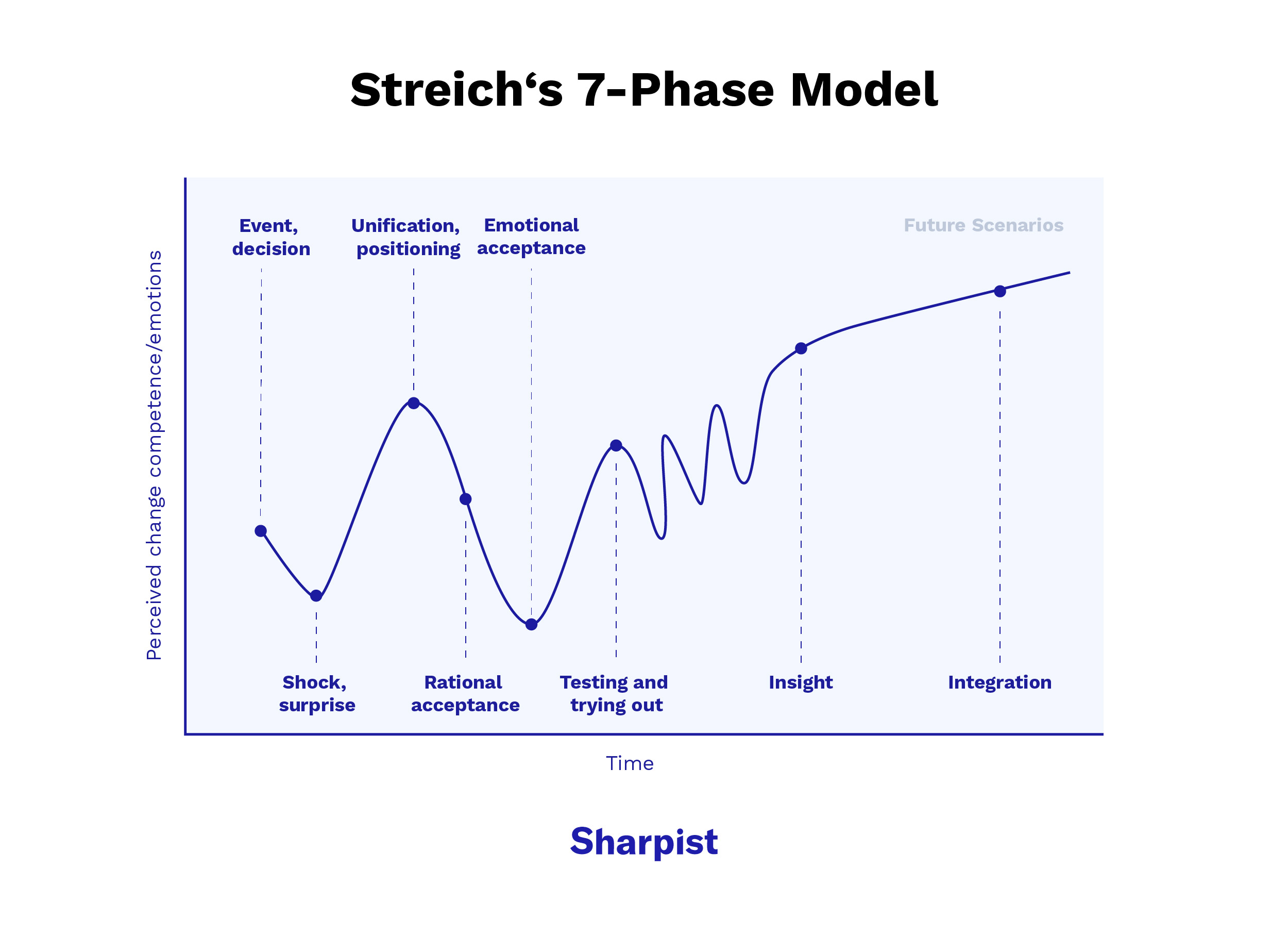
The 7-phase model according to Streich
Richard K. Streich's 7-phase model focuses on the emotional rollercoaster ride that accompanies abrupt changes. The key difference to other models is that Streich separates rational and emotional acceptance. Managers may understand cognitively, but they are not yet emotionally ready. Closing this gap between head and heart is central to successful transformations. The seven phases according to Streich:
The model is suitable for situations with high emotional impact, such as site closures or fundamental reorganizations. Streich's distinction between rational and emotional acceptance helps HR teams develop realistic timelines and place targeted coaching in critical phases 3 to 5 to accelerate emotional acceptance.
Which Change Management Model Is Right For My Company?
After presenting the six models, the practical question arises: Which approach suits your specific situation? The choice of model depends on a number of important factors:
Smaller companies typically benefit from simpler models such as Lewin's, while large corporations require more complex approaches such as the Kotter model. A clear framework is usually sufficient for minor adjustments, while extensive transformations require structured support.
The culture of the company influences how well change is accepted. Hierarchical structures often favor top-down models, while participatory or open cultures benefit from people-centered models. In addition, the amount of experience the organization has with change processes is crucial. Simple models are ideal for initial projects, while more complex ones are better suited to experienced organizations. The following table provides a quick overview of the most important change management models and shows which areas of application are particularly suitable for each:
Success factors and best practices for implementation
Regardless of the change management model chosen, certain factors determine success. Visible top management commitment is the most important of these. Every single manager is both a role model and a trailblazer. Transparent communication throughout all phases builds trust and prevents rumors. The early involvement of those affected through genuine participation significantly increases acceptance.
Other critical success factors include realistic scheduling without excessive pressure, sufficient resources for coaching and training, systematic monitoring with clear KPIs, and a constructive error culture for rapid learning from setbacks. Best practices for implementation:
Systematically empowering managers for change pays off in multiple ways: through reduced resistance, accelerated acceptance, and authentic change leadership that truly engages employees.

Common Mistakes When Applying Change Models
Many change projects fail because models are applied too rigidly or are not suited to the current situation. The following overview shows common mistakes and how they can be avoided:
This is especially true for middle managers: they are usually the link, the trailblazers, and themselves affected. Without their active involvement, many changes fail. Combining these practices with tailored, professional coaching significantly enhances the effect. Managers receive individualized support for their specific challenges, while the organization progresses in a structured manner.
Combining Sharpist Change Management And Digital Coaching
The change models presented provide the structural framework, while individual coaching addresses personal development. The combination significantly enhances the effect. Sharpist shows how both dimensions can be integrated in a scalable manner and how the design of change processes is systematically supported: The platform combines structured change journeys with 1:1 coaching by over 1,500 certified coaches.
The Sharpist solution for every change model:
Whether you use Lewin's 3-phase model, Kotter's 8-step process, or the ADKAR model, 32 focus areas cover all relevant leadership skills.
FAQ
Which change management models are particularly suitable for SMEs?
For small and medium-sized enterprises, the 3-phase model according to Lewin is particularly suitable due to its simplicity, as is the 5-phase model according to Krüger with its explicit mobilization phase. Both offer a clear structure without excessive complexity. The ADKAR model is also well suited when personal support is a priority. Kotter's 8-phase model is often too complex for SMEs, but can be useful for fundamental transformations. Important: The model should fit the corporate culture and available resources.
How long does it take to implement a change model?
The duration depends heavily on the scope of change. Minor adjustments based on the 3-phase model can take 3 to 6 months, while comprehensive transformations based on Kotter's 8-phase model can take 12 to 24 months or longer.
Cultural change processes are particularly time-consuming, as new behaviors must be firmly established. Realistic time planning is crucial: moving too quickly often leads to resistance and jeopardizes long-term success. Quick wins should become visible within 6 to 18 months.
Are classic phase models also suitable for agile organizations?
Yes, with the right adaptation. Classic phase models such as Lewin or Kotter offer valuable structure, but should be interpreted more flexibly in agile contexts. Instead of a strictly sequential sequence, phases can be run through iteratively or worked on in parallel. The 5-phase model according to Krüger and the ADKAR model can be combined particularly well with agile principles, as they offer room for adaptation. The key is to retain the basic principles of the model, but to make the implementation agile: with short iterations, continuous feedback, and a willingness to adjust course if necessary.
What is the difference between change management and change leadership?
Change management focuses on the structural and procedural aspects: planning, coordination, monitoring, and the systematic application of models and methods. Change leadership, on the other hand, addresses the human dimension: communicating vision, generating enthusiasm, overcoming emotional resistance, and authentically guiding people through change. Successful transformations need both: management provides structure and measurability, while leadership provides motivation and commitment.
When should I change or adapt a change model?
A model change is advisable if, despite correct application, no progress is made, the organizational situation changes fundamentally (e.g., due to a merger or crisis situation), or if persistent resistance signals that the chosen model does not fit the culture.
Adjustments are also necessary if feedback shows that certain phases need to be skipped or given greater weight. Important: A model change should be carefully considered and not made at the first sign of difficulty. Often, the problem lies not with the model itself, but with its implementation. External coaching can help to make this distinction and find the right course of action.
.avif)





.svg)


%20(1).avif)