


.png)
.png)
.svg)

.png)
.png)


.png)


.png)


.svg)


.svg)

E-learning courses are ready to go, yet no one uses them. A scenario many HR professionals know all too well. But what exactly is the alternative – and when does switching to a coaching platform pay off? Sharpist shows how a hybrid approach combining coaching and personalized micro tasks leads to sustainable behavioral change.
The Topic in a Nutshell
What Do E-Learning and Coaching Have in Common?
E-learning and coaching are not mutually exclusive. Both learning formats pursue the same overarching goal: the targeted development of people within organizations. They share the following:
E-Learning vs. Coaching: The Key Differences Compared
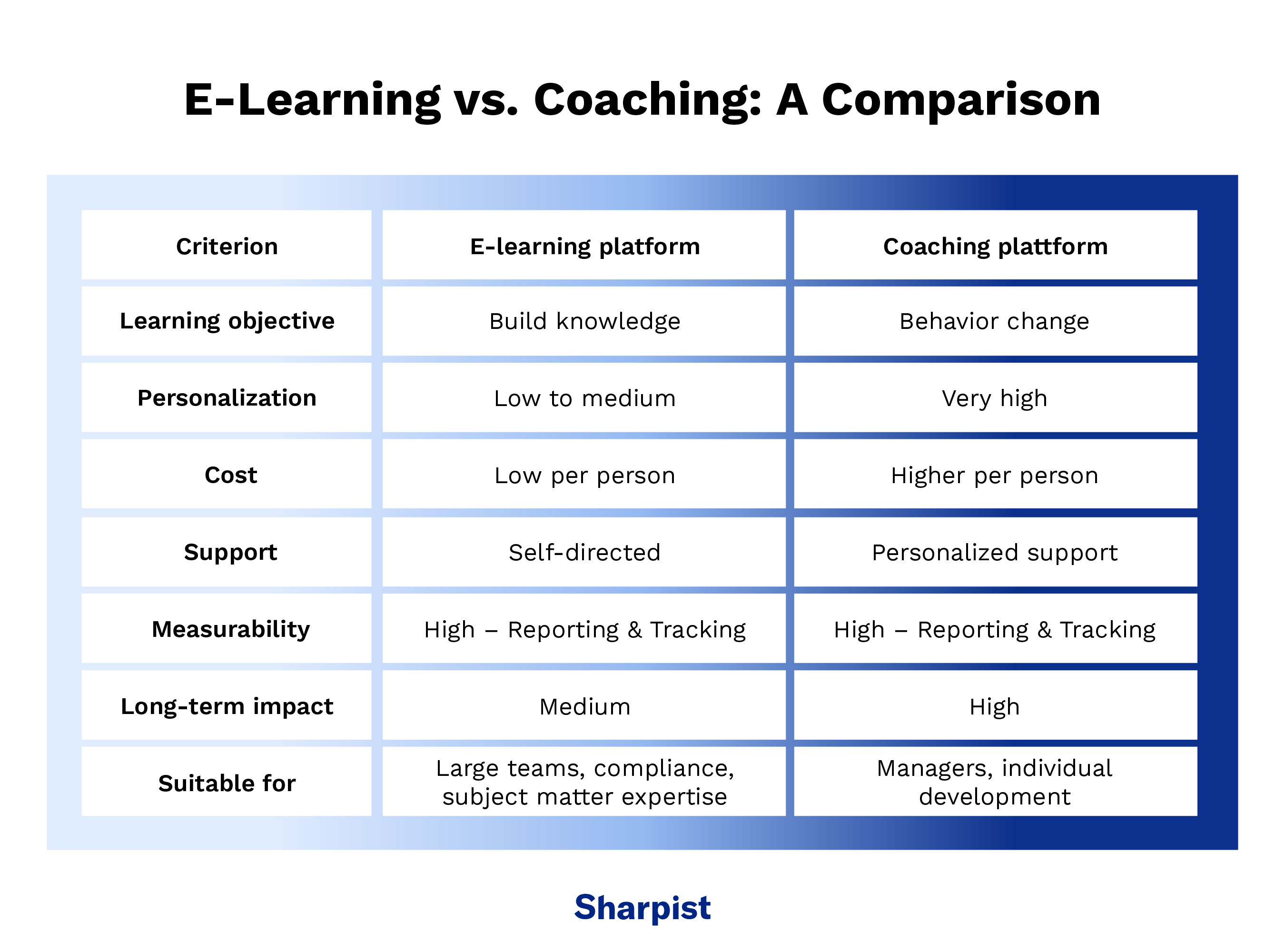
Both learning formats develop employees further, yet they leverage entirely different mechanisms. Where exactly do the differences lie? And why does the choice of format determine actual learning success? The following four dimensions reveal what really matters when deciding between e-learning and coaching.
Building Knowledge vs. Changing Behavior
E-learning courses are excellent for imparting specialist knowledge: compliance training, product training, or hard skills can be scaled efficiently via standardized content. But when it comes to leadership behavior, communication, or conflict resolution, pure e-learning reaches its limits.
Coaching programs target sustainable behavioral change. At Sharpist, for example, 83% of coachees transfer what they've learned directly into their everyday work. The combination of 1:1 coaching and over 2,000 personalized micro tasks ensures that knowledge is not only absorbed, but translated into concrete behavior. Crucially, each coach curates the tasks individually for their coachees.
Self-Directed vs. Appointment-Based
E-learning platforms offer maximum flexibility: participants learn at their own pace, whenever and wherever they choose. This sounds ideal, yet the reality tells a different story. Over 50% of registered e-learning users do not actively engage with the course material. Self-directed learning is susceptible to procrastination, especially when day-to-day work demands attention.
Coaching programs create accountability through fixed appointments. Regular sessions with a personal coach establish a structure that keeps participants on track throughout the learning process. Sharpist's hybrid approach combines both: appointment-based 1:1 sessions with certified coaches and micro tasks for self-directed learning. This creates accountability through fixed appointments.
Standard Course vs. Personal Support
With traditional e-learning courses, all participants see the same content: the same videos, the same quiz questions, the same learning material. Whether someone has been leading for ten years or has just taken on their first team leadership role makes no difference. This one-size-fits-all approach saves costs, but misses individual development goals.
Digital coaching works differently. Every session is tailored to the role, context, and personal goals of the individual. At Sharpist, this begins with coach matching: a 97% success rate on the first attempt, drawn from a pool of over 1,500 ICF/DBVC-certified coaches across 55+ languages and 32 measurable focus areas. The result: 99% satisfaction with coaching sessions. Micro tasks are also not assigned generically, but curated individually by the coach – a crucial distinction from e-learning libraries, where everyone sees the same content.
Cost and Scalability
E-learning platforms excel with low entry costs. Scalability is high: thousands of employees can be trained simultaneously. But the key question is: what is the value of a low price point when completion rates sit at 10–15%? Every unfinished course represents wasted budget with no measurable learning impact.
Coaching has traditionally been more expensive and harder to scale. Sharpist addresses this with a flexible credit system instead of a rigid flat rate. Credits can be redistributed from less active to more active users, ensuring no budget is lost on unused sessions. The core message: a higher investment, but a significantly higher ROI through measurable results.
E-Learning Platforms: Advantages and Disadvantages
E-learning has its place: 91.8% of companies in the DACH region use digital learning. However, its effectiveness depends heavily on the area of application. Where are the real strengths, and where does an e-learning platform reach its limits?
E-learning is an excellent fit for standardized knowledge and specialist content that needs to be rolled out quickly to large numbers of employees. For sustainable leadership development and genuine competency growth, however, more than courses and content is required.
When Is a Coaching Platform the Better Choice?
As soon as the goal moves beyond pure knowledge building toward individual development and real behavioral change, e-learning courses reach their limits. This is precisely where coaching platforms come into their own. But in which situations does deployment make concrete sense?
Sharpist goes a step further than traditional coaching programs: 1:1 sessions with certified coaches are complemented by personalized micro tasks. This means learning doesn't end at the session boundary, but continuously accompanies your employees in their everyday work.
Why Sharpist's Hybrid Approach Is the Perfect Solution
The choice between e-learning and coaching doesn't have to be either/or. Sharpist combines the best of both learning formats on a single platform – with measurable results. We assess the success of coaching programs using the Kirkpatrick Model – the scientifically recognized standard for measuring the effectiveness of learning and development initiatives. The model evaluates not only whether participants are satisfied, but whether they actually change their behavior and whether this has a measurable impact on organizational goals.
While pure e-learning platforms stagnate at 10–20% activation rates, Sharpist's hybrid approach achieves 80–90%. Three pillars make the difference:
FAQ
What Is the Main Difference Between an E-Learning Platform and a Coaching Platform?
E-learning delivers standardized knowledge through self-study and is particularly well-suited to compliance and onboarding. A coaching platform, by contrast, relies on individual support from certified coaches and targets sustainable behavioral change – for example in leadership development.
What Company Size Is Best Suited to an E-Learning Platform?
E-learning platforms are suitable for organizations of all sizes, especially when standardized content needs to be rolled out to large numbers of employees simultaneously. From 1,000+ employees onward, supplementing e-learning with coaching for leaders and key personnel becomes worthwhile.
Can I Combine E-Learning and Coaching – and If So, How?
Yes – and this is precisely the most effective approach. Sharpist combines 1:1 coaching with personalized micro tasks. This means knowledge is not only delivered, but transferred into everyday work through individual support. The result: 80–90% activation rates.
How Do I Know Whether My Team Needs Knowledge Building or Behavioral Change?
Is the issue a lack of specialist knowledge, process knowledge, or compliance? Then e-learning is the right approach. If the focus is on topics such as leadership behavior, communication, resilience, or change, a coaching platform with individual support is more effective.
What Should I Look for When Selecting a Platform for My Organization?
Look for measurable results, activation rates, GDPR compliance, and flexibility in the pricing model. Check whether the platform offers individual support or simply provides content. A flexible credit system and real-time analytics help demonstrate ROI and deploy budgets efficiently. An overview of pricing and features is available on our pricing page.
.avif)


.png)




.svg)


%20(1).avif)