



.png)
.png)
.svg)

.png)
.png)


.png)


.png)


.svg)


.svg)

How do you ensure that your leader in São Paulo receives the same quality of development as their counterpart in Munich – while both are coached in their native language and you can compare the progress of both in a single dashboard? Digital coaching platforms like Sharpist solve this problem.
The Topic in a Nutshell
Why International Leadership Development Is Becoming a Strategic Priority
The numbers are clear: according to the DDI Global Leadership Forecast 2025, 71% of leaders worldwide report increased stress, and 40% are considering stepping down from their leadership role. At the same time, 77% of CHROs lack confidence in their succession bench for critical positions. For organizations with locations in multiple countries, this problem is compounded because leadership gaps don't stay local – they destabilize entire regions and business units.
Gallup reported a global decline in employee engagement to 21% in 2025. High potentials who don't receive regular development opportunities are nearly four times more likely to be ready to leave the organization, according to DDI. When a DACH company with eight international locations delivers different leadership quality at each site, these effects add up to a measurable business risk: higher turnover, slower transformations, and inconsistent customer experiences.
At the same time, the global coaching market is growing rapidly. Coaching is no longer a one-off measure for top management – it has become a strategic investment in organizational resilience. The decisive question is no longer whether, but how organizations scale coaching internationally.
The 5 Biggest Challenges in Coaching Across Borders
Anyone looking to scale coaching internationally will quickly encounter obstacles that go far beyond logistics and time zone differences. The following five challenges determine whether a global coaching program achieves real impact – or gets bogged down in local resistance.
1. Cultural Complexity: Coaching Isn't the Same Everywhere
In Germany, coaching is often associated with personal, individual psychology topics. In the US, a stronger business focus dominates. In some Arab countries, coachees expect the coach to take on the role of a strategic advisor. These differences are not a footnote – they determine whether a coaching program is accepted or fails.
Erin Meyer's "Culture Map" framework shows how significantly leadership concepts differ along cultural dimensions: hierarchy vs. consensus, direct vs. indirect communication, task vs. relationship orientation. Executive coaching that ignores these dimensions misses its mark. For HR leaders, this means that coach matching must account for cultural competence and regional experience alongside professional qualifications.
2. Language Barriers: Why Translation Isn't Enough
Coaching works with emotions, metaphors, and cultural references. When coached in a foreign language, people often remain on a cognitive level and fail to reach the emotional depth necessary for genuine behavioral change. A leader reflecting on a team conflict in German will find different words and access points than the same person would in English.
Multilingual coaching therefore means far more than translation. It requires coaches who are at home in the coachee's native language and understand the cultural context. Sharpist's network of over 1,500 coaches in 55+ languages addresses exactly this need, with a coach matching success rate of 97% on the first attempt.
3. Quality Control Across Borders
Since the professional title "coach" is not protected, quality standards vary considerably between countries. An organization that independently engages local coaches in eight markets has no guarantee of consistent quality. Professional certifications such as ICF (ACC, PCC, MCC) or DBVC offer guidance, but verification and matching remain manual and error-prone in decentralized approaches.
Digital coaching platforms like Sharpist solve this problem through central quality assurance with decentralized delivery. Every coach goes through the same selection process, regardless of location. The algorithmic coach matching simultaneously accounts for certification, industry experience, leadership level, and language competence.
4. The "Frozen Middle" Trap
Global programs rarely fail because of top management or the participants themselves. They fail at middle management, which is supposed to implement the programs locally but was never brought on board. When regional HR teams or local leaders perceive a program as a "directive from headquarters," acceptance drops dramatically.
Successful international programs bring middle management in early as the first coaching target group. Those who have personally experienced the impact of coaching become local champions rather than points of resistance.
5. Lack of Measurability and Comparability
Many HR teams have no systematic evaluation process. For international programs, this problem intensifies: how do you compare leadership development at your plant in the Czech Republic with that at your sales office in Singapore, when both use different coaches, formats, and reporting standards?
Without cross-location benchmarking, the foundation for data-driven decisions is missing. Modern digital coaching solutions like Sharpist offer L&D dashboards with real-time analytics that make engagement, progress, and business impact comparable across all locations.
Classic vs. Platform-Based Approaches Compared
Most international organizations face a choice between three models: decentralized local programs, centralized in-person programs, or a digital coaching platform. Each model has specific strengths and limitations, which are particularly evident when scaling internationally.
Classic in-person programs deliver valuable experiences, but reach economic and logistical limits when scaling internationally. Digital platforms enable the balance between global consistency and local relevance by combining central quality standards with local coach matching. Sharpist's flexible credit system additionally allows HR teams to redistribute coaching resources between countries and departments, rather than assigning fixed quotas per location.
Scaling International Coaching in 4 Phases
Global coaching programs rarely fail due to a lack of resources – they fail due to a lack of structure. With a clear phase model, you avoid the typical pitfalls of international rollouts: from inconsistent quality and cultural mismatches to unmeasurable results.
Phase 1: Define a Global Leadership Competency Model
Before rolling out a coaching program internationally, you need clarity on which leadership competencies apply company-wide and where local flexibility is permitted. A global competency model defines 5–8 core competencies (e.g., change leadership, intercultural communication, strategic thinking) that are relevant at every location. Local HR teams add location-specific focal points. Sharpist's 32 focus areas offer a proven structure that can be adapted to individual company frameworks.
Phase 2: Launch a Pilot in 1 to 2 Countries
For the pilot, choose locations that are representative of your challenges, not the easiest ones. Define KPIs from the outset: leadership quality (e.g., via 360-degree feedback), engagement rate, participant satisfaction, and at least one business KPI such as turnover or team performance. Plan 3–6 months for the pilot in order to collect reliable data.
Phase 3: Learn, Adapt, Expand
After the pilot, analyze which coaching formats and styles worked best in which cultural context. Adjust the coach matching, expand the coach pool for the next regions, and train local HR teams as program champions. Sharpist clients such as IKEA saw an improvement in their leadership index of 8–10% during this phase.
Phase 4: Global Rollout with Central Monitoring
During the global rollout, the dashboard becomes the management tool. You compare engagement rates, progress data, and business impact across all locations. Sharpist's credit system makes it possible to direct resources dynamically to where the need is greatest. Additionally, the AI coach is available around the clock, so leaders in every time zone receive support – even between regular coaching sessions.
What to Look for When Selecting an International Coaching Solution
Not every coaching platform is suited for international scaling. When evaluating, you should systematically check six criteria:
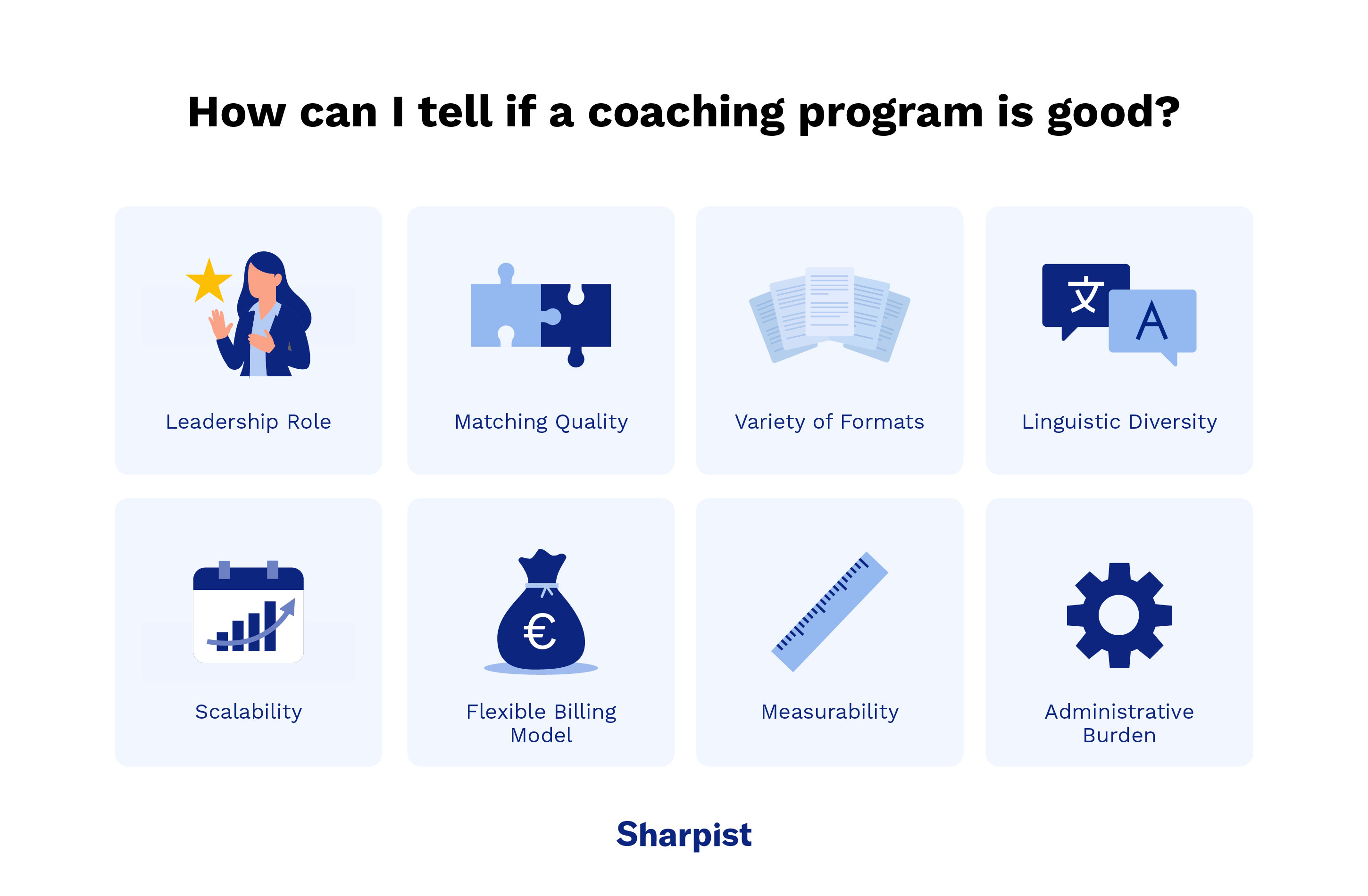
How Sharpist Makes International Coaching Programs Scalable and Measurable
The central challenge of international leadership development lies in balancing global consistency with local relevance, while maintaining measurability and cost control. Sharpist was built precisely for this use case:
This turns international leadership development from a logistical challenge into a scalable, data-driven competitive advantage.
FAQ
How Many Languages Should a Coaching Platform Cover for International Programs?
What matters is not the sheer number, but the depth of coverage in your target regions. Check whether enough qualified coaches with relevant industry experience are available per language. Sharpist offers over 1,500 coaches in 55+ languages, which fully covers most international organizational structures.
How Do I Ensure That Coaching Quality Is Equally High at All Locations?
Choose a platform with central quality assurance: consistent certification requirements (at minimum ICF ACC), algorithmic matching, and continuous feedback tracking. Decentralized independent searches for local coaches almost always lead to inconsistent quality.
How Long Does It Take to Get an International Coaching Program from Pilot Phase to Global Rollout?
Plan for 3–6 months for a meaningful pilot in 1–2 countries. Expansion to additional regions can happen within a few weeks on a digital platform, since the coach network and infrastructure are already in place. The entire process from pilot to global program takes 6–12 months in practice.
How Do I Justify the Investment in International Coaching to the CFO?
Combine coaching-specific metrics (activation rate, satisfaction) with business KPIs (turnover, leadership index, succession readiness). Digital platforms deliver this data automatically. Additionally, compare total costs against in-person programs: travel costs, admin effort, and coordination time are eliminated, which typically means savings of 40–50%.
Can an AI Coach Replace a Human Coach in an International Context?
No, and that is not the goal. The AI coach complements human coaching by being available 24/7 for ad-hoc questions, conversation preparation, and reflection – independent of time zones. For deep behavioral change, cultural nuances, and strategic leadership development, the human coach remains indispensable. Sharpist's hybrid approach combines both systematically.
.avif)





.svg)


%20(1).avif)