



.png)
.png)
.svg)

.png)
.png)


.png)


.png)


.svg)


.svg)

How do HR teams in large organizations enable individual development for hundreds of leaders simultaneously? While standardized training reaches its limits, personalized coaching enables tailored 1:1 development – scalable across locations, hierarchies, and cultures. Discover how HR professionals can implement coaching programs with Sharpist that drive real behavioral change and deliver measurable business results.
The Topic in a Nutshell
Personalized Coaching: Why Demand for Individual Solutions Is Growing
In decentralized organizations with diverse leadership experiences, multiple locations, and complex challenges, standardized training increasingly reaches its limits. A one-size-fits-all approach can neither address the specific needs of an emerging leader in manufacturing nor the strategic challenges of executives in digital transformation processes.
The limitations of standardized training become quickly visible in practice. While generic programs attempt to provide all participants with the same tools, individual differences in personality, experience, and company context remain unaddressed. This lack of fit leads to low engagement, low application rates, and ultimately to absent behavioral changes.
Individual solutions, however, prove to be significantly more effective:
Personalized coaching is thus no longer a nice-to-have measure, but a structural necessity for organizations that want to systematically drive leadership transformation.
Scalable platforms like Sharpist enable this individual support for large organizations through the combination of 1:1 coaching, continuous learning, and data-driven tracking.
Benefits: What Makes Successful Personalized Coaching
Successful personalized coaching combines various elements that together enable sustainable behavioral change. These components interlock and create measurable impact on all levels – from individual development and behavioral change to organizational impact.
Defining Individual Goals
The difference between generic learning objectives and individual goals in the coaching context is crucial for success. While traditional training often pursues vague goals like "strengthen leadership competencies," personalized coaching defines specific, measurable, achievable, relevant, and time-bound goals for each leader.
The process begins with a thorough self-assessment, complemented by 360-degree feedback from supervisors and employees. Individual conversations derive concrete development goals that consider both personal strengths and weaknesses as well as strategic organizational objectives. From this holistic analysis emerge concrete, measurable development goals that have both personal relevance and contribute to company objectives.
Coaching Goals Comparison

Alignment to Context Like Industry, Personal Challenges, and More
The same leadership challenge can require entirely different solution approaches in different contexts and industries. Contextual adaptation is therefore not a nice-to-have, but a basic prerequisite for effective coaching.
The dimensions of this context adaptation are diverse:
The dimensions of context adaptation include industry, company culture, leadership experience, and specific situations like restructurings or mergers. Sharpist develops customized coaching journeys that are tailored to the respective company culture and established leadership principles. Schedule a personal demo now!

Enabling Flexible Adjustments Throughout
Leadership development is not a linear process with a fixed beginning and defined end. Development needs change, new challenges arise, achieved goals create space for next development steps. Personalized coaching must not only accept this dynamic, but actively use it.
The adjustment mechanisms during the coaching process encompass several levels:
This flexibility fundamentally distinguishes personalized coaching from standardized training with fixed schedules. It enables genuine, sustainable development instead of superficial competency checklists.

Planning and Implementation: Successfully Implementing Personalized Coaching
Successful implementation requires structured procedures in five phases. From stakeholder engagement through needs analysis to continuous monitoring – every phase is crucial for long-term success. Only when all steps are coordinated does personalized coaching unfold its full impact in large organizations.
1. Secure Leadership Buy-In
2. Conduct Needs Analysis
3. Concretize Program Setup
4. Plan Strategic Rollout
5. Establish Continuous Support
.jpg)
Measuring Success of Personalized Coaching: How to Prove Effectiveness
ROI proof is the central requirement for CHROs in coaching programs. Without measurable results, the investment cannot be justified to management. However, measuring coaching success is complex – it must capture both the individual development of the leader and the organizational business impact.
The Kirkpatrick Model offers a proven framework for systematic success measurement on four levels: Reaction (coachee satisfaction), Learning (competency building), Behavior (sustainable behavioral change), and Results (business impact). Only the combination of all four levels provides a complete picture of coaching effectiveness.
Level 1 – Reaction: Measuring Satisfaction and Engagement
The first level captures the immediate reaction of coaching participants. How satisfied are they with the coach, the format, and the relevance to their challenges? Regular feedback surveys after sessions provide quick insights into program quality. Important: High satisfaction is a necessary but not sufficient condition for success. Coaching participants can be very satisfied without actually changing their behavior.

Level 2 – Learning: Demonstrating Competency Building
The second level measures actual knowledge and competency gain. Pre- and post-assessments on specific leadership competencies show whether self-perception, awareness, and relevant skills have developed. Self-assessments of coachees, complemented by 360-degree feedback, make this further development measurable. Modern coaching platforms integrate such assessments into the coaching process and enable continuous tracking across defined focus areas.
Level 3 – Behavior: Capturing Behavioral Change in Daily Work
The third and most critical level measures whether the leader's behavior has actually changed in the workplace. Is delegation happening instead of micromanagement? Do difficult conversations occur more constructively? Is team dynamic improving? These behavioral changes can be captured through several methods: 180°/360° feedback from supervisors and employees before and after coaching, qualitative interviews with stakeholders, and observation of concrete situations. Only when behavioral change is demonstrable has coaching unfolded its actual impact.

Level 4 – Results: Quantifying Business Impact
The fourth level connects coaching with hard business metrics. This is where the actual ROI becomes visible: reduced turnover among high potentials (measurable in saved recruitment costs), improved team performance (productivity metrics, project successes), higher employee engagement (measured in regular surveys), or successful transformation (acceptance rates, speed of change).
Modern coaching platforms like Sharpist integrate this success measurement directly into the platform: Real-time analytics in 32 focus areas, industry comparisons, and measurable behavioral changes provide HR teams with the data they need for leadership buy-in.
Successfully Implementing Personalized Coaching With Sharpist
Personalized coaching only works when three prerequisites are met: Individualization at the level of each individual leader, scalability for hundreds of participants simultaneously, and measurable effectiveness through data-based tracking. Sharpist unites these three requirements in one platform. The decisive difference:
The global coach network with over 1,500 certified coaches in 55+ languages ensures optimal matching with 97% success rate on the first attempt. The results speak for themselves: LVMH achieved +18% leadership competency improvement, IKEA increased the leadership index by 8–10%, Miro secured 100% retention of key personnel during restructurings.
FAQ
For Whom Is Personalized Coaching Suitable?
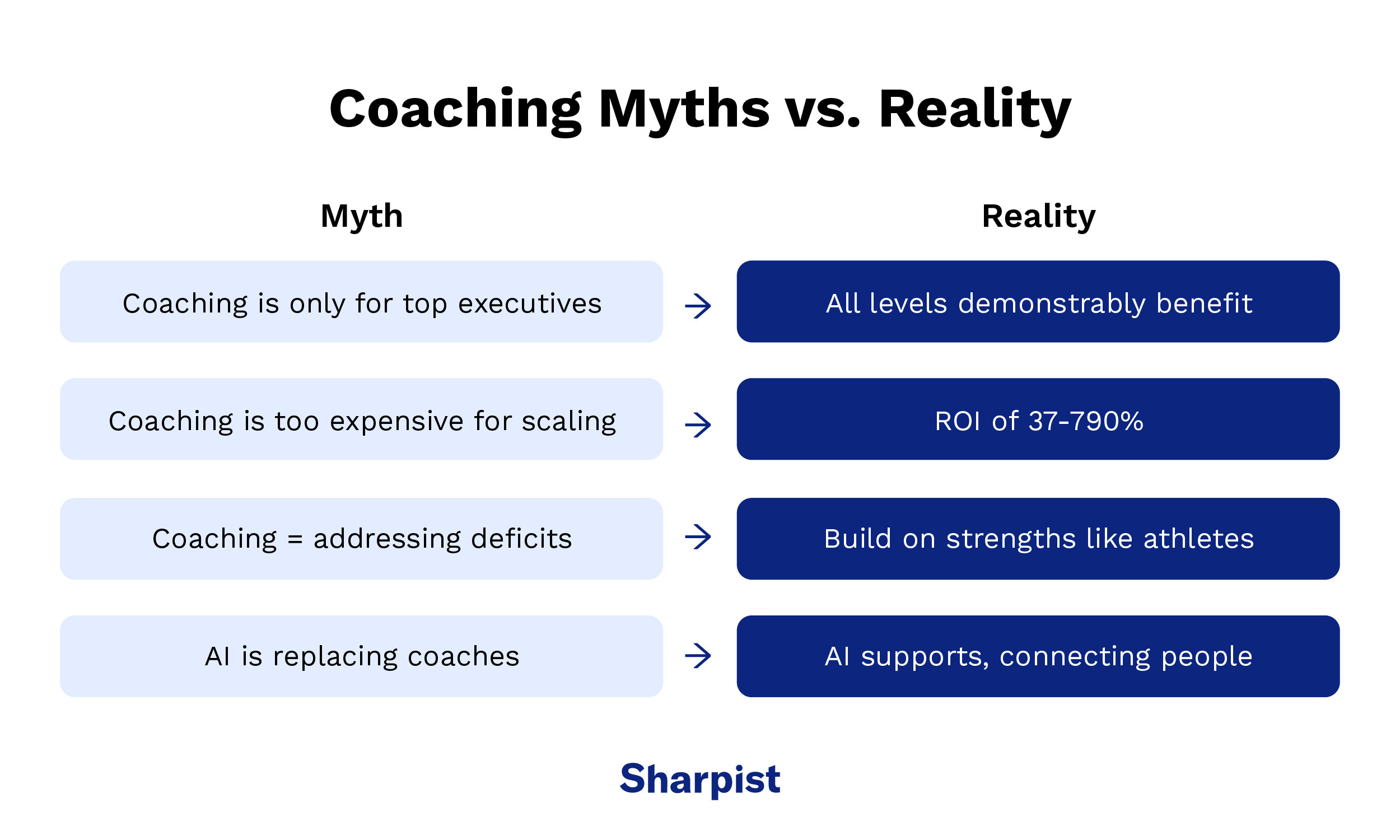
Personalized coaching is suitable for leaders at all levels – from emerging leaders to top executives – as well as for high potentials in large organizations. It is particularly effective during transformation processes, role changes, strategic challenges, and for developing specific leadership competencies. Modern platforms enable scalable programs for hundreds of participants simultaneously while maintaining high individualization.
What Distinguishes Personalized Coaching From Traditional Training?
While training conveys standardized content to groups, personalized coaching focuses on individual goals, strengths, and challenges. It combines 1:1 sessions with continuous learning between appointments, enables flexible adjustments throughout, and delivers measurable behavioral changes instead of pure knowledge transfer. Learning efficiency demonstrably increases.
How Do We Convince Employees That Coaching Is Not a "Corrective Measure"?
Position coaching as an investment in top performers and high potentials, not as a remedial tool. Leaders should share their coaching experiences and communicate success stories. Integrate coaching into development programs for talents and emphasize: Top athletes all have coaches – not because they are weak, but to achieve peak performance.
.avif)


.png)



.svg)


%20(1).avif)