


.png)
.png)
.svg)

.png)
.png)


.png)


.png)


.svg)


.svg)

Your talent assessment is complete, your most promising people have been identified, and one of your best still resigns after a year and a half. How can that happen when recruiting and diagnostics went perfectly? The answer usually lies in the gap between identifying talent and truly developing it. Good talent management with coaching from Sharpist turns identified talent into retained, promoted leaders.
The Topic in a Nutshell
Why Identifying Talent Alone Isn't Enough
Most companies with 1,000+ employees have professionalized their talent identification processes. Potential assessments, 9-box models, and talent reviews deliver solid data on who in the organization brings above-average potential. What happens afterward is far less structured: identified talent often ends up in the same standard programs as everyone else.
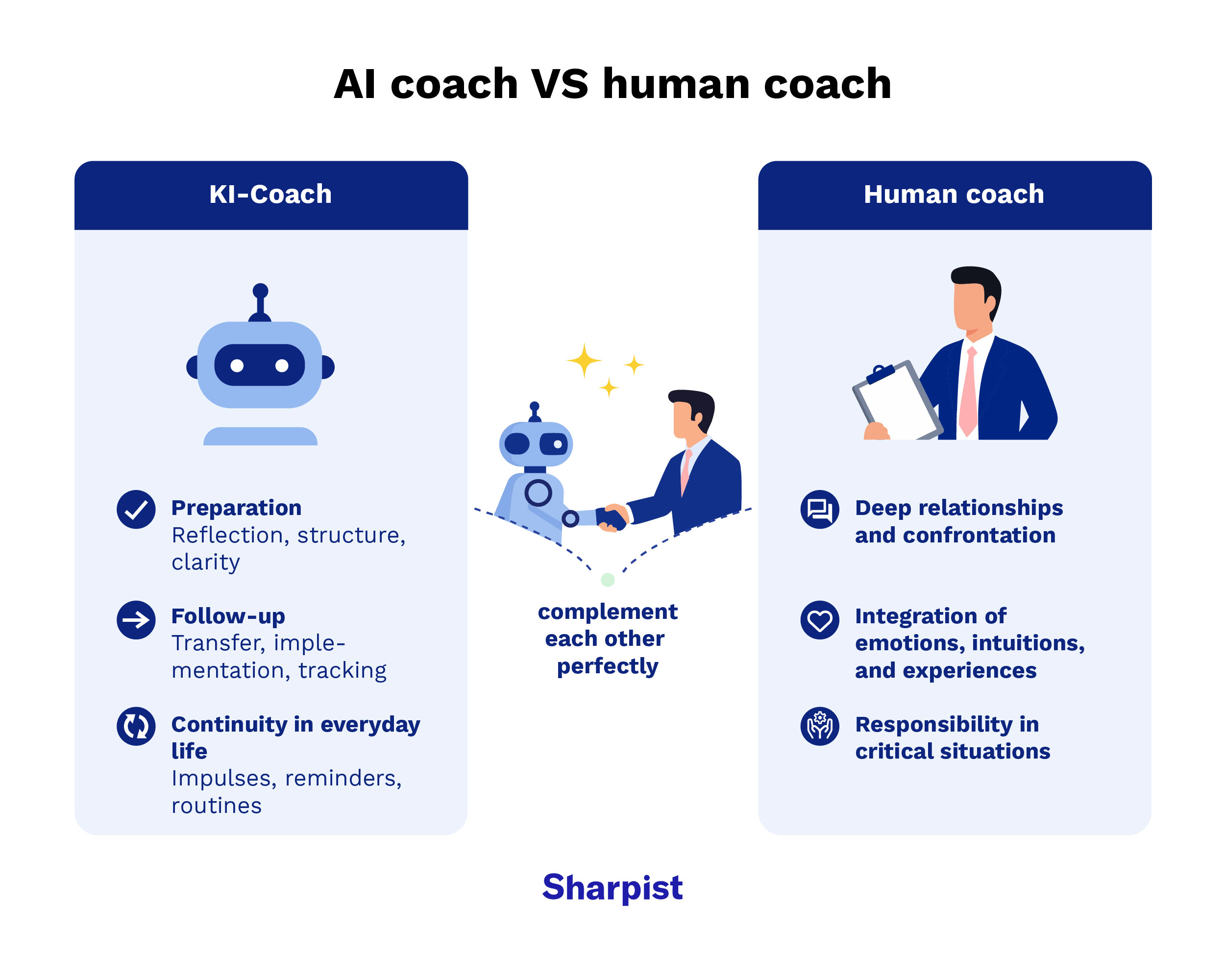
Research backs this gap up. A Kienbaum study of more than 1,000 talents across the DACH region shows that 95% of talent wants to choose their own development content and formats, yet only two-thirds find that option at their company. About half feel constrained by a one-size-fits-all development portfolio. Sharpist's hybrid coaching, combining 1:1 sessions, an AI Coach, and individually assigned micro tasks, addresses exactly this individualization gap.
Individual Development as a Retention Lever, Not Just a Satisfaction Factor
Pay raises and perks boost satisfaction short-term but don't prevent resignations. Salary and benefits are hygiene factors: they remove dissatisfaction, but don't create emotional commitment. What actually keeps High Performers is the feeling of being seen, challenged, and individually developed.
Leadership plays a central role here. According to Gallup, 70% of the variance in team engagement comes down to the direct manager. When coaching isn't used as a leadership development tool, this lever often goes unused. The economic impact is real: turnover costs run at least €43,069 per case according to WK Personalberatung; a company with 1,000 employees that cuts its turnover rate by 3 percentage points saves around €1.2 million a year. Sharpist's 1:1 coaching combined with the AI Coach addresses this development dimension directly, and it scales across leadership levels.
Retaining Talent Through Critical Phases: The Miro Example
How much individual coaching matters during high-pressure phases shows up clearly in Miro's case. During a transformation phase involving layoffs and strategic pivots, Sharpist coached around 120 culture multipliers and particularly affected employees at Miro, voluntarily and individually, never as a mandatory program.
Sharpist coached this group individually throughout the entire transformation phase and achieved 100% retention among participants, alongside a 25% increase in confidence. Sam Valentine, Head of Employee Experience at Miro, describes the effect this way: the coaching signaled to employees that they were seen as people, not just resources. That signal keeps talent in the company during critical phases more than any single isolated measure.
Beyond Retention: Promotion as a Development Goal
Talent that sees their development leading to real career advancement stays with a company on their own initiative. This second half of the equation, development with a measurable career outcome, gets neglected in most talent management programs.
At Airbus Defence and Space, Sharpist integrated digital coaching into the company's own TopWIN program for developing high-potential talent. Within the first year, 67% of participants moved into higher management positions or transitioned toward them, with 25% promoted directly into higher leadership roles. The digital coaches gave each participant a targeted focus on their own development needs. For HR decision-makers at enterprise companies, promotion rates work so well as a success metric precisely because they prove real advancement, not just satisfaction.
How Sharpist Closes the Gap Between Finding and Keeping Talent
Talent management doesn't end with identification. Only individual development, carried all the way through to promotion, creates real retention, as the Miro and Airbus Defence and Space examples show.
FAQ
What's the Difference Between Talent Management with Coaching and Traditional Succession Planning?
Succession planning identifies candidates for future positions and assigns them to roles. Talent management with coaching goes a step further: it makes those candidates genuinely ready through individual 1:1 coaching, instead of just keeping them on a list. Sharpist connects both layers, structured diagnostics and personalized development, in one scalable program for companies with 1,000+ employees.
Why Do High Potentials Leave Companies Despite Successful Recruiting Processes?
According to a Kienbaum study, 95% of talent wants to choose their own development content, but often can't find that option at their company. Missing individual development opportunities, not salary, rank among the most common reasons good employees resign. A strong recruiting process alone doesn't solve this, since the decision to stay or leave is made after hiring.
What Role Does Coaching Play in Moving from Identifying Talent to Developing It?
Coaching turns the results of a potential assessment into concrete, individual development steps. Instead of placing talent into a standard program, a certified coach works specifically on that person's strengths and development areas. Sharpist's hybrid approach of human coaching and an AI Coach supports this transition continuously, including between individual coaching sessions.
How Do HR Decision-Makers at Enterprise Companies Benefit from Coaching-Driven Promotion Paths?
Promotion rates give leadership and the board a credible success metric. At Airbus Defence and Space, 67% of program participants moved into higher management positions within their first year. For HR decision-makers, that means coaching investments can be justified through concrete career outcomes, not just satisfaction.
How Can the ROI of Talent Management Coaching Programs Be Justified Internally?
ROI can be calculated through avoided turnover costs: every prevented resignation of a key employee saves at least €43,069 in recruiting and onboarding costs. Promotion rates, activation rates, and engagement scores add further supporting evidence. Sharpist's L&D dashboard makes these metrics visible to HR teams in real time.
.avif)







.svg)


%20(1).avif)